OCR · A-Level · Physics
Course version: H556 · Version from Sept 2015
S.I. units: (c), deci
The metre (symbol m) is the S.I. base unit of length.
Checked against the OCR H556 specification (opens in a new tab) on .
- Point 13 of 16
Study notes
From the checked teaching notes for this specification point.
The idea
The metre (symbol m) is the S.I. base unit of length. The prefix deci (symbol d) means one tenth, so it multiplies a unit by 10⁻¹. Combining them gives the decimetre (dm), where 1 dm = 10⁻¹ m = 0.1 m, and conversely 1 m = 10 dm. To convert a length from decimetres to metres, divide by 10, or equivalently multiply by 10⁻¹; to convert metres to decimetres, multiply by 10. For example, 35 dm = 35 × 10⁻¹ m = 3.5 m. Although the decimetre is uncommon in A Level work, you should still recognise the prefix and its value. In calculations, convert all lengths to metres before substituting into equations, because derived units such as the newton and joule are defined in terms of the metre. A multiple-choice question may ask you to identify the correct prefix value, the correct symbol, or the result of a conversion.
What earns the marks
- States that the metre (m) is the S.I. base unit of length.
- States that deci (d) denotes a factor of 10⁻¹, i.e. one tenth.
- Applies the conversion 1 dm = 10⁻¹ m = 0.1 m and 1 m = 10 dm.
- Converts correctly in either direction, for example 35 dm = 3.5 m.
- Recognises that quantities should be expressed in metres before substitution into equations.
Common mistakes and how to put them right
Treating deci as 10⁻² rather than 10⁻¹.
Put it right: The correct factor is one tenth, so 1 dm = 0.1 m.
Multiplying by 10 when converting decimetres to metres instead of dividing.
Put it right: The correct operation is to divide by 10.
Confusing the symbol d for deci with other uses of d, such as distance.
Put it right: In a unit prefix context d always means 10⁻¹.
Exam tips
- Write the prefix as a power of ten before doing any arithmetic, so 1 dm becomes 1 × 10⁻¹ m.
- Check the direction of the conversion by asking whether the numerical value should get larger or smaller.
- Keep the unit symbol with the number throughout your working to avoid losing track of the prefix.
Try the lesson
The start of the S.I. units: (c), deci lesson, made from checked teaching notes for this specification point.
Listen
The metre (symbol m) is the S.I. base unit of length. The prefix deci (symbol d) means one tenth, so it multiplies a unit by 10⁻¹. Combining them gives the decimetre (dm), where 1 dm = 10⁻¹ m = 0.1 m, and conversely 1 m = 10 dm. To convert a length from decimetres to metres, divide by 10, or equivalently multiply by 10⁻¹; to convert metres to decimetres, multiply by 10. For example, 35 dm = 35 × 10⁻¹ m = 3.5 m. Although the decimetre is uncommon in A Level work, you should still recognise the prefix and its value. In calculations, convert all lengths to metres before substituting into equations, because derived units such as the newton and joule are defined in terms of the metre. A multiple-choice question may ask you to identify the correct prefix value, the correct symbol, or the result of a conversion. A strong answer earns marks for these points. States that the metre (m) is the S.I. base unit of length. States that deci (d) denotes a factor of 10⁻¹, i.e. one tenth. Applies the conversion 1 dm = 10⁻¹ m = 0.1 m and 1 m = 10 dm. Converts correctly in either direction, for example 35 dm = 3.5 m. Exam tip: Write the prefix as a power of ten before doing any arithmetic, so 1 dm becomes 1 × 10⁻¹ m.
See it
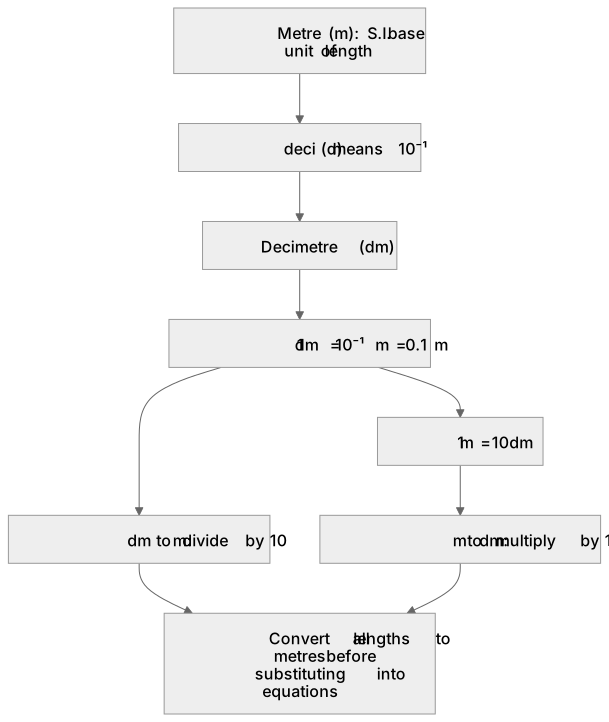
Label the diagram
Some boxes have lost their names. Pick the right name for each number.
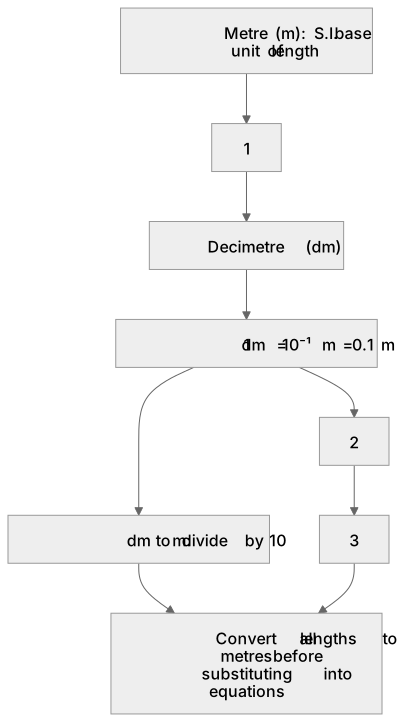
1Box 1
2Box 2
3Box 3
There is more to this lesson
The full lesson goes on to check your understanding and help you earn the marks. Create a free account to carry on, with your progress saved.
A week of Premium from your first lesson · Then the free plan continues · No card, no charge
Test your understanding of S.I. units: (c), deci
Active recall beats re-reading. Take an instant quiz now to test what you’ve learned and lock it into long-term memory.
A week of Premium from your first lesson · Then the free plan continues · No card, no charge