OCR · A-Level · Physics
Course version: H556 · Version from Sept 2015
(d) checking the homogeneity of physical equations using S.I. base units
Full specification wording
S.I. units: (d) checking the homogeneity of physical equations using S.I. base units
Homogeneity checking tests whether every term in a physical equation reduces to the same S.I. base units.
Checked against the OCR H556 specification (opens in a new tab) on .
- Point 8 of 16
Study notes
From the checked teaching notes for this specification point.
The idea
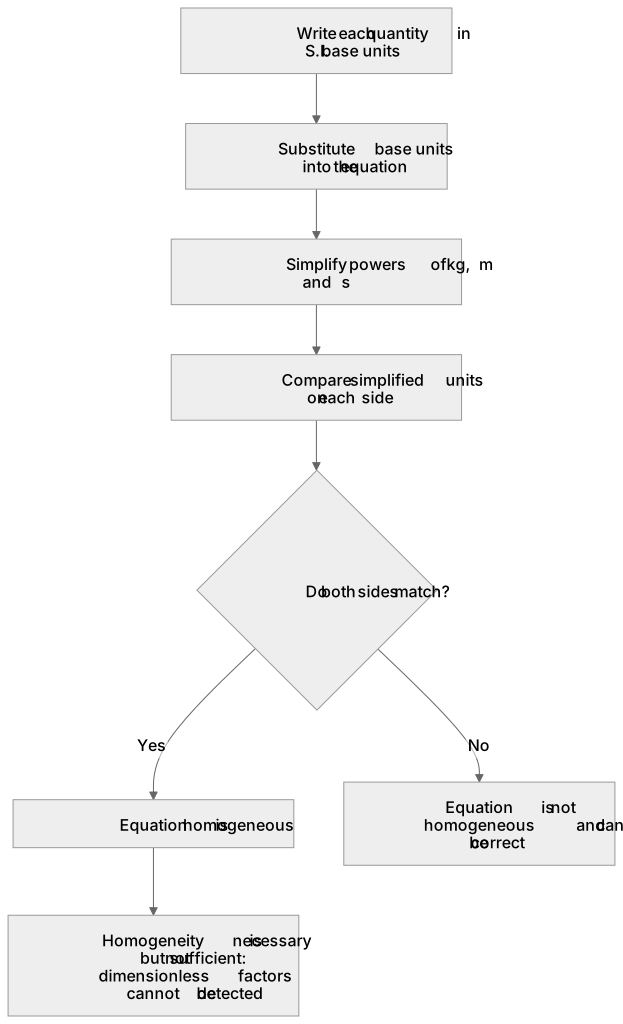
Homogeneity checking tests whether every term in a physical equation reduces to the same S.I. base units. Write each quantity as its base-unit combination: for example speed is m s⁻¹, acceleration is m s⁻², force is kg m s⁻² and energy is kg m² s⁻². Substitute these into the equation and simplify powers. If both sides match, the equation is homogeneous; if they do not, it cannot be correct. This catches errors such as writing v = u + at², where at² has units m and v has m s⁻¹. It cannot prove an equation is correct, because dimensionless factors such as ½ or 2π are invisible to the check.
What earns the marks
- State that homogeneity requires every additive term in an equation to have the same S.I. base units.
- Express each physical quantity in S.I. base units, for example force as kg m s⁻² and energy as kg m² s⁻².
- Substitute the base units into the equation and simplify the powers of kg, m and s.
- Compare the simplified units on each side and conclude whether the equation is homogeneous.
- Recognise that a homogeneous equation may still be wrong because dimensionless constants cannot be detected.
Common mistakes and how to put them right
Treating a homogeneous equation as automatically correct.
Put it right: Homogeneity is a necessary but not sufficient condition, so dimensionless factors must still be checked separately.
Adding or comparing terms with different base units, such as adding m s⁻¹ to m.
Put it right: Every additive term must reduce to the same base units before the equation can be homogeneous.
Forgetting to square or cube the units of a quantity when it is raised to a power.
Put it right: Raise the whole base-unit combination to that power, for example (m s⁻¹)² = m² s⁻².
Exam tips
- Write the base units of each symbol before substituting, so the substitution step is clear and easy to check.
- Simplify powers of kg, m and s separately, then compare the final combinations on both sides.
- If the units do not match, state clearly that the equation is not homogeneous and therefore cannot be correct.
Try the lesson
The start of the S.I. units: (d) checking the homogeneity of physical equations using S.I. base units lesson, made from checked teaching notes for this specification point.
Listen
Homogeneity checking tests whether every term in a physical equation reduces to the same S.I. base units. Write each quantity as its base-unit combination: for example speed is m s⁻¹, acceleration is m s⁻², force is kg m s⁻² and energy is kg m² s⁻². Substitute these into the equation and simplify powers. If both sides match, the equation is homogeneous; if they do not, it cannot be correct. This catches errors such as writing v = u + at², where at² has units m and v has m s⁻¹. It cannot prove an equation is correct, because dimensionless factors such as ½ or 2π are invisible to the check. A strong answer earns marks for these points. State that homogeneity requires every additive term in an equation to have the same S.I. base units. Express each physical quantity in S.I. base units, for example force as kg m s⁻² and energy as kg m² s⁻². Substitute the base units into the equation and simplify the powers of kg, m and s. Compare the simplified units on each side and conclude whether the equation is homogeneous. A common slip: Treating a homogeneous equation as automatically correct. Instead, homogeneity is a necessary but not sufficient condition, so dimensionless factors must still be checked separately. Exam tip: Write the base units of each symbol before substituting, so the substitution step is clear and easy to check.
See it
There is more to this lesson
The full lesson goes on to check your understanding and help you earn the marks. Create a free account to carry on, with your progress saved.
A week of Premium from your first lesson · Then the free plan continues · No card, no charge
Test your understanding of S.I. units: (d) checking the homogeneity of physical equations using S.I. base units
Active recall beats re-reading. Take an instant quiz now to test what you’ve learned and lock it into long-term memory.
A week of Premium from your first lesson · Then the free plan continues · No card, no charge