OCR · A-Level · Physics
Course version: H556 · Version from Sept 2015
(f) the conventions used for labelling graph axes and table columns.
Full specification wording
S.I. units: (f) the conventions used for labelling graph axes and table columns.
Graph axes and table columns must be labelled with the quantity name or symbol followed by a forward slash and its unit, for example time $t$ / s or current $I$ / A. The slash means 'divided by',…
Checked against the OCR H556 specification (opens in a new tab) on .
- Point 16 of 16
Study notes
From the checked teaching notes for this specification point.
The idea
Graph axes and table columns must be labelled with the quantity name or symbol followed by a forward slash and its unit, for example time $t$ / s or current $I$ / A. The slash means 'divided by', so the numerical scale shows the value of the quantity divided by its unit. A column heading such as mass $m$ / kg tells the reader that entries are in kilograms. If a quantity is a ratio or has no unit, write 'no unit' or leave the space after the slash empty only when the quantity is dimensionless. For logarithmic axes, label with the quantity and state that the scale is logarithmic. Always include units on both axes and every column, and use the same convention throughout a table or graph to ensure clear communication of experimental data.
What earns the marks
- Labels must show the quantity and its unit separated by a slash, for example speed $v$ / m s⁻¹.
- The slash notation means the numerical value is the quantity divided by its unit.
- Every column in a table and both axes on a graph need a label with a unit.
- Dimensionless quantities should be labelled as having no unit or as a ratio.
- Logarithmic axes must be labelled with the quantity and an indication that the scale is logarithmic.
Common mistakes and how to put them right
Writing only the unit, such as 'm/s', without the quantity name or symbol.
Put it right: The label must identify what is being measured, for example speed $v$ / m s⁻¹.
Putting the unit before the slash, such as 's / time'.
Put it right: The convention is quantity first, then slash, then unit.
Omitting units from a table column because the unit is given in the question.
Put it right: Each column still needs its own unit label.
Using brackets for units instead of the standard slash notation.
Put it right: OCR conventions require the slash, such as $F$ / N.
Exam tips
- Check every axis and column against the pattern 'quantity symbol / unit' before finishing an answer.
- If a quantity is a ratio such as efficiency, write 'efficiency' with no unit or state that it is dimensionless.
- For logarithmic scales, write '$\\log_{10} (\\text{quantity} / \\text{unit})$' or state clearly that the axis is logarithmic.
- Use the same unit throughout a column; if you convert units, change the column heading to match.
Try the lesson
The start of the S.I. units: (f) the conventions used for labelling graph axes and table columns. lesson, made from checked teaching notes for this specification point.
Listen
Graph axes and table columns must be labelled with the quantity name or symbol followed by a forward slash and its unit, for example time t / s or current I / A. The slash means 'divided by', so the numerical scale shows the value of the quantity divided by its unit. A column heading such as mass m / kg tells the reader that entries are in kilograms. If a quantity is a ratio or has no unit, write 'no unit' or leave the space after the slash empty only when the quantity is dimensionless. For logarithmic axes, label with the quantity and state that the scale is logarithmic. Always include units on both axes and every column, and use the same convention throughout a table or graph to ensure clear communication of experimental data. A strong answer earns marks for these points. Labels must show the quantity and its unit separated by a slash, for example speed v / m s⁻¹. The slash notation means the numerical value is the quantity divided by its unit. Every column in a table and both axes on a graph need a label with a unit. Dimensionless quantities should be labelled as having no unit or as a ratio. Exam tip: Check every axis and column against the pattern 'quantity symbol / unit' before finishing an answer.
See it
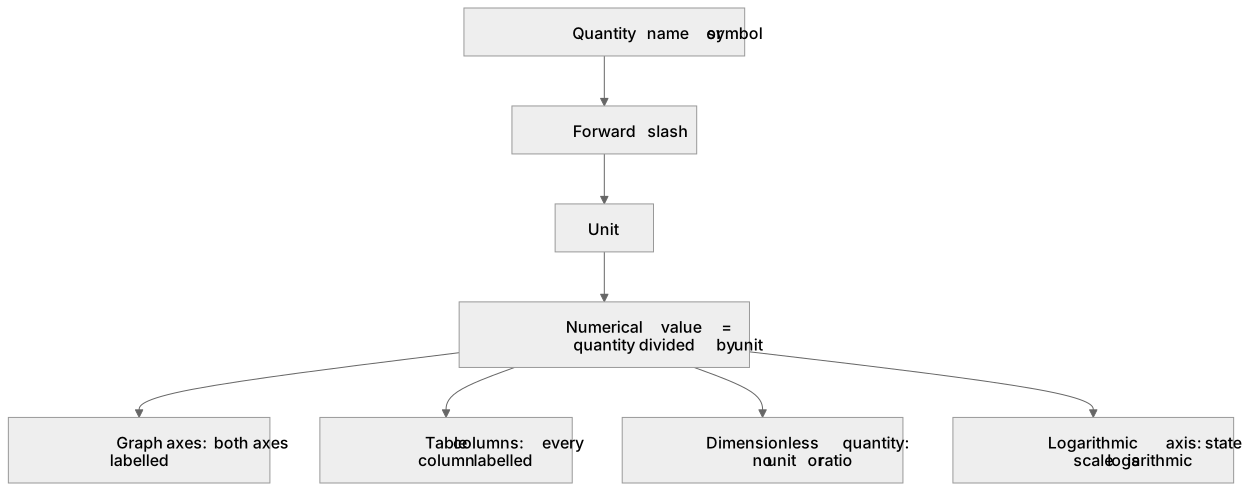
Label the diagram
Some boxes have lost their names. Pick the right name for each number.
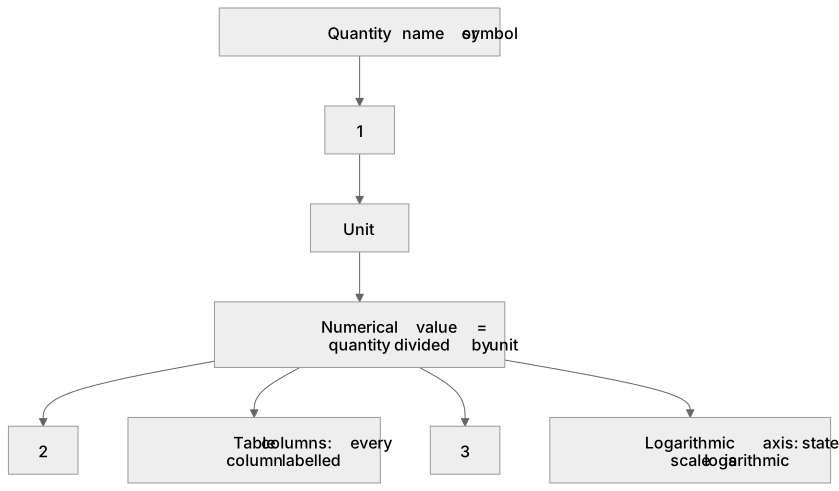
1Box 1
2Box 2
3Box 3
There is more to this lesson
The full lesson goes on to check your understanding and help you earn the marks. Create a free account to carry on, with your progress saved.
A week of Premium from your first lesson · Then the free plan continues · No card, no charge
Test your understanding of S.I. units: (f) the conventions used for labelling graph axes and table columns.
Active recall beats re-reading. Take an instant quiz now to test what you’ve learned and lock it into long-term memory.
A week of Premium from your first lesson · Then the free plan continues · No card, no charge