OCR · A-Level · Physics
Course version: H556 · Version from Sept 2015
S.I. units: (p), nano
The prefix nano, symbol n, means 10⁻⁹ of the base unit.
Checked against the OCR H556 specification (opens in a new tab) on .
- Point 10 of 16
Study notes
From the checked teaching notes for this specification point.
The idea
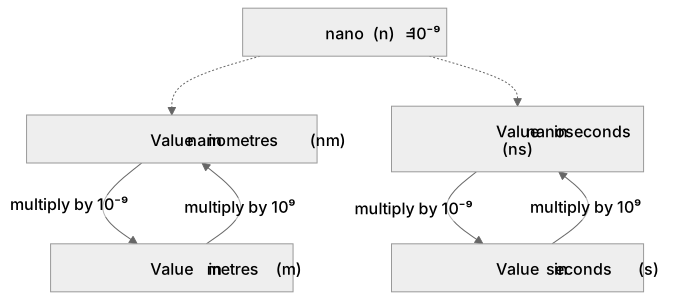
The prefix nano, symbol n, means 10⁻⁹ of the base unit. It is used for small quantities such as a nanometre (1 nm = 1 × 10⁻⁹ m) or a nanosecond (1 ns = 1 × 10⁻⁹ s). To convert a value in nanometres to metres, multiply by 10⁻⁹; to convert metres to nanometres, multiply by 10⁹. For example, 450 nm = 450 × 10⁻⁹ m = 4.5 × 10⁻⁷ m. The symbol n must not be confused with the prefix p for pico or μ for micro. In calculations, replace nano with 10⁻⁹ before substituting into an equation.
What earns the marks
- State that nano (n) represents a factor of 10⁻⁹.
- Convert a value given with the nano prefix into the base unit by multiplying by 10⁻⁹.
- Convert a base-unit value into nano units by multiplying by 10⁹.
- Use the correct symbol n and distinguish it from p and μ.
Common mistakes and how to put them right
Confusing nano with micro.
Put it right: Nano is 10⁻⁹ while micro is 10⁻⁶, so a nanometre is one thousandth of a micrometre.
Multiplying by 10⁹ when converting from nanometres to metres.
Put it right: Multiply by 10⁻⁹ to go from nm to m, and multiply by 10⁹ to go from m to nm.
Treating the prefix as a separate unit, such as writing 'n m' instead of 'nm'.
Put it right: The prefix and unit symbol form one symbol, for example nm or ns.
Exam tips
- Replace the prefix with its power of ten before doing any other arithmetic.
- Check the direction of the conversion by deciding whether the numerical value should increase or decrease.
- Keep the prefix symbol attached to the unit symbol, for example write nm rather than n m.
Try the lesson
The start of the S.I. units: (p), nano lesson, made from checked teaching notes for this specification point.
Listen
The prefix nano, symbol n, means 10⁻⁹ of the base unit. It is used for small quantities such as a nanometre (1 nm = 1 × 10⁻⁹ m) or a nanosecond (1 ns = 1 × 10⁻⁹ s). To convert a value in nanometres to metres, multiply by 10⁻⁹; to convert metres to nanometres, multiply by 10⁹. For example, 450 nm = 450 × 10⁻⁹ m = 4.5 × 10⁻⁷ m. The symbol n must not be confused with the prefix p for pico or μ for micro. In calculations, replace nano with 10⁻⁹ before substituting into an equation. A strong answer earns marks for these points. State that nano (n) represents a factor of 10⁻⁹. Convert a value given with the nano prefix into the base unit by multiplying by 10⁻⁹. Convert a base-unit value into nano units by multiplying by 10⁹. Use the correct symbol n and distinguish it from p and μ. A common slip: Confusing nano with micro. Instead, nano is 10⁻⁹ while micro is 10⁻⁶, so a nanometre is one thousandth of a micrometre. Exam tip: Replace the prefix with its power of ten before doing any other arithmetic.
See it
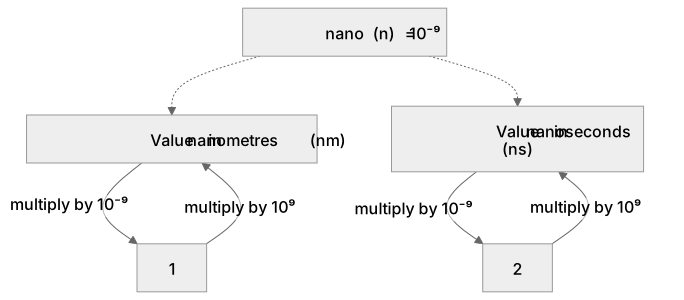
Label the diagram
Some boxes have lost their names. Pick the right name for each number.
1Box 1
2Box 2
There is more to this lesson
The full lesson goes on to check your understanding and help you earn the marks. Create a free account to carry on, with your progress saved.
A week of Premium from your first lesson · Then the free plan continues · No card, no charge
Test your understanding of S.I. units: (p), nano
Active recall beats re-reading. Take an instant quiz now to test what you’ve learned and lock it into long-term memory.
A week of Premium from your first lesson · Then the free plan continues · No card, no charge