OCR · A-Level · Physics
Course version: H556 · Version from Sept 2015
(f) analysis of circuits with more than one source of e.m.f.
Full specification wording
Series and parallel circuits: (f) analysis of circuits with more than one source of e.m.f.
When a circuit contains more than one source of e.m.f., you cannot treat the current as driven by a single p.d.
Checked against the OCR H556 specification (opens in a new tab) on .
- Point 6 of 6
- 2 key terms
Study notes
From the checked teaching notes for this specification point.
The idea
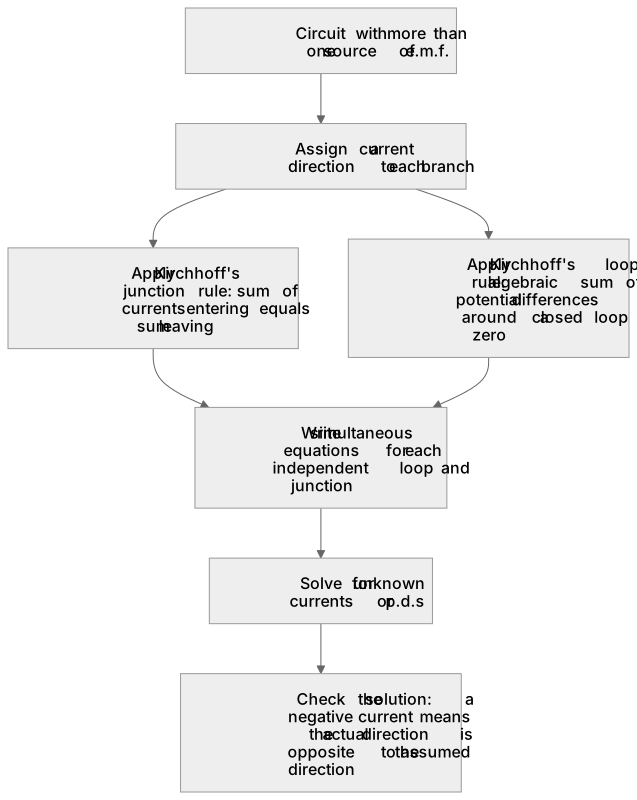
When a circuit contains more than one source of e.m.f., you cannot treat the current as driven by a single p.d. Instead, apply Kirchhoff's laws: at any junction, the sum of currents entering equals the sum leaving; around any closed loop, the algebraic sum of potential differences is zero. Assign a current direction to each branch, write loop equations using the e.m.f.s and the p.d.s across resistors, and solve the simultaneous equations. For example, two batteries of 6.0 V and 4.0 V in parallel with resistors require you to define loop directions and signs consistently. The method works for any number of sources and resistors, including opposing e.m.f.s.
What earns the marks
- State Kirchhoff's junction rule: the sum of currents entering a junction equals the sum leaving.
- State Kirchhoff's loop rule: around any closed loop, the algebraic sum of e.m.f.s equals the sum of p.d.s, or the total p.d. is zero.
- Assign a current direction to each branch and apply consistent sign conventions for e.m.f.s and p.d.s.
- Write simultaneous equations for each independent loop and junction, then solve for unknown currents or p.d.s.
- Check the solution: a negative current indicates the actual direction is opposite to the assumed direction.
Common mistakes and how to put them right
Assuming that the larger e.m.f. always determines the current direction in every branch.
Put it right: The actual direction depends on the full circuit, and a branch may carry current driven by the smaller source if the larger source is opposed by other p.d.s.
Adding e.m.f.s arithmetically without considering their polarities.
Put it right: e.m.f.s in opposing senses in a loop must be subtracted, not added.
Ignoring internal resistance of the sources.
Put it right: Each source has internal resistance, which must be included as a resistor in series with its e.m.f. when analysing the circuit.
Applying the loop rule to a non-closed path.
Put it right: Kirchhoff's loop rule applies only to closed loops.
Exam tips
- Draw the circuit clearly and label all currents with assumed directions before writing equations.
- Use a consistent sign convention: for example, traversing a loop in the chosen direction, treat e.m.f.s that drive current in that direction as positive and those opposing as negative.
- Solve the simultaneous equations carefully, then interpret any negative result as a current flowing opposite to your assumed direction.
Try the lesson
The start of the Series and parallel circuits: (f) analysis of circuits with more than one source of e.m.f. lesson, made from checked teaching notes for this specification point.
Listen
When a circuit contains more than one source of e.m.f., you cannot treat the current as driven by a single p.d. Instead, apply Kirchhoff's laws: at any junction, the sum of currents entering equals the sum leaving; around any closed loop, the algebraic sum of potential differences is zero. Assign a current direction to each branch, write loop equations using the e.m.f.s and the p.d.s across resistors, and solve the simultaneous equations. For example, two batteries of 6.0 V and 4.0 V in parallel with resistors require you to define loop directions and signs consistently. The method works for any number of sources and resistors, including opposing e.m.f.s. A strong answer earns marks for these points. State Kirchhoff's junction rule: the sum of currents entering a junction equals the sum leaving. State Kirchhoff's loop rule: around any closed loop, the algebraic sum of e.m.f.s equals the sum of p.d.s, or the total p.d. is zero. Assign a current direction to each branch and apply consistent sign conventions for e.m.f.s and p.d.s. Write simultaneous equations for each independent loop and junction, then solve for unknown currents or p.d.s. A common slip: Assuming that the larger e.m.f. always determines the current direction in every branch. Instead, the actual direction depends on the full circuit, and a branch may carry current driven by the smaller source if the larger source is opposed by other p.d.s. Exam tip: Draw the circuit clearly and label all currents with assumed directions before writing equations.
See it
Key words
Say what each word means before you turn the card.
Kirchhoff's laws
Try answering aloud or in your head before turning the card.
Simultaneous equations in circuit analysis
Try answering aloud or in your head before turning the card.
See every definition
- Kirchhoff's laws
- At any junction the sum of currents entering equals the sum leaving, and around any closed loop the algebraic sum of potential differences is zero.
- Simultaneous equations in circuit analysis
- Assign a current direction to each branch, write loop equations using the e.m.f.s and the p.d.s across resistors, and solve the simultaneous equations.
Label the diagram
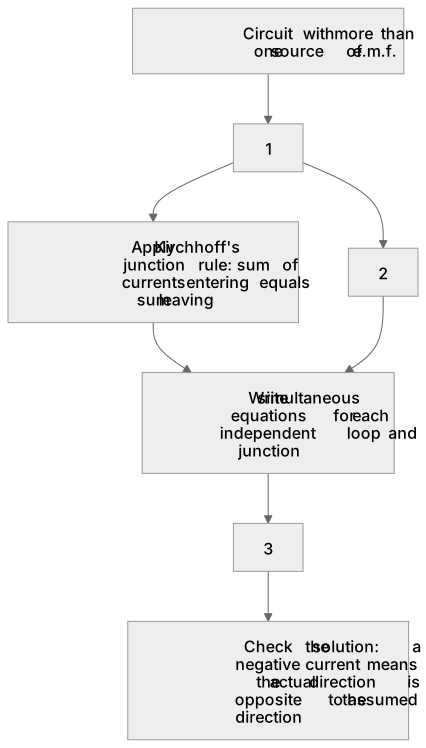
Some boxes have lost their names. Pick the right name for each number.
1Box 1
2Box 2
3Box 3
There is more to this lesson
The full lesson goes on to check your understanding and help you earn the marks. Create a free account to carry on, with your progress saved.
A week of Premium from your first lesson · Then the free plan continues · No card, no charge
Test your understanding of Series and parallel circuits: (f) analysis of circuits with more than one source of e.m.f.
Active recall beats re-reading. Take an instant quiz now to test what you’ve learned and lock it into long-term memory.
A week of Premium from your first lesson · Then the free plan continues · No card, no charge