OCR · A-Level · Physics
Course version: H556 · Version from Sept 2015
(a) displacement, amplitude, period, frequency, angular frequency and…
Full specification wording
Simple harmonic oscillations: (a) displacement, amplitude, period, frequency, angular frequency and phase difference
These six quantities describe any oscillation.
Checked against the OCR H556 specification (opens in a new tab) on .
- Point 1 of 7
- 4 key terms
Study notes
From the checked teaching notes for this specification point.
The idea
These six quantities describe any oscillation. Displacement x is the signed distance from the equilibrium position, so it is negative on one side and positive on the other. Amplitude A is the maximum magnitude of displacement, always positive. Period T is the time for one complete cycle, measured in seconds. Frequency f is the number of cycles per second, f = 1/T, in hertz. Angular frequency ω converts cycles to radians per second: ω = 2π/T = 2πf, so a 2.0 Hz oscillation has ω = 2π × 2.0 = 4π rad s⁻¹ ≈ 12.6 rad s⁻¹. Phase difference φ compares two oscillations of the same frequency, expressed in radians or degrees; a quarter-cycle lag is π/2 rad or 90°.
What earns the marks
- Displacement is a signed vector-like quantity measured from the equilibrium position, not the total distance travelled.
- Amplitude is the maximum magnitude of displacement and is always positive.
- Period T is the time for one complete oscillation, measured in seconds.
- Frequency f = 1/T is the number of complete oscillations per second, measured in hertz.
- Angular frequency ω = 2π/T = 2πf, measured in rad s⁻¹.
- Phase difference compares the timing of two oscillations of the same frequency, in rad or degrees.
Common mistakes and how to put them right
Confusing displacement with distance travelled.
Put it right: Displacement is signed and measured from equilibrium, whereas distance travelled accumulates and is never negative.
Treating amplitude as a signed quantity.
Put it right: Amplitude is the maximum magnitude of displacement and is always positive.
Using ω = 2πT instead of ω = 2π/T.
Put it right: Check that a larger period gives a smaller angular frequency.
Expressing phase difference in seconds.
Put it right: Phase difference is an angle in radians or degrees, not a time.
Exam tips
- Write the defining relationship for each quantity before substituting numbers, so the examiner can see your reasoning.
- Check units carefully: T in s, f in Hz, ω in rad s⁻¹, phase difference in rad or degrees.
- When comparing two oscillations, confirm they have the same frequency before quoting a phase difference.
Try the lesson
The start of the Simple harmonic oscillations: (a) displacement, amplitude, period, frequency, angular frequency and phase difference lesson, made from checked teaching notes for this specification point.
Listen
These six quantities describe any oscillation. Displacement x is the signed distance from the equilibrium position, so it is negative on one side and positive on the other. Amplitude A is the maximum magnitude of displacement, always positive. Period T is the time for one complete cycle, measured in seconds. Frequency f is the number of cycles per second, f = 1/T, in hertz. Angular frequency ω converts cycles to radians per second: ω = 2π/T = 2πf, so a 2.0 Hz oscillation has ω = 2π × 2.0 = 4π rad s⁻¹ ≈ 12.6 rad s⁻¹. Phase difference φ compares two oscillations of the same frequency, expressed in radians or degrees; a quarter-cycle lag is π/2 rad or 90°. A strong answer earns marks for these points. Displacement is a signed vector-like quantity measured from the equilibrium position, not the total distance travelled. Amplitude is the maximum magnitude of displacement and is always positive. Period T is the time for one complete oscillation, measured in seconds. Frequency f = 1/T is the number of complete oscillations per second, measured in hertz. Exam tip: Write the defining relationship for each quantity before substituting numbers, so the examiner can see your reasoning.
See it
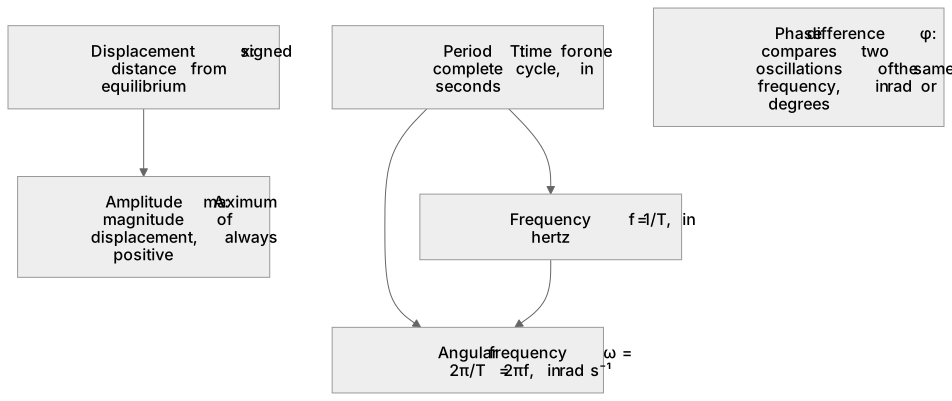
Key words
Say what each word means before you turn the card.
Displacement
Try answering aloud or in your head before turning the card.
Amplitude
Try answering aloud or in your head before turning the card.
Period
Try answering aloud or in your head before turning the card.
Phase difference
Try answering aloud or in your head before turning the card.
See every definition
- Displacement
- The signed distance from the equilibrium position, so it is negative on one side and positive on the other.
- Amplitude
- The maximum magnitude of displacement, always positive.
- Period
- The time for one complete cycle, measured in seconds.
- Phase difference
- A comparison of two oscillations of the same frequency, expressed in radians or degrees.
Label the diagram
Some boxes have lost their names. Pick the right name for each number.
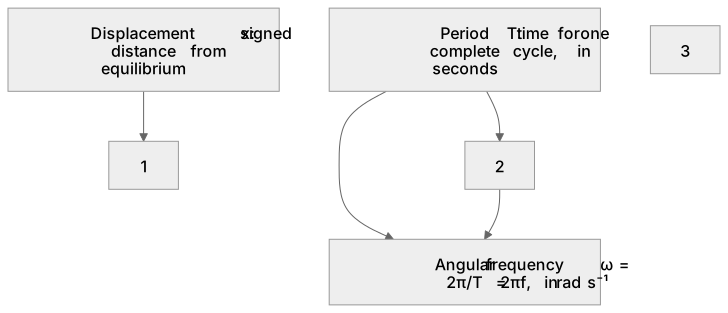
1Box 1
2Box 2
3Box 3
There is more to this lesson
The full lesson goes on to check your understanding and help you earn the marks. Create a free account to carry on, with your progress saved.
A week of Premium from your first lesson · Then the free plan continues · No card, no charge
Test your understanding of Simple harmonic oscillations: (a) displacement, amplitude, period, frequency, angular frequency and phase difference
Active recall beats re-reading. Take an instant quiz now to test what you’ve learned and lock it into long-term memory.
A week of Premium from your first lesson · Then the free plan continues · No card, no charge