OCR · A-Level · Physics
Course version: H556 · Version from Sept 2015
(g) graphical methods to relate the changes in displacement, velocity and…
Full specification wording
Simple harmonic oscillations: (g) graphical methods to relate the changes in displacement, velocity and acceleration during simple harmonic motion.
Simple harmonic motion (SHM) is defined by acceleration proportional to displacement and directed towards the equilibrium position, a = −ω²x.
Checked against the OCR H556 specification (opens in a new tab) on .
- Point 7 of 7
- 3 key terms
Study notes
From the checked teaching notes for this specification point.
The idea
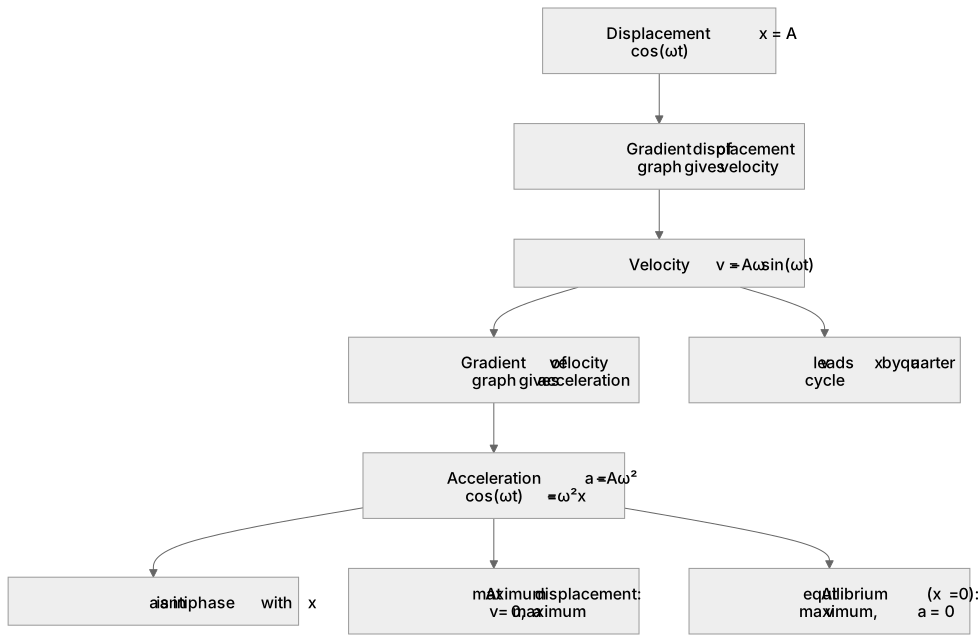
Simple harmonic motion (SHM) is defined by acceleration proportional to displacement and directed towards the equilibrium position, a = −ω²x. Graphical methods let you relate displacement, velocity and acceleration at any instant. Plot x = A cos(ωt): the gradient at a point gives velocity, so v = −Aω sin(ωt), and the gradient of the velocity graph gives acceleration, a = −Aω² cos(ωt) = −ω²x. Velocity is maximum at equilibrium where x = 0, and zero at maximum displacement where a is maximum. Acceleration is always opposite in sign to displacement. Sketching these three curves on shared axes, or reading gradients and intercepts, reveals the phase relationships: v leads x by a quarter cycle and a is in antiphase with x.
What earns the marks
- Acceleration is proportional to displacement and directed towards equilibrium: a = −ω²x, with the minus sign showing opposition to displacement.
- Velocity is the gradient of the displacement–time graph, so v = −Aω sin(ωt) for x = A cos(ωt).
- Acceleration is the gradient of the velocity–time graph, giving a = −Aω² cos(ωt), consistent with a = −ω²x.
- At maximum displacement, velocity is zero and acceleration is maximum; at equilibrium, velocity is maximum and acceleration is zero.
- The velocity–time graph leads the displacement–time graph by a quarter of a period, and acceleration is in antiphase with displacement.
- Graphical methods include reading gradients, intercepts and phase differences from sketched or plotted curves.
Common mistakes and how to put them right
Thinking velocity and displacement are in phase.
Put it right: They are a quarter cycle out of phase, so velocity is zero when displacement is maximum.
Believing acceleration is maximum at equilibrium.
Put it right: Acceleration is zero there because displacement is zero, while velocity is maximum.
Forgetting the minus sign in a = −ω²x, which would wrongly suggest acceleration acts with displacement rather than towards equilibrium.
Confusing the gradient of a velocity–time graph with velocity itself.
Put it right: The gradient gives acceleration, not displacement.
Exam tips
- Sketch all three curves on the same time axis so phase relationships are visible and easy to compare.
- State the defining relationship a = −ω²x before using graphs, then link each feature to it.
- When reading a graph, identify the gradient or intercept the question asks for rather than describing the whole curve.
Try the lesson
The start of the Simple harmonic oscillations: (g) graphical methods to relate the changes in displacement, velocity and acceleration during simple harmonic motion. lesson, made from checked teaching notes for this specification point.
Listen
Simple harmonic motion (SHM) is defined by acceleration proportional to displacement and directed towards the equilibrium position, a = −ω²x. Graphical methods let you relate displacement, velocity and acceleration at any instant. Plot x = A cos(ωt): the gradient at a point gives velocity, so v = −Aω sin(ωt), and the gradient of the velocity graph gives acceleration, a = −Aω² cos(ωt) = −ω²x. Velocity is maximum at equilibrium where x = 0, and zero at maximum displacement where a is maximum. Acceleration is always opposite in sign to displacement. Sketching these three curves on shared axes, or reading gradients and intercepts, reveals the phase relationships: v leads x by a quarter cycle and a is in antiphase with x. A strong answer earns marks for these points. Acceleration is proportional to displacement and directed towards equilibrium: a = −ω²x, with the minus sign showing opposition to displacement. Velocity is the gradient of the displacement–time graph, so v = −Aω sin(ωt) for x = A cos(ωt). Acceleration is the gradient of the velocity–time graph, giving a = −Aω² cos(ωt), consistent with a = −ω²x. At maximum displacement, velocity is zero and acceleration is maximum; at equilibrium, velocity is maximum and acceleration is zero. Exam tip: Sketch all three curves on the same time axis so phase relationships are visible and easy to compare.
See it
Key words
Say what each word means before you turn the card.
Defining equation of simple harmonic motion
Try answering aloud or in your head before turning the card.
Gradient as a graphical derivative
Try answering aloud or in your head before turning the card.
Energy and motion at equilibrium and maximum displacement
Try answering aloud or in your head before turning the card.
See every definition
- Defining equation of simple harmonic motion
- Acceleration is proportional to displacement and directed towards the equilibrium position, written a = −ω²x, with the minus sign showing opposition to displacement.
- Gradient as a graphical derivative
- The gradient of the displacement–time graph gives velocity, and the gradient of the velocity–time graph gives acceleration.
- Energy and motion at equilibrium and maximum displacement
- At maximum displacement, velocity is zero and acceleration is maximum; at equilibrium, velocity is maximum and acceleration is zero.
Label the diagram
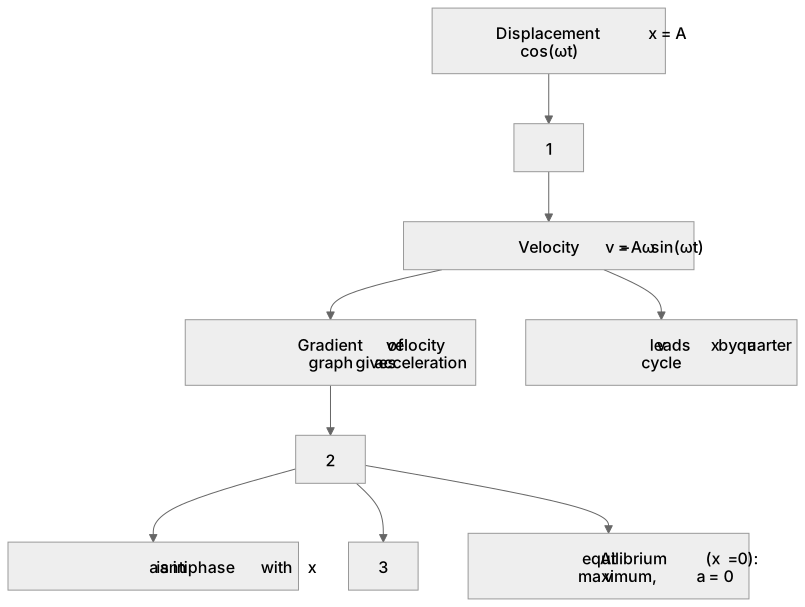
Some boxes have lost their names. Pick the right name for each number.
1Box 1
2Box 2
3Box 3
There is more to this lesson
The full lesson goes on to check your understanding and help you earn the marks. Create a free account to carry on, with your progress saved.
A week of Premium from your first lesson · Then the free plan continues · No card, no charge
Test your understanding of Simple harmonic oscillations: (g) graphical methods to relate the changes in displacement, velocity and acceleration during simple harmonic motion.
Active recall beats re-reading. Take an instant quiz now to test what you’ve learned and lock it into long-term memory.
A week of Premium from your first lesson · Then the free plan continues · No card, no charge