OCR · A-Level · Physics
Course version: H556 · Version from Sept 2015
(b) simple kinetic model for solids, liquids and gases
Full specification wording
Solid, liquid and gas: (b) simple kinetic model for solids, liquids and gases
The simple kinetic model treats a substance as a large number of particles in continuous random motion, and uses that motion to explain bulk behaviour.
Checked against the OCR H556 specification (opens in a new tab) on .
- Point 2 of 7
- 4 key terms
Study notes
From the checked teaching notes for this specification point.
The idea
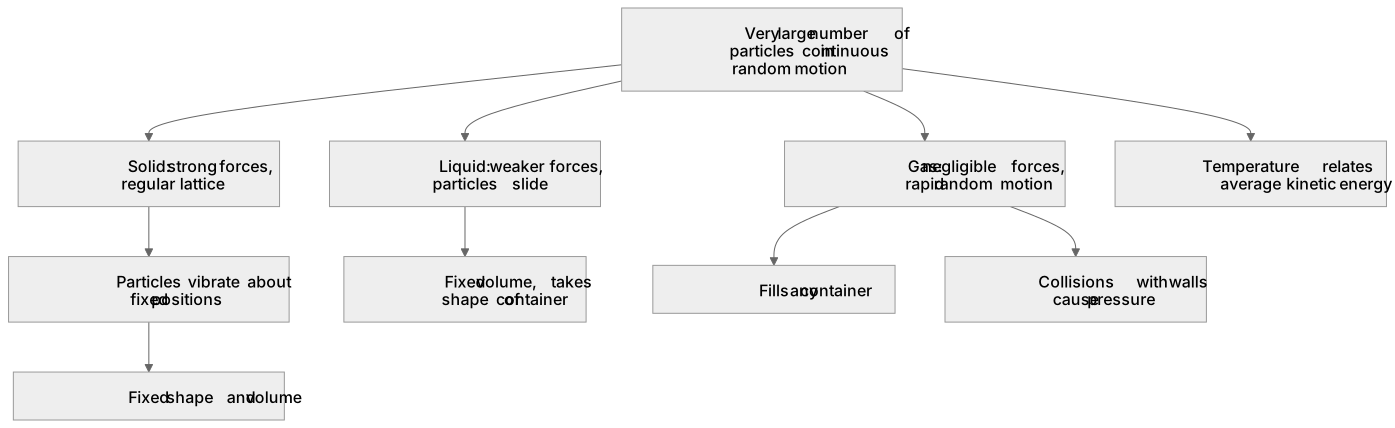
The simple kinetic model treats a substance as a large number of particles in continuous random motion, and uses that motion to explain bulk behaviour. In a solid, strong forces hold particles in a regular lattice, so they vibrate about fixed positions and the solid keeps a fixed shape and volume. In a liquid, forces are weaker and particles can slide, so a liquid has a fixed volume but takes the shape of its container. In a gas, forces between particles are negligible, so particles move rapidly and randomly, filling any container and exerting pressure through collisions with the walls. The model also links temperature to the average kinetic energy of the particles. When answering, decide which feature of the model explains the observation in the question, such as pressure arising from collisions rather than from particles pushing each other apart.
What earns the marks
- Matter is modelled as a very large number of particles in continuous random motion.
- In solids, strong interparticle forces hold particles in a regular lattice so they vibrate about fixed positions.
- In liquids, weaker forces allow particles to slide past one another, giving a fixed volume but no fixed shape.
- In gases, interparticle forces are negligible and particles move rapidly and randomly.
- Gas pressure arises from collisions of particles with the container walls.
- Temperature relates to the average kinetic energy of the particles in the model.
Common mistakes and how to put them right
Saying gas pressure is caused by particles pushing each other apart.
Put it right: The pressure comes from collisions between particles and the container walls.
Treating the model as a literal picture of particles touching in a gas.
Put it right: In the simple kinetic model gas particles are widely separated with negligible forces between them.
Assuming liquids have no intermolecular forces because they flow.
Put it right: Forces are present but weak enough to allow sliding.
Believing that all particles in a sample have the same speed.
Put it right: The model uses a random distribution of speeds, and temperature relates to the average kinetic energy.
Exam tips
- Match each observation in the question to the specific feature of the model that explains it, such as collisions for pressure.
- Use the words random and continuous when describing particle motion, since these are central to the model.
- Check whether the question is about shape, volume, pressure or temperature before choosing an option.
- Eliminate options that describe particles as stationary or as having no forces at all in every state.
Try the lesson
The start of the Solid, liquid and gas: (b) simple kinetic model for solids, liquids and gases lesson, made from checked teaching notes for this specification point.
Listen
The simple kinetic model treats a substance as a large number of particles in continuous random motion, and uses that motion to explain bulk behaviour. In a solid, strong forces hold particles in a regular lattice, so they vibrate about fixed positions and the solid keeps a fixed shape and volume. In a liquid, forces are weaker and particles can slide, so a liquid has a fixed volume but takes the shape of its container. In a gas, forces between particles are negligible, so particles move rapidly and randomly, filling any container and exerting pressure through collisions with the walls. The model also links temperature to the average kinetic energy of the particles. When answering, decide which feature of the model explains the observation in the question, such as pressure arising from collisions rather than from particles pushing each other apart. A strong answer earns marks for these points. Matter is modelled as a very large number of particles in continuous random motion. In solids, strong interparticle forces hold particles in a regular lattice so they vibrate about fixed positions. In liquids, weaker forces allow particles to slide past one another, giving a fixed volume but no fixed shape. In gases, interparticle forces are negligible and particles move rapidly and randomly. Exam tip: Match each observation in the question to the specific feature of the model that explains it, such as collisions for pressure.
See it
Key words
Say what each word means before you turn the card.
Particles in continuous random motion
Try answering aloud or in your head before turning the card.
Interparticle forces and their strength in each state
Try answering aloud or in your head before turning the card.
Explaining shape, volume and pressure with the model
Try answering aloud or in your head before turning the card.
Temperature and average kinetic energy
Try answering aloud or in your head before turning the card.
See every definition
- Particles in continuous random motion
- The simple kinetic model treats a substance as a large number of particles in continuous random motion.
- Interparticle forces and their strength in each state
- Strong forces hold particles in a regular lattice in a solid, weaker forces allow particles to slide in a liquid, and forces are negligible in a gas.
- Explaining shape, volume and pressure with the model
- A solid keeps a fixed shape and volume, a liquid has a fixed volume but takes the shape of its container, and gas pressure arises from collisions of particles with the container walls.
- Temperature and average kinetic energy
- The model links temperature to the average kinetic energy of the particles.
Label the diagram
Some boxes have lost their names. Pick the right name for each number.
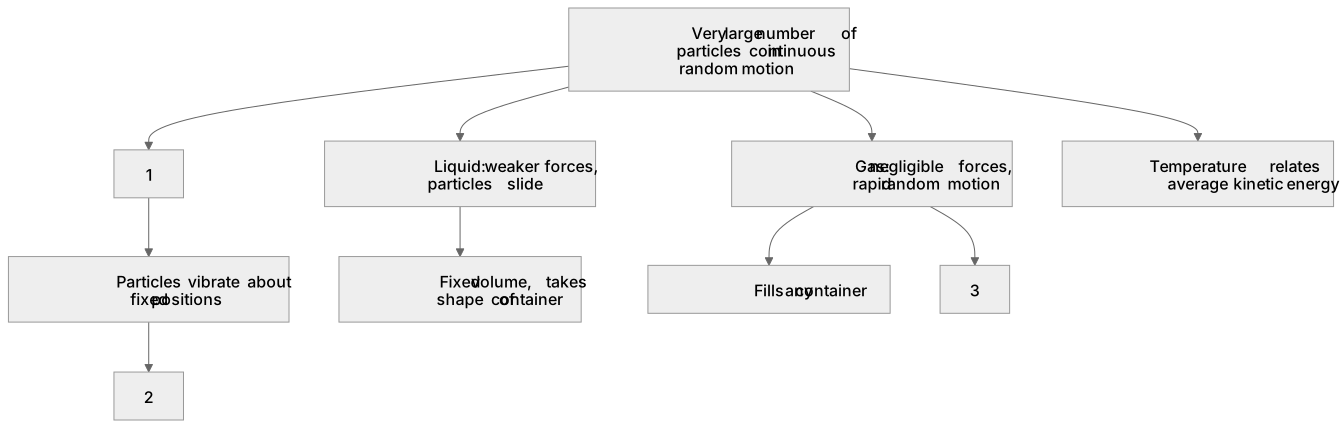
1Box 1
2Box 2
3Box 3
There is more to this lesson
The full lesson goes on to check your understanding and help you earn the marks. Create a free account to carry on, with your progress saved.
A week of Premium from your first lesson · Then the free plan continues · No card, no charge
Test your understanding of Solid, liquid and gas: (b) simple kinetic model for solids, liquids and gases
Active recall beats re-reading. Take an instant quiz now to test what you’ve learned and lock it into long-term memory.
A week of Premium from your first lesson · Then the free plan continues · No card, no charge