OCR · A-Level · Physics
Course version: H556 · Version from Sept 2015
(e) absolute zero (0 K) as the lowest limit for temperature; the…
Full specification wording
Solid, liquid and gas: (e) absolute zero (0 K) as the lowest limit for temperature; the temperature at which a substance has minimum internal energy
Absolute zero is 0 K, the lowest temperature on the thermodynamic scale.
Checked against the OCR H556 specification (opens in a new tab) on .
- Point 5 of 7
- 3 key terms
Study notes
From the checked teaching notes for this specification point.
The idea
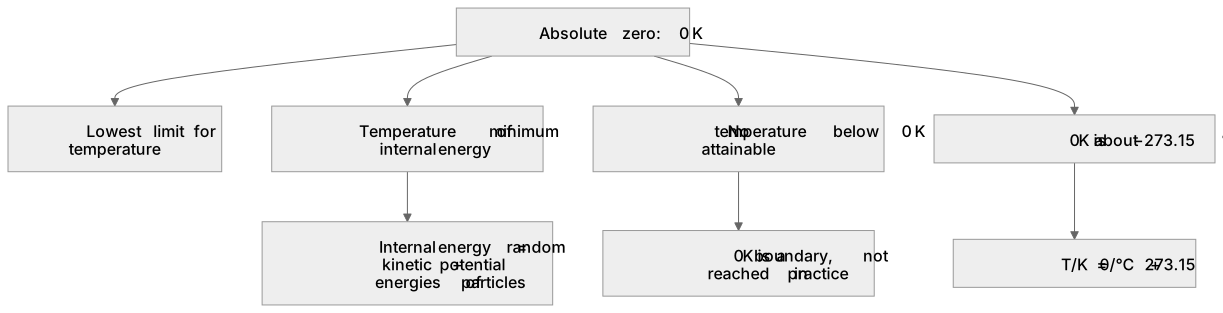
Absolute zero is 0 K, the lowest temperature on the thermodynamic scale. It is the lower limit: no temperature below 0 K is attainable, so 0 K is a boundary rather than a value reached in practice. At this limit a substance has minimum internal energy. Internal energy is the sum of the random kinetic and potential energies of its particles, so cooling towards 0 K reduces particle motion and the associated energy. Convert with T/K = θ/°C + 273.15, so 0 K is about −273.15 °C. A question may ask which value is the lowest possible temperature, or which statement about internal energy at 0 K is correct.
What earns the marks
- Absolute zero is 0 K, the lowest limit for temperature.
- Internal energy is the sum of random kinetic and potential energies of the particles.
- 0 K corresponds to about −273.15 °C, using T/K = θ/°C + 273.15.
- No temperature below 0 K is attainable, so 0 K is a limiting value.
Common mistakes and how to put them right
Thinking 0 K can be reached easily in a laboratory.
Put it right: It is a lower limit approached but not attained, so treat it as a boundary.
Confusing 0 K with 0 °C.
Put it right: 0 °C is 273.15 K, whereas 0 K is about −273.15 °C.
Saying internal energy is zero at 0 K.
Put it right: The statement is minimum internal energy, not zero.
Treating temperature as a measure of total internal energy.
Put it right: Temperature relates to the average random kinetic energy of particles.
Exam tips
- Read the options for the exact wording: lowest limit and minimum internal energy are the key phrases.
- Convert between kelvin and degrees Celsius using T/K = θ/°C + 273.15 before comparing values.
- Eliminate options that claim a temperature below 0 K or that internal energy is exactly zero at 0 K.
Try the lesson
The start of the Solid, liquid and gas: (e) absolute zero (0 K) as the lowest limit for temperature; the temperature at which a substance has minimum internal energy lesson, made from checked teaching notes for this specification point.
Listen
Absolute zero is 0 K, the lowest temperature on the thermodynamic scale. It is the lower limit: no temperature below 0 K is attainable, so 0 K is a boundary rather than a value reached in practice. At this limit a substance has minimum internal energy. Internal energy is the sum of the random kinetic and potential energies of its particles, so cooling towards 0 K reduces particle motion and the associated energy. Convert with T/K = θ/°C + 273.15, so 0 K is about −273.15 °C. A question may ask which value is the lowest possible temperature, or which statement about internal energy at 0 K is correct. A strong answer earns marks for these points. Absolute zero is 0 K, the lowest limit for temperature. Internal energy is the sum of random kinetic and potential energies of the particles. 0 K corresponds to about −273.15 °C, using T/K = θ/°C + 273.15. No temperature below 0 K is attainable, so 0 K is a limiting value. Exam tip: Read the options for the exact wording: lowest limit and minimum internal energy are the key phrases.
See it
Key words
Say what each word means before you turn the card.
Absolute zero
Try answering aloud or in your head before turning the card.
Internal energy
Try answering aloud or in your head before turning the card.
Kelvin–Celsius conversion
Try answering aloud or in your head before turning the card.
See every definition
- Absolute zero
- 0 K, the lowest limit for temperature, at which a substance has minimum internal energy.
- Internal energy
- The sum of the random kinetic and potential energies of the particles of a substance.
- Kelvin–Celsius conversion
- Convert between kelvin and degrees Celsius using T/K = θ/°C + 273.15, so 0 K is about −273.15 °C.
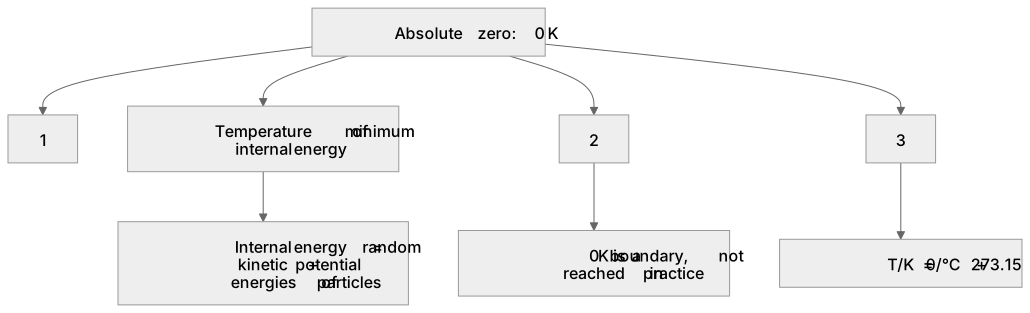
Label the diagram
Some boxes have lost their names. Pick the right name for each number.
1Box 1
2Box 2
3Box 3
There is more to this lesson
The full lesson goes on to check your understanding and help you earn the marks. Create a free account to carry on, with your progress saved.
A week of Premium from your first lesson · Then the free plan continues · No card, no charge
Test your understanding of Solid, liquid and gas: (e) absolute zero (0 K) as the lowest limit for temperature; the temperature at which a substance has minimum internal energy
Active recall beats re-reading. Take an instant quiz now to test what you’ve learned and lock it into long-term memory.
A week of Premium from your first lesson · Then the free plan continues · No card, no charge