OCR · A-Level · Physics
Course version: H556 · Version from Sept 2015
Springs: (a) tensile and compressive deformation; extension and compression
When a material is subjected to opposing forces, it can deform.
Checked against the OCR H556 specification (opens in a new tab) on .
- Point 1 of 4
- 4 key terms
Study notes
From the checked teaching notes for this specification point.
The idea
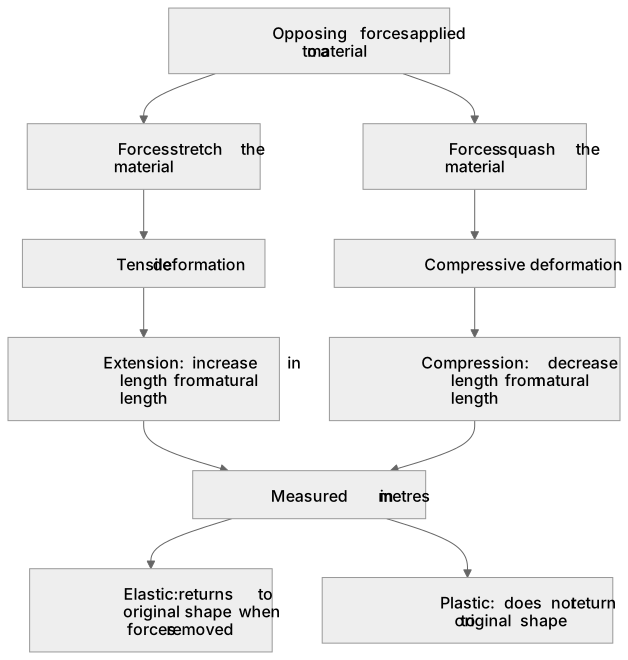
When a material is subjected to opposing forces, it can deform. Tensile deformation occurs when forces stretch the material, producing an extension (increase in length). Compressive deformation occurs when forces squash the material, producing a compression (decrease in length). For example, a spring pulled at both ends experiences tensile deformation and its extension is the increase from its natural length. A spring pushed at both ends experiences compressive deformation and its compression is the decrease from its natural length. Extension and compression are both measured in metres and are vector quantities in the sense that they have direction along the line of the force, but in this course they are usually treated as magnitudes with a sign convention. The deformation is elastic if the material returns to its original shape when the forces are removed, and plastic if it does not.
What earns the marks
- Tensile deformation is caused by forces that stretch a material, producing an extension.
- Compressive deformation is caused by forces that squash a material, producing a compression.
- Extension is the increase in length from the natural length; compression is the decrease in length from the natural length.
- Elastic deformation is reversible; plastic deformation is permanent.
- The direction of the deforming force determines whether deformation is tensile or compressive.
Common mistakes and how to put them right
Confusing extension with compression.
Put it right by checking whether the material is stretched or squashed.
Thinking that compression always means the material gets shorter than its natural length.
Put it right: Compression is a decrease relative to the natural length, but the material may still be under compression while shorter than its original length.
Assuming all deformation is elastic.
Put it right by distinguishing between elastic and plastic behaviour.
Forgetting to measure extension from the natural length, not from an arbitrary starting point.
Put it right by using the unstretched length as the reference.
Exam tips
- Read the question carefully to identify whether the material is being stretched or squashed.
- Use the terms extension and compression correctly in your answers.
- If a graph of force against extension is given, note that the gradient gives the spring constant for a spring obeying Hooke’s law.
- Remember that extension and compression are measured in metres, and convert from cm or mm if necessary.
Try the lesson
The start of the Springs: (a) tensile and compressive deformation; extension and compression lesson, made from checked teaching notes for this specification point.
Listen
When a material is subjected to opposing forces, it can deform. Tensile deformation occurs when forces stretch the material, producing an extension (increase in length). Compressive deformation occurs when forces squash the material, producing a compression (decrease in length). For example, a spring pulled at both ends experiences tensile deformation and its extension is the increase from its natural length. A spring pushed at both ends experiences compressive deformation and its compression is the decrease from its natural length. Extension and compression are both measured in metres and are vector quantities in the sense that they have direction along the line of the force, but in this course they are usually treated as magnitudes with a sign convention. The deformation is elastic if the material returns to its original shape when the forces are removed, and plastic if it does not. A strong answer earns marks for these points. Tensile deformation is caused by forces that stretch a material, producing an extension. Compressive deformation is caused by forces that squash a material, producing a compression. Extension is the increase in length from the natural length; compression is the decrease in length from the natural length. Elastic deformation is reversible; plastic deformation is permanent. A common slip: Confusing extension with compression: extension is an increase in length, compression is a decrease. Instead, checking whether the material is stretched or squashed. Exam tip: Read the question carefully to identify whether the material is being stretched or squashed.
See it
Key words
Say what each word means before you turn the card.
Tensile deformation
Try answering aloud or in your head before turning the card.
Compressive deformation
Try answering aloud or in your head before turning the card.
Extension and compression
Try answering aloud or in your head before turning the card.
Elastic and plastic behaviour
Try answering aloud or in your head before turning the card.
See every definition
- Tensile deformation
- Occurs when forces stretch the material, producing an extension, which is an increase in length.
- Compressive deformation
- Occurs when forces squash the material, producing a compression, which is a decrease in length.
- Extension and compression
- The increase in length from the natural length and the decrease in length from the natural length respectively, both measured in metres.
- Elastic and plastic behaviour
- The deformation is elastic if the material returns to its original shape when the forces are removed, and plastic if it does not.
Label the diagram
Some boxes have lost their names. Pick the right name for each number.
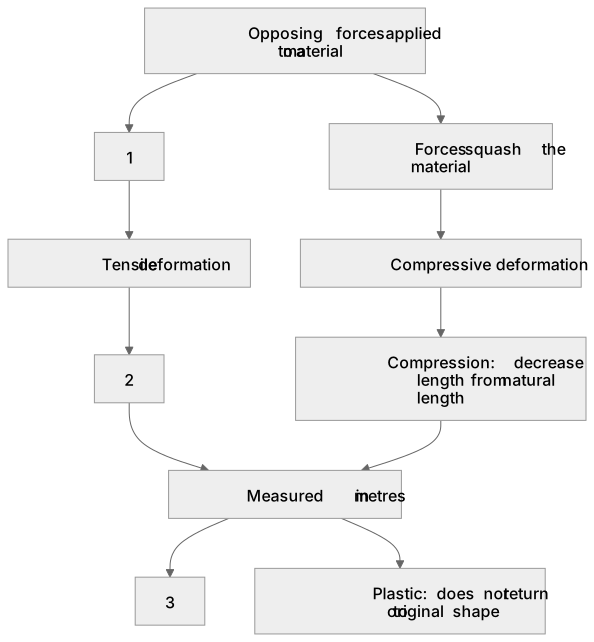
1Box 1
2Box 2
3Box 3
There is more to this lesson
The full lesson goes on to check your understanding and help you earn the marks. Create a free account to carry on, with your progress saved.
A week of Premium from your first lesson · Then the free plan continues · No card, no charge
Test your understanding of Springs: (a) tensile and compressive deformation; extension and compression
Active recall beats re-reading. Take an instant quiz now to test what you’ve learned and lock it into long-term memory.
A week of Premium from your first lesson · Then the free plan continues · No card, no charge