OCR · A-Level · Physics
Course version: H556 · Version from Sept 2015
(g) fundamental mode of vibration (1st harmonic); harmonics.
Full specification wording
Stationary waves: (g) fundamental mode of vibration (1st harmonic); harmonics.
A stationary wave on a stretched string or in a pipe can vibrate in several distinct patterns called harmonics.
Checked against the OCR H556 specification (opens in a new tab) on .
- Point 8 of 8
- 2 key terms
Study notes
From the checked teaching notes for this specification point.
The idea
A stationary wave on a stretched string or in a pipe can vibrate in several distinct patterns called harmonics. The simplest pattern is the fundamental mode, also called the first harmonic. For a string fixed at both ends, the fundamental has one antinode in the middle and nodes at each end, so the string length L equals λ/2. The second harmonic has two antinodes and L = λ, the third harmonic has three antinodes and L = 3λ/2, and so on. In general, for a string fixed at both ends, L = nλ/2 where n is the harmonic number. The frequency of each harmonic is an integer multiple of the fundamental frequency: f_n = nf_1. For a pipe open at both ends, the pattern is similar, but a pipe closed at one end has only odd harmonics.
What earns the marks
- Defines the fundamental mode (first harmonic) as the lowest frequency stationary wave pattern.
- States that for a string fixed at both ends, the fundamental has L = λ/2.
- Identifies that the nth harmonic has n antinodes and L = nλ/2 for a string fixed at both ends.
- States that harmonic frequencies are integer multiples of the fundamental frequency.
- Recognises that a pipe closed at one end supports only odd harmonics.
Common mistakes and how to put them right
Confusing the harmonic number with the number of nodes.
Put it right: The nth harmonic has n antinodes and n+1 nodes for a string fixed at both ends.
Assuming that a closed pipe supports all harmonics.
Put it right: It supports only odd harmonics.
Using L = λ for the fundamental of a string fixed at both ends instead of L = λ/2.
Forgetting that the fundamental frequency is the lowest possible frequency, not the highest.
Exam tips
- Count antinodes to identify the harmonic number quickly in diagram questions.
- Write the general relationship L = nλ/2 and rearrange before substituting numbers.
- For closed pipes, remember the sequence 1st, 3rd, 5th harmonic and use odd values of n.
- Check whether the question asks for frequency, wavelength or harmonic number and give the correct quantity with units.
Try the lesson
The start of the Stationary waves: (g) fundamental mode of vibration (1st harmonic); harmonics. lesson, made from checked teaching notes for this specification point.
Listen
A stationary wave on a stretched string or in a pipe can vibrate in several distinct patterns called harmonics. The simplest pattern is the fundamental mode, also called the first harmonic. For a string fixed at both ends, the fundamental has one antinode in the middle and nodes at each end, so the string length L equals λ/2. The second harmonic has two antinodes and L = λ, the third harmonic has three antinodes and L = 3λ/2, and so on. In general, for a string fixed at both ends, L = nλ/2 where n is the harmonic number. The frequency of each harmonic is an integer multiple of the fundamental frequency: f_n = nf_1. For a pipe open at both ends, the pattern is similar, but a pipe closed at one end has only odd harmonics. A strong answer earns marks for these points. Defines the fundamental mode (first harmonic) as the lowest frequency stationary wave pattern. States that for a string fixed at both ends, the fundamental has L = λ/2. Identifies that the nth harmonic has n antinodes and L = nλ/2 for a string fixed at both ends. States that harmonic frequencies are integer multiples of the fundamental frequency. Exam tip: Count antinodes to identify the harmonic number quickly in diagram questions.
See it

Key words
Say what each word means before you turn the card.
Fundamental mode
Try answering aloud or in your head before turning the card.
Harmonics
Try answering aloud or in your head before turning the card.
See every definition
- Fundamental mode
- The lowest frequency stationary wave pattern, also called the first harmonic.
- Harmonics
- Distinct patterns in which a stationary wave on a stretched string or in a pipe can vibrate, with frequencies that are integer multiples of the fundamental frequency.
Label the diagram
Some boxes have lost their names. Pick the right name for each number.
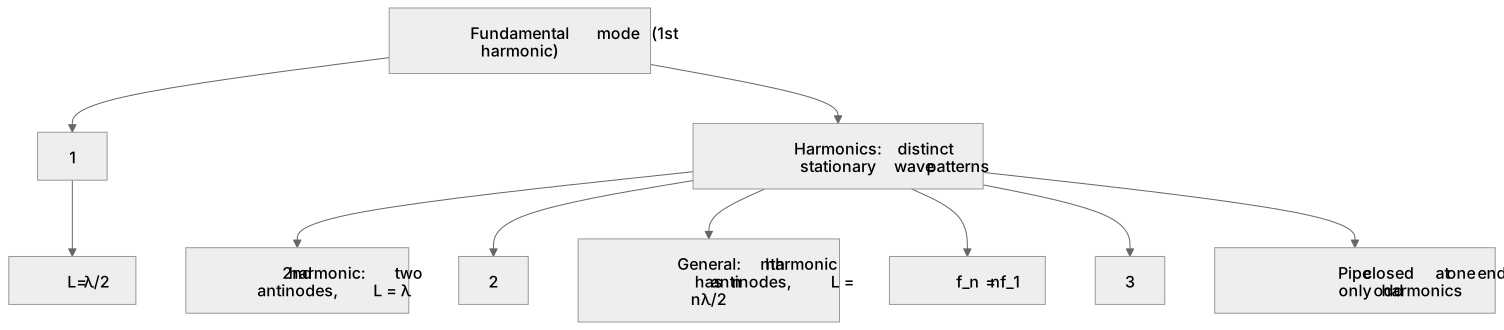
1Box 1
2Box 2
3Box 3
There is more to this lesson
The full lesson goes on to check your understanding and help you earn the marks. Create a free account to carry on, with your progress saved.
A week of Premium from your first lesson · Then the free plan continues · No card, no charge
Test your understanding of Stationary waves: (g) fundamental mode of vibration (1st harmonic); harmonics.
Active recall beats re-reading. Take an instant quiz now to test what you’ve learned and lock it into long-term memory.
A week of Premium from your first lesson · Then the free plan continues · No card, no charge