OCR · A-Level · Physics
Course version: H556 · Version from Sept 2015
Superposition: (1) a double-slit, and
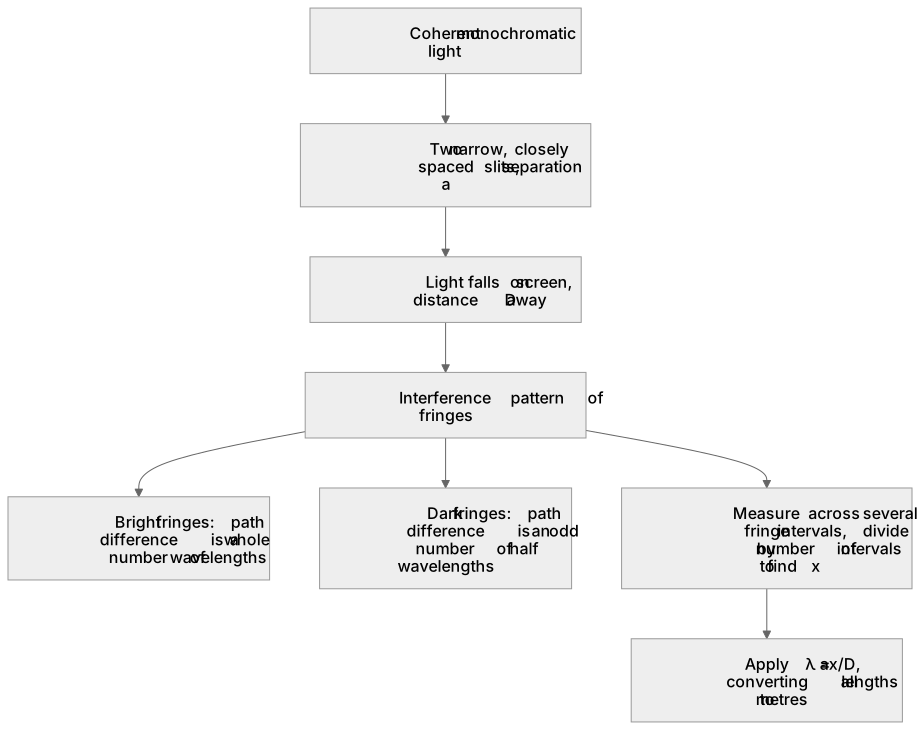
In the double-slit technique, coherent light passes through two narrow slits separated by a small distance a and falls on a screen a distance D away.
Checked against the OCR H556 specification (opens in a new tab) on .
- Point 9 of 10
- 3 key terms
Study notes
From the checked teaching notes for this specification point.
The idea
In the double-slit technique, coherent light passes through two narrow slits separated by a small distance a and falls on a screen a distance D away. Bright fringes occur where the path difference from the two slits is a whole number of wavelengths, and dark fringes where it is an odd number of half wavelengths. The fringe spacing x is measured between corresponding points on adjacent bright fringes, ideally by measuring across several fringes and dividing by the number of intervals. The wavelength follows from λ = ax/D. For example, if a = 0.25 mm, D = 2.00 m and ten fringe intervals span 48.0 mm, then x = 4.80 mm and λ = (0.25 × 10⁻³ m × 4.80 × 10⁻³ m) / 2.00 m = 6.0 × 10⁻⁷ m. The slits must be narrow enough to diffract light and close enough that a ≪ D.
What earns the marks
- Sets up two narrow, closely spaced slits illuminated by coherent monochromatic light.
- Measures the slit separation a and the perpendicular screen distance D.
- Measures the distance across several fringe intervals and divides by the number of intervals to find x.
- Applies λ = ax/D, converting all lengths to metres.
- Explains that bright fringes correspond to path differences of whole wavelengths and dark fringes to half-wavelength path differences.
- Identifies that the slits must be narrow enough to produce noticeable diffraction and close enough that a ≪ D.
Common mistakes and how to put them right
Measuring the distance across n bright fringes and dividing by n rather than by the number of intervals n − 1.
Put it right by counting intervals between fringes.
Using a wide single slit instead of two narrow slits.
Put it right by using a double slit so two coherent sources interfere.
Assuming the central fringe is a dark fringe.
Put it right by recognising the central point is a bright fringe because the path difference there is zero.
Neglecting to darken the room, so the fringes are washed out by background light.
Put it right by reducing ambient light or using a laser.
Exam tips
- Draw a clear ray diagram showing the two slits, the screen and the distances a, x and D.
- Measure across as many fringes as possible and divide by the number of intervals to reduce percentage uncertainty in x.
- Check that a ≪ D before applying λ = ax/D; if not, the small-angle approximation fails.
- State the colour or wavelength of the source, since fringe spacing depends on wavelength.
Try the lesson
The start of the Superposition: (1) a double-slit, and lesson, made from checked teaching notes for this specification point.
Listen
In the double-slit technique, coherent light passes through two narrow slits separated by a small distance a and falls on a screen a distance D away. Bright fringes occur where the path difference from the two slits is a whole number of wavelengths, and dark fringes where it is an odd number of half wavelengths. The fringe spacing x is measured between corresponding points on adjacent bright fringes, ideally by measuring across several fringes and dividing by the number of intervals. The wavelength follows from λ = ax/D. For example, if a = 0.25 mm, D = 2.00 m and ten fringe intervals span 48.0 mm, then x = 4.80 mm and λ = (0.25 × 10⁻³ m × 4.80 × 10⁻³ m) / 2.00 m = 6.0 × 10⁻⁷ m. The slits must be narrow enough to diffract light and close enough that a ≪ D. A strong answer earns marks for these points. Sets up two narrow, closely spaced slits illuminated by coherent monochromatic light. Measures the slit separation a and the perpendicular screen distance D. Measures the distance across several fringe intervals and divides by the number of intervals to find x. Applies λ = ax/D, converting all lengths to metres. A common slip: Measuring the distance across n bright fringes and dividing by n rather than by the number of intervals n − 1. Instead, counting intervals between fringes. Exam tip: Draw a clear ray diagram showing the two slits, the screen and the distances a, x and D.
See it
Key words
Say what each word means before you turn the card.
Two-source interference
Try answering aloud or in your head before turning the card.
Path difference and fringe formation
Try answering aloud or in your head before turning the card.
Measurement and uncertainty
Try answering aloud or in your head before turning the card.
See every definition
- Two-source interference
- Coherent light passes through two narrow slits separated by a small distance a and falls on a screen a distance D away, producing an interference pattern.
- Path difference and fringe formation
- Bright fringes occur where the path difference from the two slits is a whole number of wavelengths, and dark fringes where it is an odd number of half wavelengths.
- Measurement and uncertainty
- The fringe spacing x is measured between corresponding points on adjacent bright fringes, ideally by measuring across several fringes and dividing by the number of intervals.
Label the diagram
Some boxes have lost their names. Pick the right name for each number.
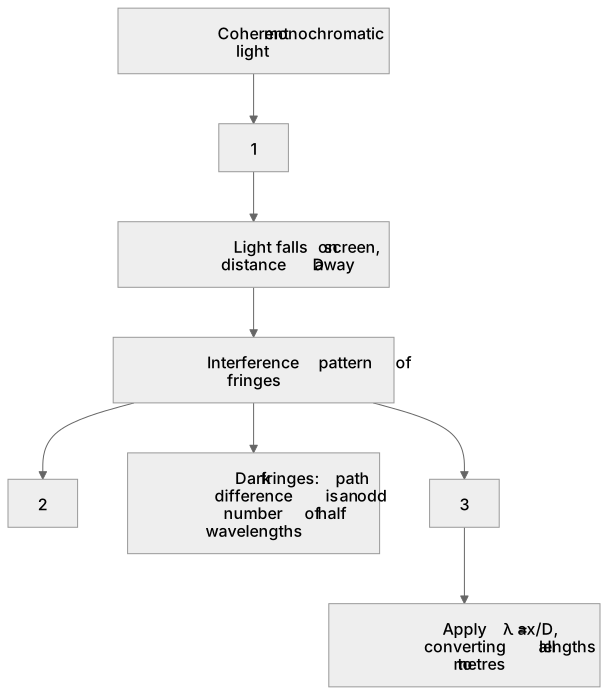
1Box 1
2Box 2
3Box 3
There is more to this lesson
The full lesson goes on to check your understanding and help you earn the marks. Create a free account to carry on, with your progress saved.
A week of Premium from your first lesson · Then the free plan continues · No card, no charge
Test your understanding of Superposition: (1) a double-slit, and
Active recall beats re-reading. Take an instant quiz now to test what you’ve learned and lock it into long-term memory.
A week of Premium from your first lesson · Then the free plan continues · No card, no charge