OCR · A-Level · Physics
Course version: H556 · Version from Sept 2015
(b) simple nuclear model of the atom; protons, neutrons and electrons
Full specification wording
The nuclear atom: (b) simple nuclear model of the atom; protons, neutrons and electrons
The simple nuclear model describes an atom as a small, dense, positively charged nucleus surrounded by electrons.
Checked against the OCR H556 specification (opens in a new tab) on .
- Point 2 of 7
- 4 key terms
Study notes
From the checked teaching notes for this specification point.
The idea
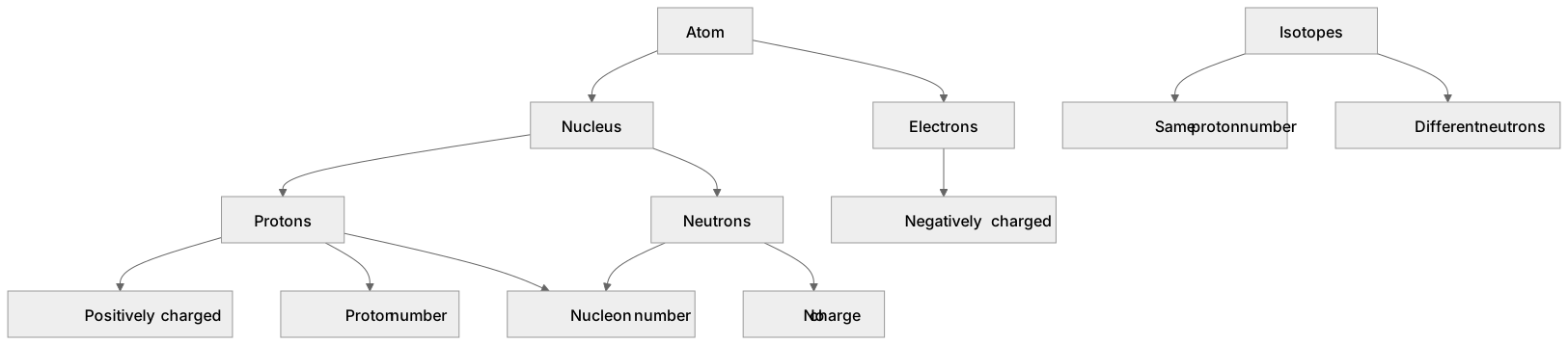
The simple nuclear model describes an atom as a small, dense, positively charged nucleus surrounded by electrons. The nucleus contains protons, which are positively charged, and neutrons, which are neutral. Together, protons and neutrons are called nucleons. Electrons are negatively charged and occupy the space around the nucleus. In a neutral atom, the number of electrons equals the number of protons, so the total charge is zero. The proton number, or atomic number, gives the number of protons and identifies the element. The nucleon number, or mass number, is the total number of protons and neutrons. Isotopes have the same proton number but different numbers of neutrons.
What earns the marks
- The nucleus contains protons and neutrons, collectively called nucleons.
- Protons are positively charged, neutrons have no charge, and electrons are negatively charged.
- In a neutral atom, the number of electrons equals the number of protons.
- The proton number determines the element, while the nucleon number is the total number of protons and neutrons.
- Isotopes of an element have the same number of protons but different numbers of neutrons.
Common mistakes and how to put them right
Confusing proton number with nucleon number.
Put it right: Proton number counts protons only, while nucleon number counts protons plus neutrons.
Thinking neutrons are charged.
Put it right: Neutrons are neutral, so they do not contribute to the electrostatic charge of the nucleus.
Assuming all atoms of an element have the same mass.
Put it right: Isotopes have different numbers of neutrons and therefore different masses.
Exam tips
- Use the terms proton number and nucleon number precisely, and state what each counts.
- Check charge balance by comparing the number of protons with the number of electrons in a neutral atom.
- When identifying an isotope, compare proton numbers and neutron numbers rather than total nucleon numbers alone.
Try the lesson
The start of the The nuclear atom: (b) simple nuclear model of the atom; protons, neutrons and electrons lesson, made from checked teaching notes for this specification point.
Listen
The simple nuclear model describes an atom as a small, dense, positively charged nucleus surrounded by electrons. The nucleus contains protons, which are positively charged, and neutrons, which are neutral. Together, protons and neutrons are called nucleons. Electrons are negatively charged and occupy the space around the nucleus. In a neutral atom, the number of electrons equals the number of protons, so the total charge is zero. The proton number, or atomic number, gives the number of protons and identifies the element. The nucleon number, or mass number, is the total number of protons and neutrons. Isotopes have the same proton number but different numbers of neutrons. A strong answer earns marks for these points. The nucleus contains protons and neutrons, collectively called nucleons. Protons are positively charged, neutrons have no charge, and electrons are negatively charged. In a neutral atom, the number of electrons equals the number of protons. The proton number determines the element, while the nucleon number is the total number of protons and neutrons. Exam tip: Use the terms proton number and nucleon number precisely, and state what each counts.
See it
Key words
Say what each word means before you turn the card.
Atomic structure
Try answering aloud or in your head before turning the card.
Charge and neutrality
Try answering aloud or in your head before turning the card.
Proton and nucleon number
Try answering aloud or in your head before turning the card.
Isotopes
Try answering aloud or in your head before turning the card.
See every definition
- Atomic structure
- A small, dense, positively charged nucleus surrounded by electrons, with the nucleus containing protons and neutrons.
- Charge and neutrality
- Protons are positively charged, neutrons have no charge and electrons are negatively charged; in a neutral atom the number of electrons equals the number of protons, so the total charge is zero.
- Proton and nucleon number
- The proton number gives the number of protons and identifies the element, while the nucleon number is the total number of protons and neutrons.
- Isotopes
- Atoms with the same proton number but different numbers of neutrons.
Label the diagram
Some boxes have lost their names. Pick the right name for each number.
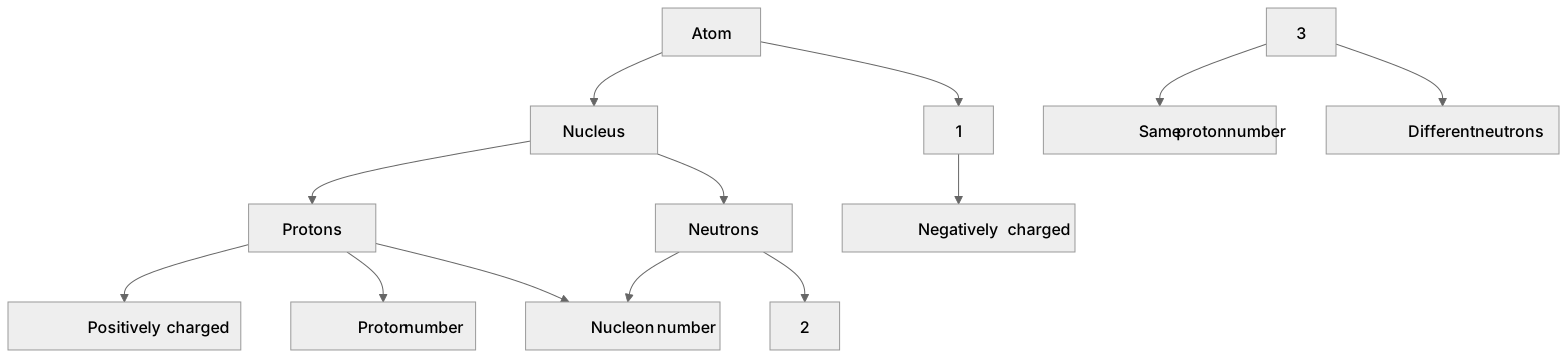
1Box 1
2Box 2
3Box 3
There is more to this lesson
The full lesson goes on to check your understanding and help you earn the marks. Create a free account to carry on, with your progress saved.
A week of Premium from your first lesson · Then the free plan continues · No card, no charge
Test your understanding of The nuclear atom: (b) simple nuclear model of the atom; protons, neutrons and electrons
Active recall beats re-reading. Take an instant quiz now to test what you’ve learned and lock it into long-term memory.
A week of Premium from your first lesson · Then the free plan continues · No card, no charge