OCR · A-Level · Physics
Course version: H556 · Version from Sept 2015
(c) specific latent heat of fusion and specific latent heat of…
Full specification wording
Thermal properties of materials: (c) specific latent heat of fusion and specific latent heat of vaporisation; E = m l
Specific latent heat of fusion is the energy needed to change unit mass of a substance from solid to liquid at its melting point without a change in temperature.
Checked against the OCR H556 specification (opens in a new tab) on .
- Point 2 of 2
- 4 key terms
Study notes
From the checked teaching notes for this specification point.
The idea
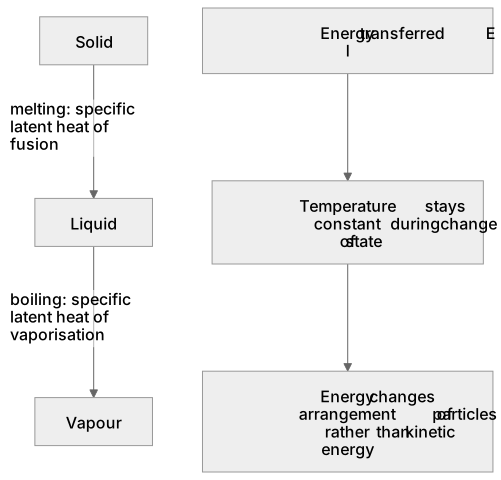
Specific latent heat of fusion is the energy needed to change unit mass of a substance from solid to liquid at its melting point without a change in temperature. Specific latent heat of vaporisation is the energy needed to change unit mass from liquid to vapour at its boiling point without a change in temperature. The energy transferred is E = m l, where m is the mass and l is the specific latent heat.
For example: Melting 0.50 kg of ice with a specific latent heat of fusion of 3.34 × 10⁵ J kg⁻¹ requires E = 0.50 × 3.34 × 10⁵ = 1.67 × 10⁵ J. During a change of state the temperature stays constant, so the energy supplied changes the arrangement of particles rather than their kinetic energy.
What earns the marks
- Defines specific latent heat of fusion as the energy per unit mass to change from solid to liquid at constant temperature.
- Defines specific latent heat of vaporisation as the energy per unit mass to change from liquid to vapour at constant temperature.
- States and applies E = m l, using the correct specific latent heat for the change of state.
- Recognises that temperature remains constant during a change of state, so the energy supplied does not raise the temperature.
- Uses correct units, J kg⁻¹ for specific latent heat and J for energy, and converts mass to kg where necessary.
Common mistakes and how to put them right
Using the specific heat capacity equation instead of the latent heat equation during a change of state.
Put it right: Use E = m l when the temperature is constant.
Mixing up fusion and vaporisation.
Put it right: Remember that fusion is solid to liquid and vaporisation is liquid to gas.
Forgetting to convert grams to kilograms.
Put it right: Divide the mass in grams by 1000 before substituting.
Assuming the temperature rises while the substance is melting or boiling.
Put it right: State that the temperature stays constant during the change of state.
Exam tips
- Check whether the question involves a temperature change or a change of state before choosing between E = m c Δθ and E = m l.
- Write down the value and unit of the specific latent heat you are using, and make sure it matches fusion or vaporisation.
- Convert mass to kilograms and keep powers of ten consistent when substituting.
Try the lesson
The start of the Thermal properties of materials: (c) specific latent heat of fusion and specific latent heat of vaporisation; E = m l lesson, made from checked teaching notes for this specification point.
Listen
Specific latent heat of fusion is the energy needed to change unit mass of a substance from solid to liquid at its melting point without a change in temperature. Specific latent heat of vaporisation is the energy needed to change unit mass from liquid to vapour at its boiling point without a change in temperature. The energy transferred is E = m l, where m is the mass and l is the specific latent heat. For example, melting 0.50 kg of ice with a specific latent heat of fusion of 3.34 × 10⁵ J kg⁻¹ requires E = 0.50 × 3.34 × 10⁵ = 1.67 × 10⁵ J. During a change of state the temperature stays constant, so the energy supplied changes the arrangement of particles rather than their kinetic energy. A strong answer earns marks for these points. Defines specific latent heat of fusion as the energy per unit mass to change from solid to liquid at constant temperature. Defines specific latent heat of vaporisation as the energy per unit mass to change from liquid to vapour at constant temperature. States and applies E = m l, using the correct specific latent heat for the change of state. Recognises that temperature remains constant during a change of state, so the energy supplied does not raise the temperature. A common slip: Using the specific heat capacity equation instead of the latent heat equation during a change of state. Instead, use E = m l when the temperature is constant. Exam tip: Check whether the question involves a temperature change or a change of state before choosing between E = m c Δθ and E = m l.
See it
Key words
Say what each word means before you turn the card.
Specific latent heat of fusion
Try answering aloud or in your head before turning the card.
Specific latent heat of vaporisation
Try answering aloud or in your head before turning the card.
Energy transfer and the equation E = m l
Try answering aloud or in your head before turning the card.
Changes of state and constant temperature
Try answering aloud or in your head before turning the card.
See every definition
- Specific latent heat of fusion
- The energy needed to change unit mass of a substance from solid to liquid at its melting point without a change in temperature.
- Specific latent heat of vaporisation
- The energy needed to change unit mass from liquid to vapour at its boiling point without a change in temperature.
- Energy transfer and the equation E = m l
- The energy transferred is E = m l, where m is the mass and l is the specific latent heat.
- Changes of state and constant temperature
- During a change of state the temperature stays constant, so the energy supplied changes the arrangement of particles rather than their kinetic energy.
Label the diagram
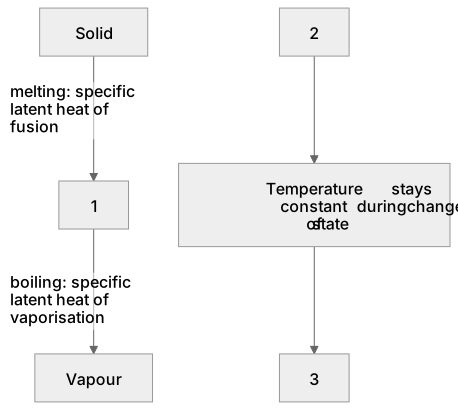
Some boxes have lost their names. Pick the right name for each number.
1Box 1
2Box 2
3Box 3
There is more to this lesson
The full lesson goes on to check your understanding and help you earn the marks. Create a free account to carry on, with your progress saved.
A week of Premium from your first lesson · Then the free plan continues · No card, no charge
Test your understanding of Thermal properties of materials: (c) specific latent heat of fusion and specific latent heat of vaporisation; E = m l
Active recall beats re-reading. Take an instant quiz now to test what you’ve learned and lock it into long-term memory.
A week of Premium from your first lesson · Then the free plan continues · No card, no charge