OCR · A-Level · Physics
Course version: H556 · Version from Sept 2015
(d) energy in different forms; transfer and conservation
Full specification wording
Work and conservation of energy: (d) energy in different forms; transfer and conservation
Energy exists in different forms or stores, including kinetic, gravitational potential, elastic potential, thermal, chemical, nuclear, electrostatic and magnetic.
Checked against the OCR H556 specification (opens in a new tab) on .
- Point 4 of 5
- 4 key terms
Study notes
From the checked teaching notes for this specification point.
The idea
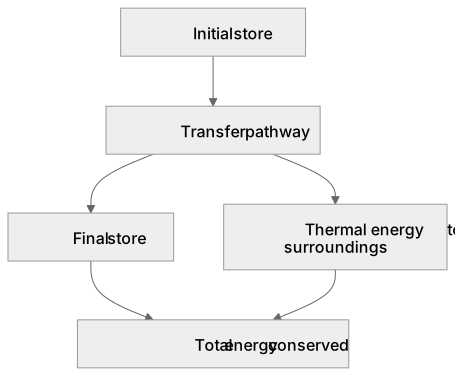
Energy exists in different forms or stores, including kinetic, gravitational potential, elastic potential, thermal, chemical, nuclear, electrostatic and magnetic. Energy can be transferred between these stores by mechanical work, electrical work, heating or radiation. For example, a stretched spring stores elastic potential energy; when released, it transfers energy to kinetic energy of a moving object and some thermal energy to the surroundings. A battery transfers chemical energy to electrical energy, which can then be transferred to thermal energy in a resistor. In every transfer, the total energy is conserved. To analyse a process, identify the initial store, the transfer pathway and the final store, then apply conservation of energy. Energy transfer diagrams or Sankey diagrams can help visualise the transfers and any energy dissipated to the surroundings.
What earns the marks
- List different forms or stores of energy, such as kinetic, gravitational potential, elastic potential, thermal, chemical, nuclear, electrostatic and magnetic.
- Describe energy transfers between stores, for example gravitational potential to kinetic, or chemical to electrical to thermal.
- State that energy is conserved during any transfer: the total energy before equals the total energy after.
- Identify the transfer pathway, such as mechanical work, electrical work, heating or radiation.
- Use energy transfer diagrams or Sankey diagrams to represent inputs, useful outputs and dissipated energy.
- Recognise that in real transfers, some energy is often dissipated to the surroundings as thermal energy, but the total remains constant.
- Apply conservation of energy to calculate unknown quantities in multi-step transfers.
Common mistakes and how to put them right
Treating energy as a substance that can be used up.
Put it right by describing energy as transferred between stores, with the total conserved.
Confusing energy forms with energy transfer pathways.
Put it right by distinguishing stores (kinetic, potential, thermal, chemical) from pathways (work, heating, radiation).
Ignoring dissipated energy in real processes.
Put it right by including thermal energy transferred to the surroundings in energy balance calculations.
Assuming that energy transfer is always 100% efficient.
Put it right by recognising that some energy is always dissipated in practical devices.
Mixing up gravitational potential energy and elastic potential energy.
Put it right by identifying the store based on the physical situation.
Exam tips
- When describing an energy transfer, name the initial store, the pathway and the final store.
- Use a Sankey diagram to show the proportion of energy transferred usefully and dissipated.
- In calculations, write down the conservation of energy equation before substituting numbers.
- Check that all energy forms are accounted for, including thermal energy to the surroundings.
Try the lesson
The start of the Work and conservation of energy: (d) energy in different forms; transfer and conservation lesson, made from checked teaching notes for this specification point.
Listen
Energy exists in different forms or stores, including kinetic, gravitational potential, elastic potential, thermal, chemical, nuclear, electrostatic and magnetic. Energy can be transferred between these stores by mechanical work, electrical work, heating or radiation. For example, a stretched spring stores elastic potential energy; when released, it transfers energy to kinetic energy of a moving object and some thermal energy to the surroundings. A battery transfers chemical energy to electrical energy, which can then be transferred to thermal energy in a resistor. In every transfer, the total energy is conserved. To analyse a process, identify the initial store, the transfer pathway and the final store, then apply conservation of energy. Energy transfer diagrams or Sankey diagrams can help visualise the transfers and any energy dissipated to the surroundings. A strong answer earns marks for these points. List different forms or stores of energy, such as kinetic, gravitational potential, elastic potential, thermal, chemical, nuclear, electrostatic and magnetic. Describe energy transfers between stores, for example gravitational potential to kinetic, or chemical to electrical to thermal. State that energy is conserved during any transfer: the total energy before equals the total energy after. Identify the transfer pathway, such as mechanical work, electrical work, heating or radiation. A common slip: Treating energy as a substance that can be used up. Instead, describing energy as transferred between stores, with the total conserved. Exam tip: When describing an energy transfer, name the initial store, the pathway and the final store.
See it
Key words
Say what each word means before you turn the card.
Energy stores and forms
Try answering aloud or in your head before turning the card.
Energy transfer pathways
Try answering aloud or in your head before turning the card.
Conservation of energy
Try answering aloud or in your head before turning the card.
Dissipation and efficiency
Try answering aloud or in your head before turning the card.
See every definition
- Energy stores and forms
- Energy exists in different forms or stores, including kinetic, gravitational potential, elastic potential, thermal, chemical, nuclear, electrostatic and magnetic.
- Energy transfer pathways
- Energy can be transferred between stores by mechanical work, electrical work, heating or radiation.
- Conservation of energy
- In every transfer, the total energy is conserved: the total energy before equals the total energy after.
- Dissipation and efficiency
- In real transfers, some energy is often dissipated to the surroundings as thermal energy, but the total remains constant.
Label the diagram
Some boxes have lost their names. Pick the right name for each number.
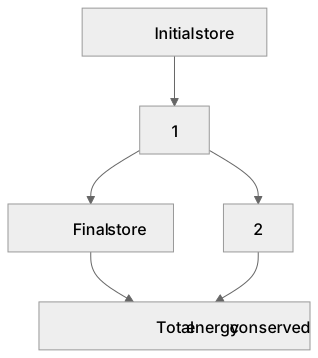
1Box 1
2Box 2
There is more to this lesson
The full lesson goes on to check your understanding and help you earn the marks. Create a free account to carry on, with your progress saved.
A week of Premium from your first lesson · Then the free plan continues · No card, no charge
Test your understanding of Work and conservation of energy: (d) energy in different forms; transfer and conservation
Active recall beats re-reading. Take an instant quiz now to test what you’ve learned and lock it into long-term memory.
A week of Premium from your first lesson · Then the free plan continues · No card, no charge