OCR · A-Level · Physics
Course version: H556 · Version from Sept 2015
(e) transfer of energy is equal to work done.
Full specification wording
Work and conservation of energy: (e) transfer of energy is equal to work done.
The transfer of energy to or from an object is equal to the work done on or by that object.
Checked against the OCR H556 specification (opens in a new tab) on .
- Point 5 of 5
Study notes
From the checked teaching notes for this specification point.
The idea
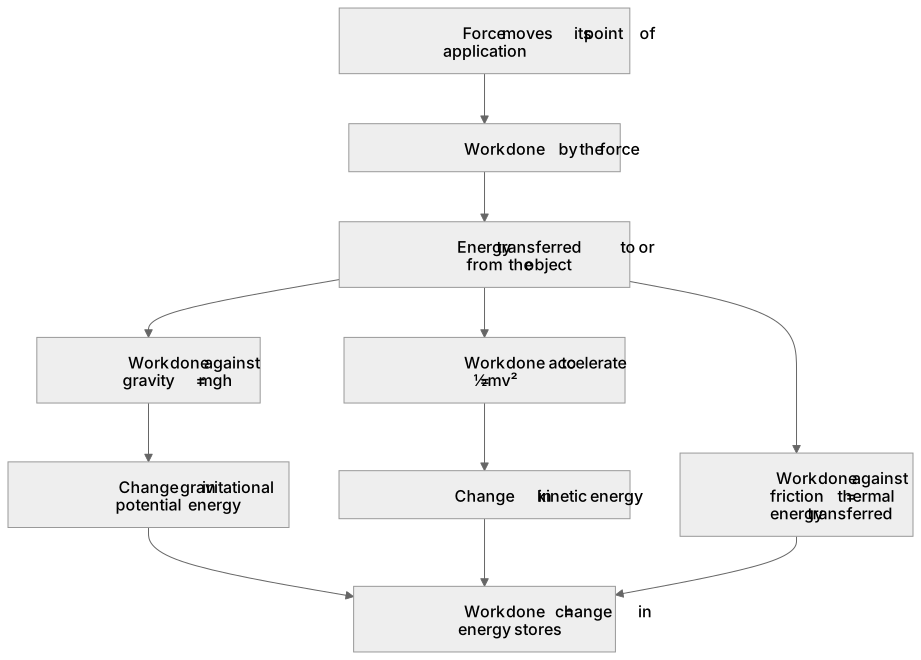
The transfer of energy to or from an object is equal to the work done on or by that object. When a force moves its point of application, the work done by the force equals the energy transferred. For example, lifting a mass m through a height h requires work done against gravity equal to mgh, which equals the increase in gravitational potential energy. Accelerating a body from rest to speed v requires work done equal to ½mv², which equals the increase in kinetic energy. If friction acts, the work done against friction equals the thermal energy transferred to the surroundings. This relationship links mechanics to energy conservation: work is the mechanical transfer of energy, and the total energy transferred equals the work done by all forces. In calculations, equate work done to the change in energy stores.
What earns the marks
- State that the work done by a force equals the energy transferred to or from the object.
- Use W = ΔE, where W is work done and ΔE is the change in energy of the system.
- Calculate work done against gravity as mgh, equal to the change in gravitational potential energy.
- Calculate work done to accelerate an object as ½mv², equal to the change in kinetic energy.
- Recognise that work done against friction equals the thermal energy transferred to the surroundings.
- Apply the relationship to solve problems involving forces, distances and energy changes.
- Account for all forces when determining the total work done on an object.
Common mistakes and how to put them right
Thinking that work done and energy transferred are different quantities.
Put it right by stating that work done is the mechanical transfer of energy, so they are equal.
Forgetting to include the work done against friction when calculating total energy transfer.
Put it right by adding the thermal energy term.
Using the wrong energy store when equating work done.
Put it right by identifying the relevant store, such as gravitational potential or kinetic.
Assuming that work done is always positive.
Put it right by recognising that work done by a force opposite to displacement is negative, reducing the object's energy.
Confusing work done with power.
Put it right by noting that power is the rate of doing work, not the total work done.
Exam tips
- Write down the energy balance equation: work done = change in energy stores.
- For lifting problems, equate work done to mgh; for acceleration problems, equate work done to ½mv².
- If friction is present, include the work done against friction as a thermal energy transfer.
- Check the sign of work done: positive work increases the object's energy, negative work decreases it.
Try the lesson
The start of the Work and conservation of energy: (e) transfer of energy is equal to work done. lesson, made from checked teaching notes for this specification point.
Listen
The transfer of energy to or from an object is equal to the work done on or by that object. When a force moves its point of application, the work done by the force equals the energy transferred. For example, lifting a mass m through a height h requires work done against gravity equal to mgh, which equals the increase in gravitational potential energy. Accelerating a body from rest to speed v requires work done equal to ½mv², which equals the increase in kinetic energy. If friction acts, the work done against friction equals the thermal energy transferred to the surroundings. This relationship links mechanics to energy conservation: work is the mechanical transfer of energy, and the total energy transferred equals the work done by all forces. In calculations, equate work done to the change in energy stores. A strong answer earns marks for these points. State that the work done by a force equals the energy transferred to or from the object. Use W = ΔE, where W is work done and ΔE is the change in energy of the system. Calculate work done against gravity as mgh, equal to the change in gravitational potential energy. Calculate work done to accelerate an object as ½mv², equal to the change in kinetic energy. A common slip: Thinking that work done and energy transferred are different quantities. Instead, stating that work done is the mechanical transfer of energy, so they are equal. Exam tip: Write down the energy balance equation: work done = change in energy stores.
See it
Label the diagram
Some boxes have lost their names. Pick the right name for each number.
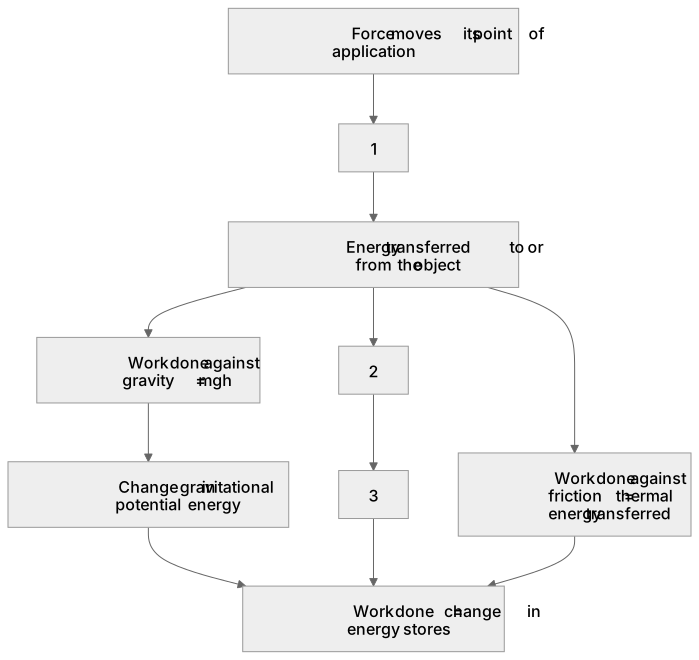
1Box 1
2Box 2
3Box 3
There is more to this lesson
The full lesson goes on to check your understanding and help you earn the marks. Create a free account to carry on, with your progress saved.
A week of Premium from your first lesson · Then the free plan continues · No card, no charge
Test your understanding of Work and conservation of energy: (e) transfer of energy is equal to work done.
Active recall beats re-reading. Take an instant quiz now to test what you’ve learned and lock it into long-term memory.
A week of Premium from your first lesson · Then the free plan continues · No card, no charge