OCR · GCSE · Physics
Asteroids
This guide provides a comprehensive overview of Asteroids (OCR GCSE Physics 8.4), focusing on securing maximum marks. It covers their composition, location, and the crucial differences between asteroids and comets, complete with examiner insights and memory aids.
- 6 min read
- 3 worked examples
- 5 practice questions
- 6 key terms
Study Notes
Overview
Welcome to your essential guide for OCR GCSE Physics, topic 8.4: Asteroids. This topic explores the rocky remnants of our Solar System's formation. While it may seem like a small part of the specification, it is a source of guaranteed marks for candidates who can recall key facts with precision. Examiners frequently test the definition, composition, and location of asteroids, often in comparison to comets. Understanding this topic not only helps in direct questions but also provides context for the broader study of the Solar System (Topic 8) and the forces that govern it (Topic 5). This guide will break down the core concepts, provide exam-focused strategies, and give you the tools to answer any question on asteroids with confidence.

Key Concepts
Concept 1: What are Asteroids?
Asteroids are minor planets, primarily composed of rock and metal, that orbit the Sun. They are the debris left over from the formation of the Solar System approximately 4.6 billion years ago. During this era, dust and gas coalesced under gravity in a process called accretion to form planets. However, not all of this material was incorporated into planets. The gravitational influence of the newly formed gas giant, Jupiter, was so immense that it prevented the material in its vicinity from forming another planet. This leftover material became the asteroids we see today.
Candidates must remember that asteroids are not 'failed stars' or moons; they are distinct celestial bodies orbiting the Sun directly. Their composition is the key to earning marks: always state they are made of rock and metal.
Concept 2: The Asteroid Belt
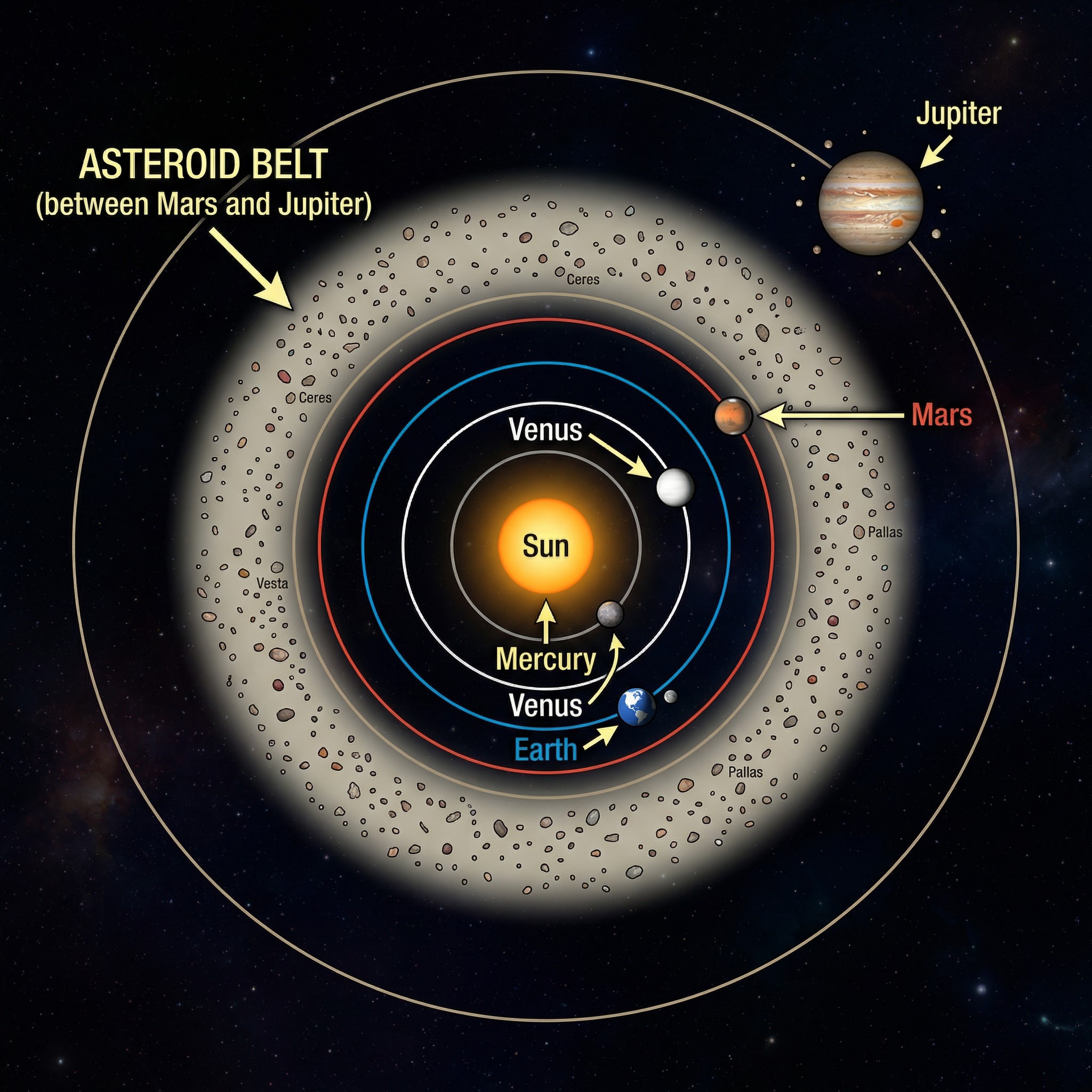
The vast majority of asteroids are located in a specific region of space known as the main asteroid belt. For full marks, candidates must state that this belt is located between the orbits of Mars and Jupiter. This is a non-negotiable fact that examiners look for. Placing the belt anywhere else (e.g., between Earth and Mars, or beyond Neptune) is a common error that will result in zero marks for that question.
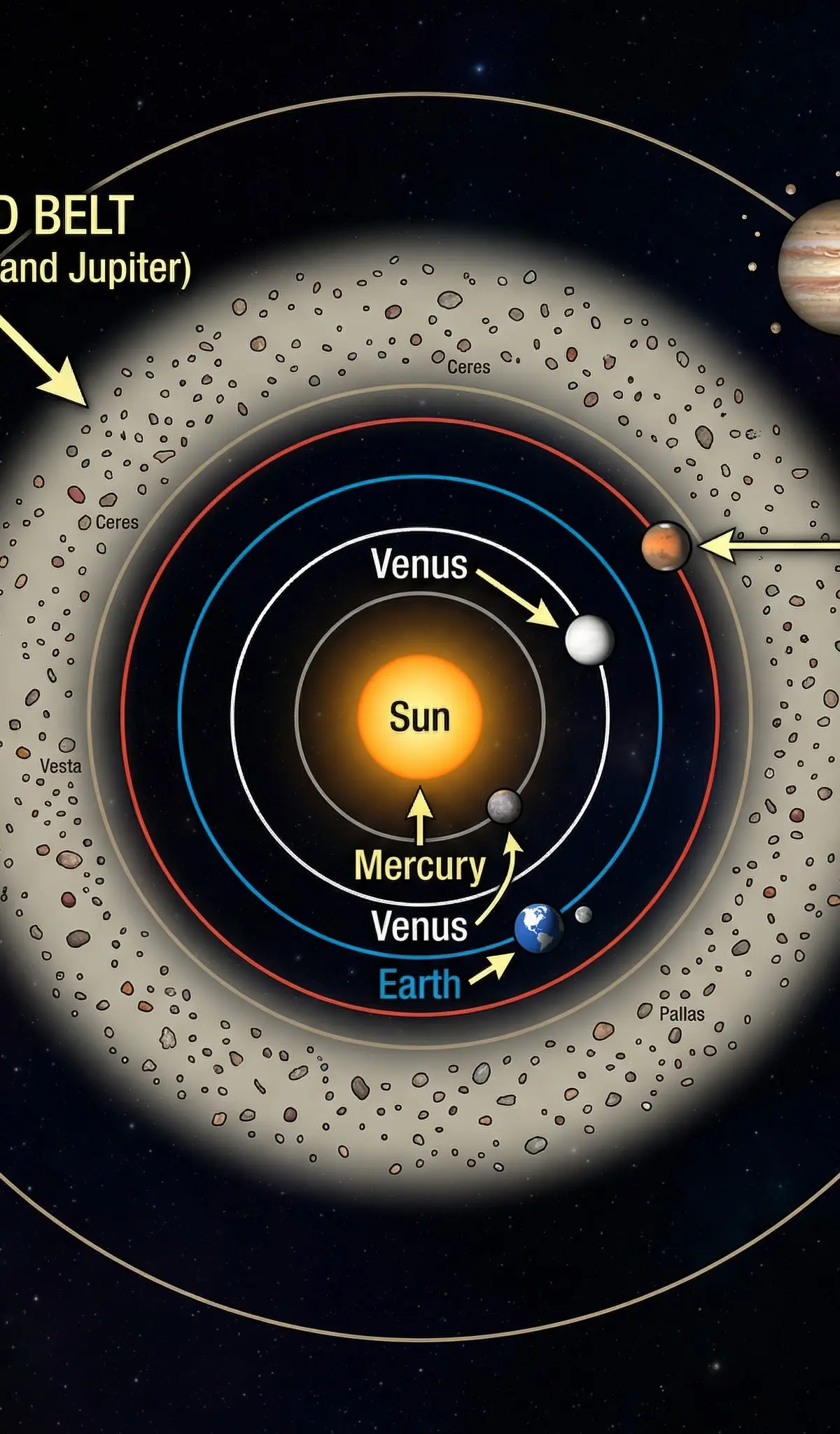
This diagram shows the precise location of the asteroid belt within the inner Solar System. Note its position relative to Mars and Jupiter.
While most asteroids reside here, some have orbits that bring them closer to Earth. These are known as Near-Earth Asteroids (NEAs) and are monitored by space agencies due to the potential for impact, linking this topic to ideas of risk and gravitational trajectories.
Concept 3: Distinguishing Asteroids from Comets
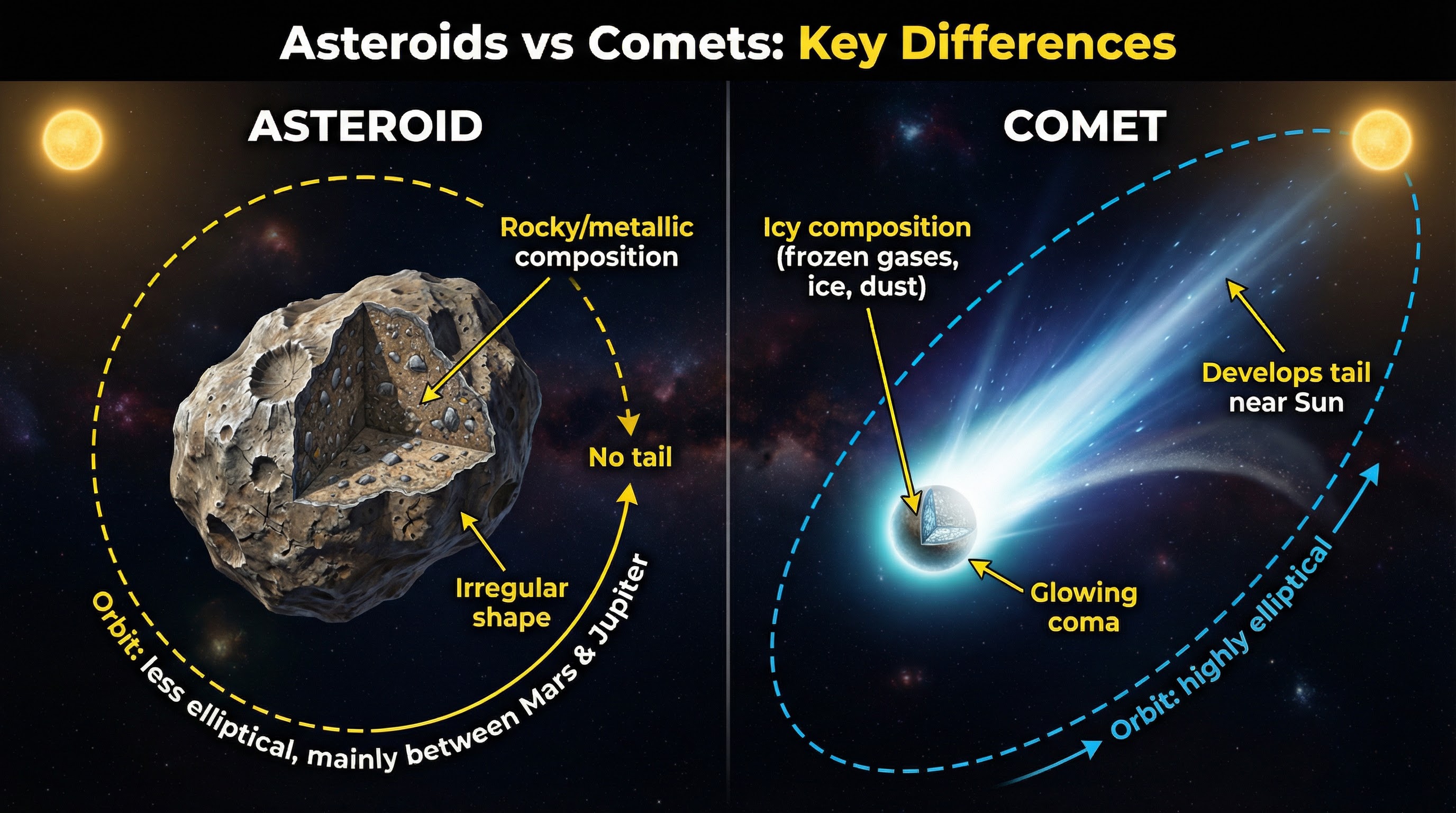
A very common exam question style involves comparing asteroids and comets. Candidates must be able to state clear and distinct differences. Credit is given for comparisons based on composition and orbit.
| Feature | Asteroids | Comets | Examiner Note |
|---|---|---|---|
| Composition | Primarily rock and metal | Primarily ice, dust, and frozen gases | This is the most fundamental difference and a guaranteed mark. |
| Orbit Shape | More circular (less elliptical) | Highly elliptical (very elongated) | Mentioning the shape of the orbit is a strong distinguishing point. |
| Location | Mostly in the asteroid belt (between Mars & Jupiter) | Originate in the outer Solar System (Kuiper Belt/Oort Cloud) | This provides excellent context and demonstrates deeper understanding. |
| Appearance | Solid, rocky, irregular shape. No tail. | Develops a coma (glowing head) and tail when near the Sun. | The tail is a key visual difference. Explain that it forms as ice vaporises. |
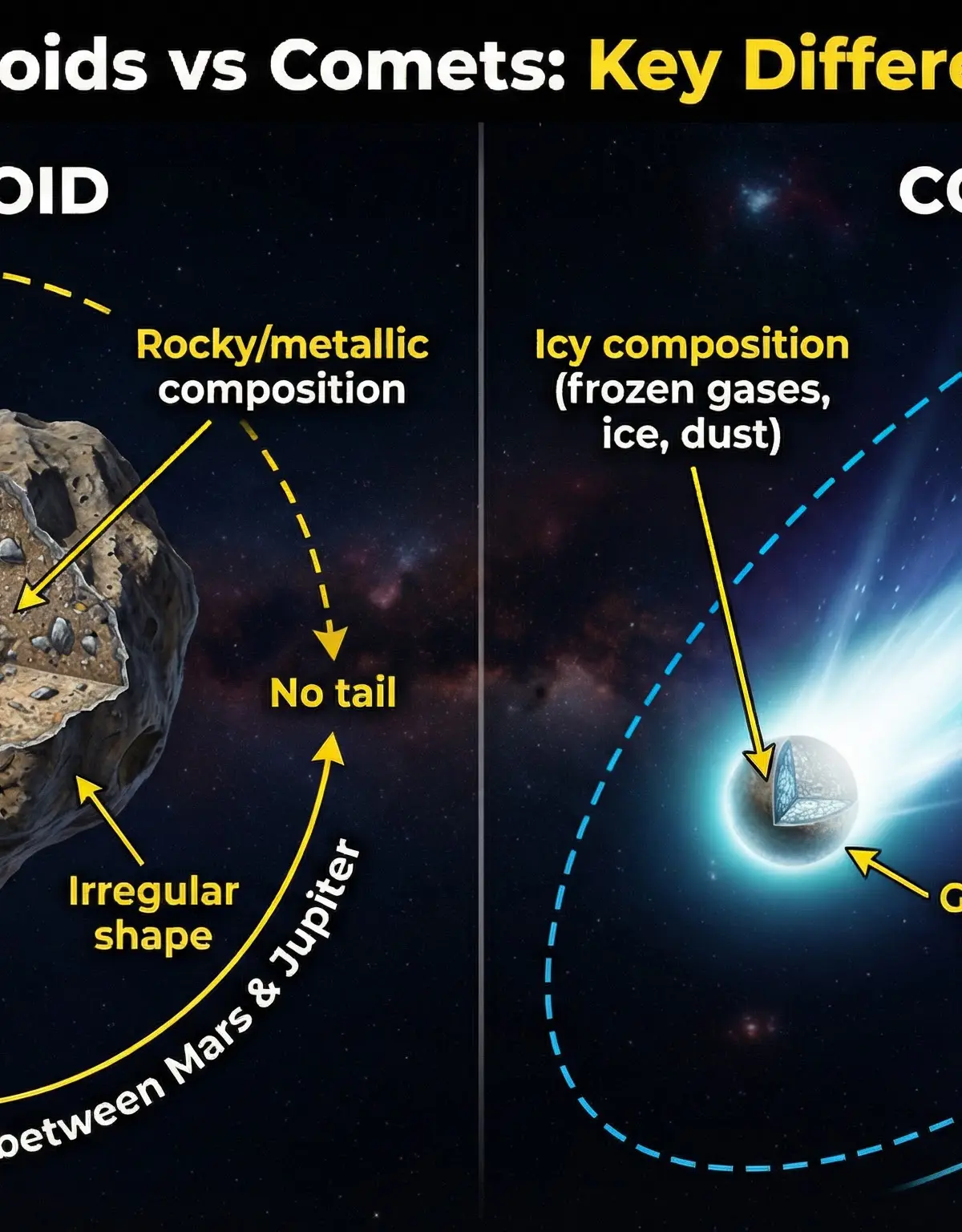
This comparison highlights the key visual and structural differences between a rocky asteroid and an icy comet.
Mathematical/Scientific Relationships
There are no specific formulas to memorise for the Asteroids topic itself at GCSE level. However, questions may draw on concepts from other parts of the specification, such as:
- Orbital Speed:
v = (2 * π * r) / T(Given on formula sheet). A question could ask you to calculate the orbital speed of an asteroid given its orbital radius and period. This is a synoptic link to Topic 8.2 (Orbits). - Gravitational Force: The force that keeps asteroids in orbit around the Sun. Understanding that the Sun's gravitational field is responsible is key.
Practical Applications
While there are no required practicals for this specific topic, the study of asteroids has significant real-world applications:
- Planetary Defence: Monitoring Near-Earth Asteroids to predict and potentially mitigate impact events. This links to concepts of force, momentum, and energy transfer.
- Space Exploration & Mining: Asteroids are rich in valuable minerals, including iron, nickel, and platinum group metals. Future space missions may involve mining asteroids for resources, which would be crucial for building structures in space or providing materials for long-duration missions.
Visual Resources
2 diagrams and illustrations
Interactive Diagrams
2 interactive diagrams to visualise key concepts
Conceptual Flow Outline
Flowchart showing the formation of the asteroid belt as part of Solar System formation.
Conceptual Flow Outline
Concept map comparing the key features of asteroids and comets.
Worked Examples
3 worked examples — open one to explore the question and available guidance.
Practice Questions
Test your understanding — click to reveal model answers
State the location of the main asteroid belt. [1 mark]
Hint: Think about which two planets the majority of asteroids orbit between.
Describe the composition of an asteroid. [2 marks]
Hint: What are the two main types of material that make up most asteroids?
Explain why comets have tails but asteroids do not. [3 marks]
Hint: Consider the composition of each object and how they react to the Sun's heat.
Compare the orbits of a typical asteroid in the main belt and a comet. [4 marks]
Hint: Think about the shape of the orbit and its location.
Explain how the existence of the asteroid belt provides evidence for the model of Solar System formation. [4 marks]
Hint: How does the theory of accretion relate to material that *didn't* form a planet?