OCR · GCSE · Physics
Biofuels
This guide provides a comprehensive, exam-focused breakdown of Biofuels (OCR GCSE Physics 5.13). It covers the core concepts of carbon neutrality, reliability, and the environmental and socio-economic debates essential for securing top marks. Mastering this topic will equip candidates to answer everything from a 1-mark definition to a 6-mark evaluate question with confidence.
- 6 min read
- 3 worked examples
- 5 practice questions
- 7 key terms
Study Notes
Overview
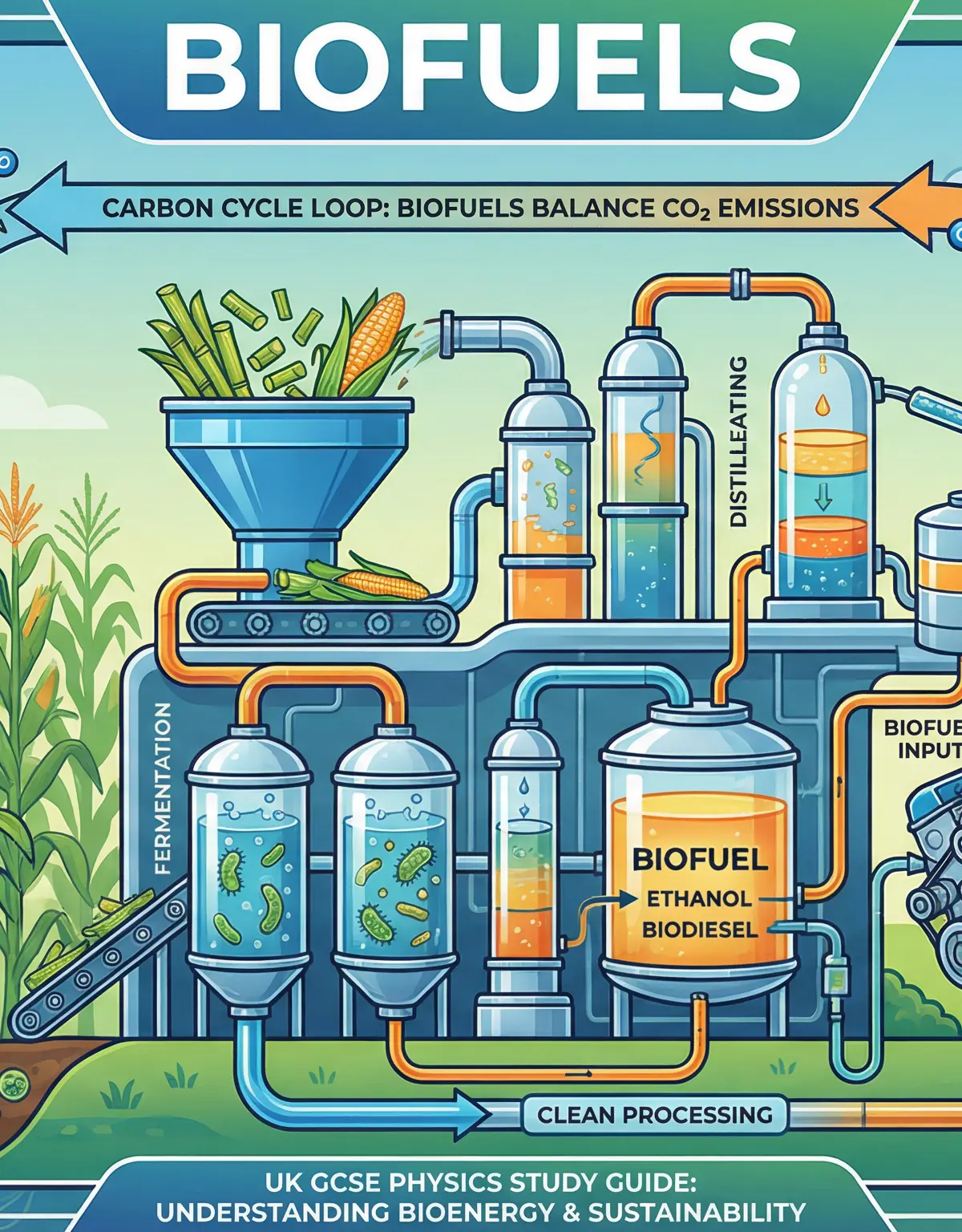
Welcome to your deep-dive into Biofuels, a key topic within the OCR GCSE Physics 'Global Challenges' module. This guide will equip you with the precise knowledge and exam technique required to master this subject. Biofuels are energy sources derived from biological matter, and understanding them is crucial not just for your physics exam, but for comprehending the global energy landscape. This topic synoptically links to concepts of energy stores, transfers, and efficiency, as well as environmental science. Examiners typically test this through a mix of short-answer 'State' and 'Explain' questions and longer, structured 'Evaluate' questions that demand a balanced argument. This guide will prepare you for all of them.

Key Concepts
Concept 1: Renewable vs. Non-Renewable
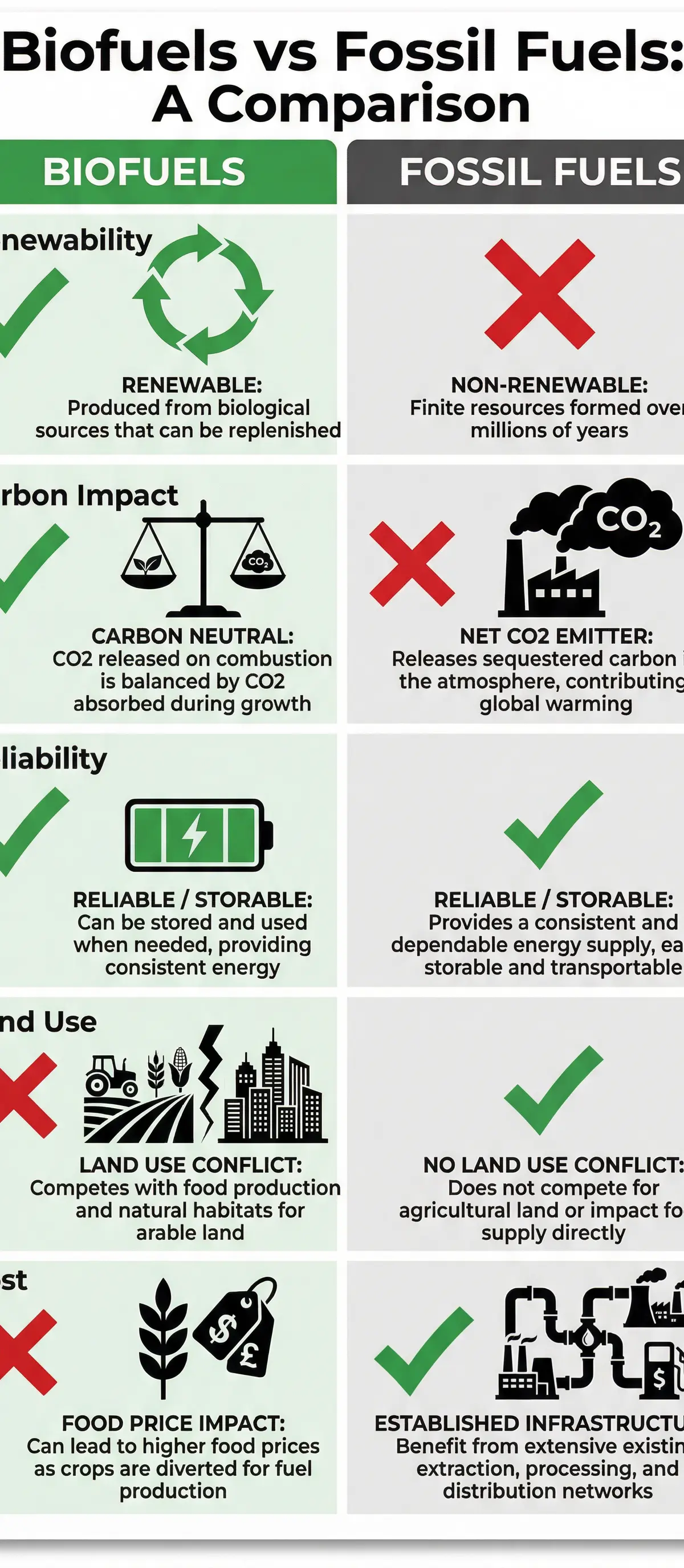
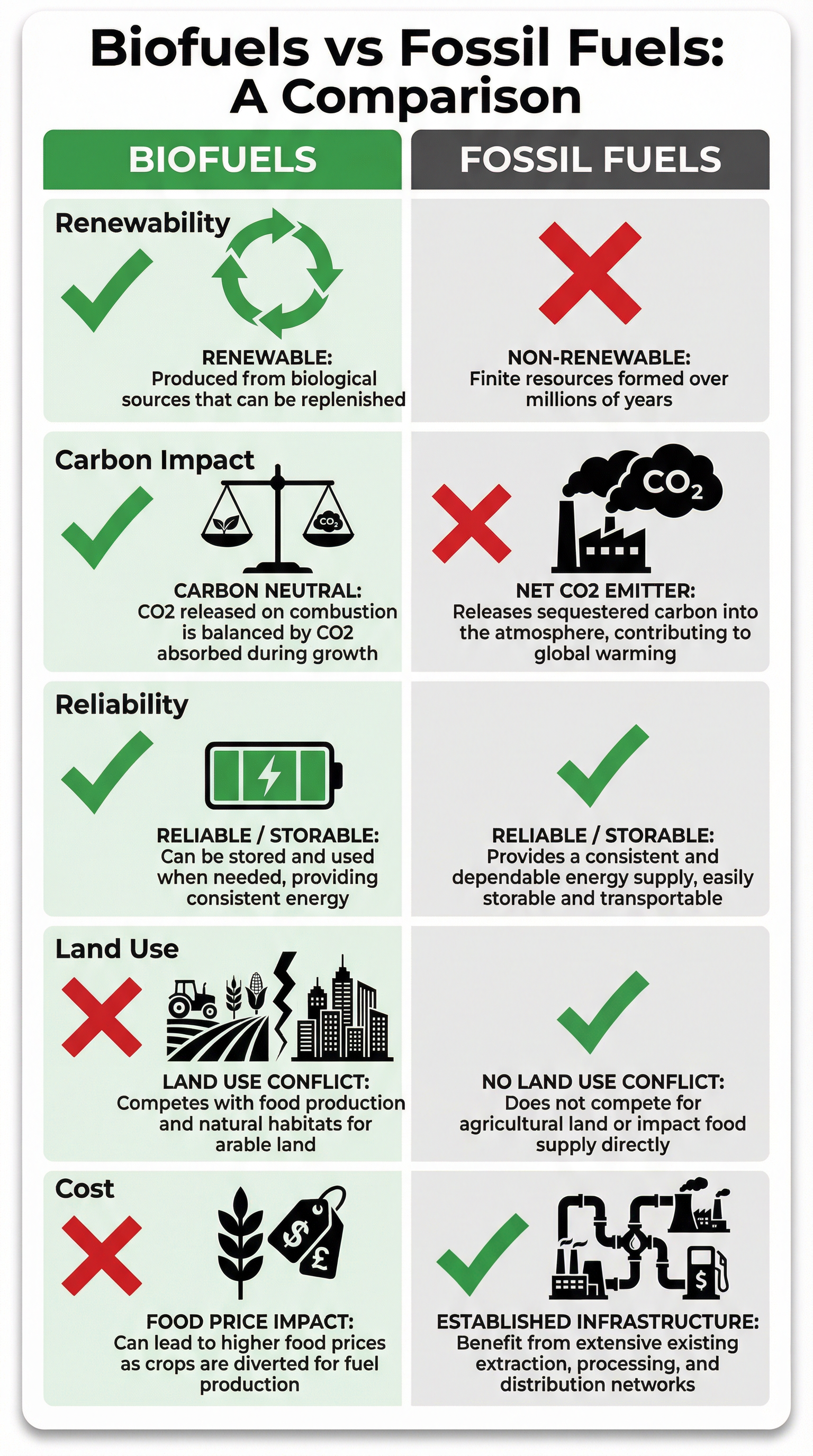
Biofuels are classified as a renewable energy resource. This is a critical definition that earns marks. It means the source can be replenished within a human lifetime. We can grow more plants, so we can create more biofuel. This is the fundamental difference between biofuels and non-renewable fossil fuels (coal, oil, gas), which were formed over millions of years and are finite. Candidates must be precise: 'renewable' does not mean 'clean' or 'free', it simply means it won't run out if managed sustainably.
Concept 2: The Carbon Neutrality Cycle
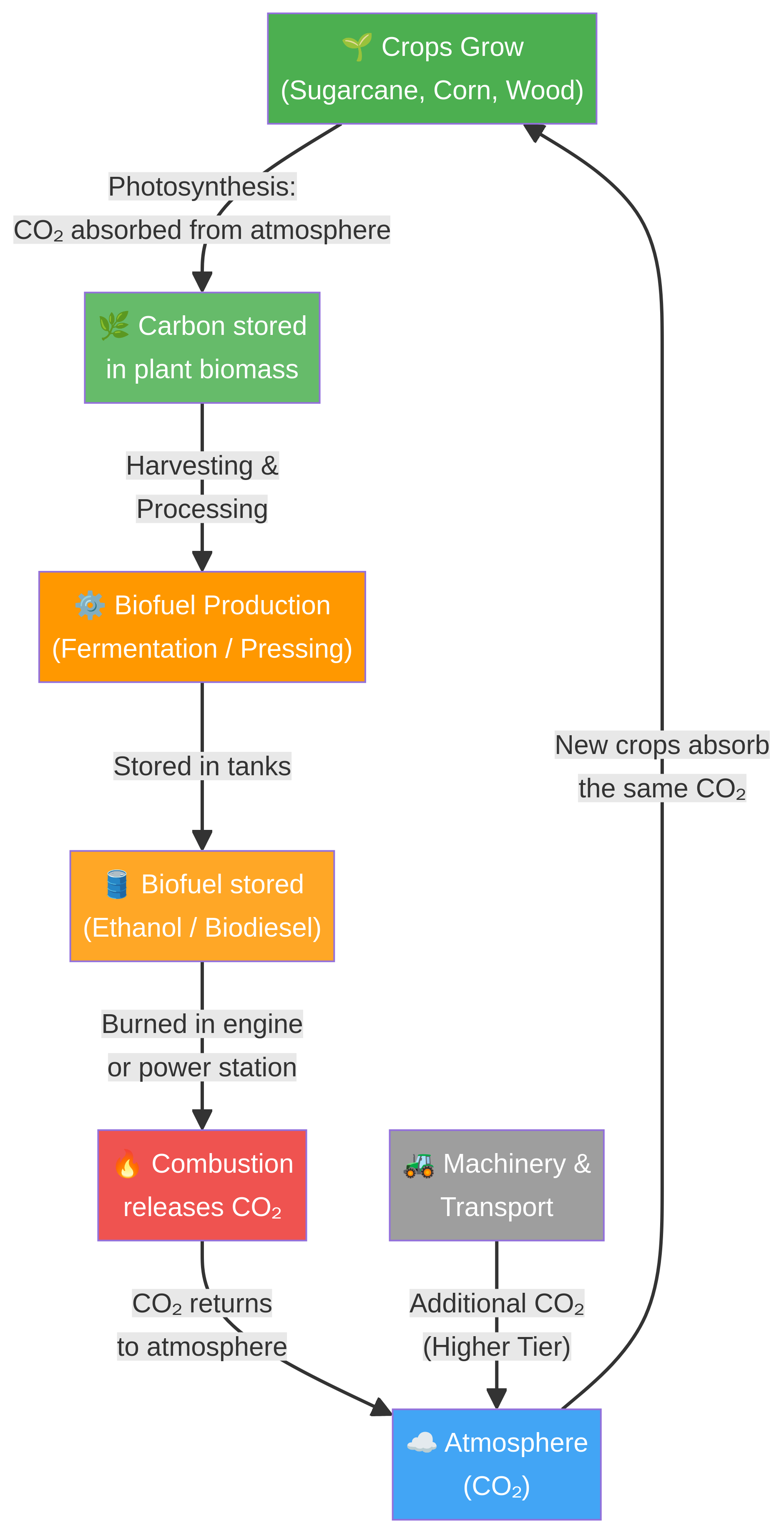
The central scientific principle of biofuels is carbon neutrality. This is a concept that is frequently misunderstood by candidates, leading to lost marks. It is a cycle in two parts:
- Absorption: As a plant grows, it absorbs carbon dioxide (CO2) from the atmosphere for photosynthesis. This carbon is used to build the plant's biomass.
- Emission: When this biomass is harvested, converted into biofuel, and then burned (combustion), it releases CO2 back into the atmosphere.
In theory, the amount of CO2 released is equal to the amount absorbed. Therefore, there is no net increase in atmospheric CO2. It is a closed loop. Credit is given for explicitly linking the CO2 absorbed during photosynthesis to the CO2 released during combustion.
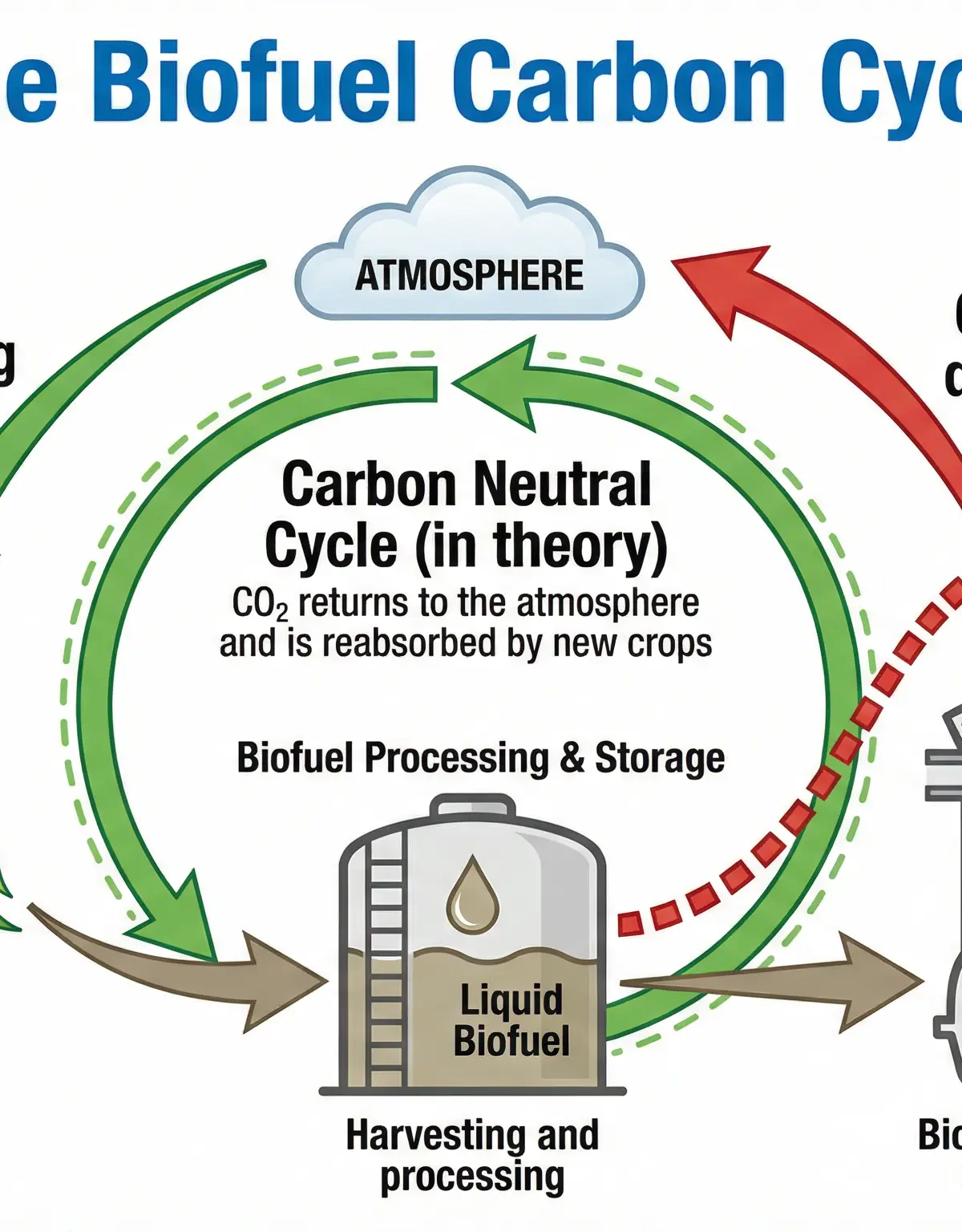
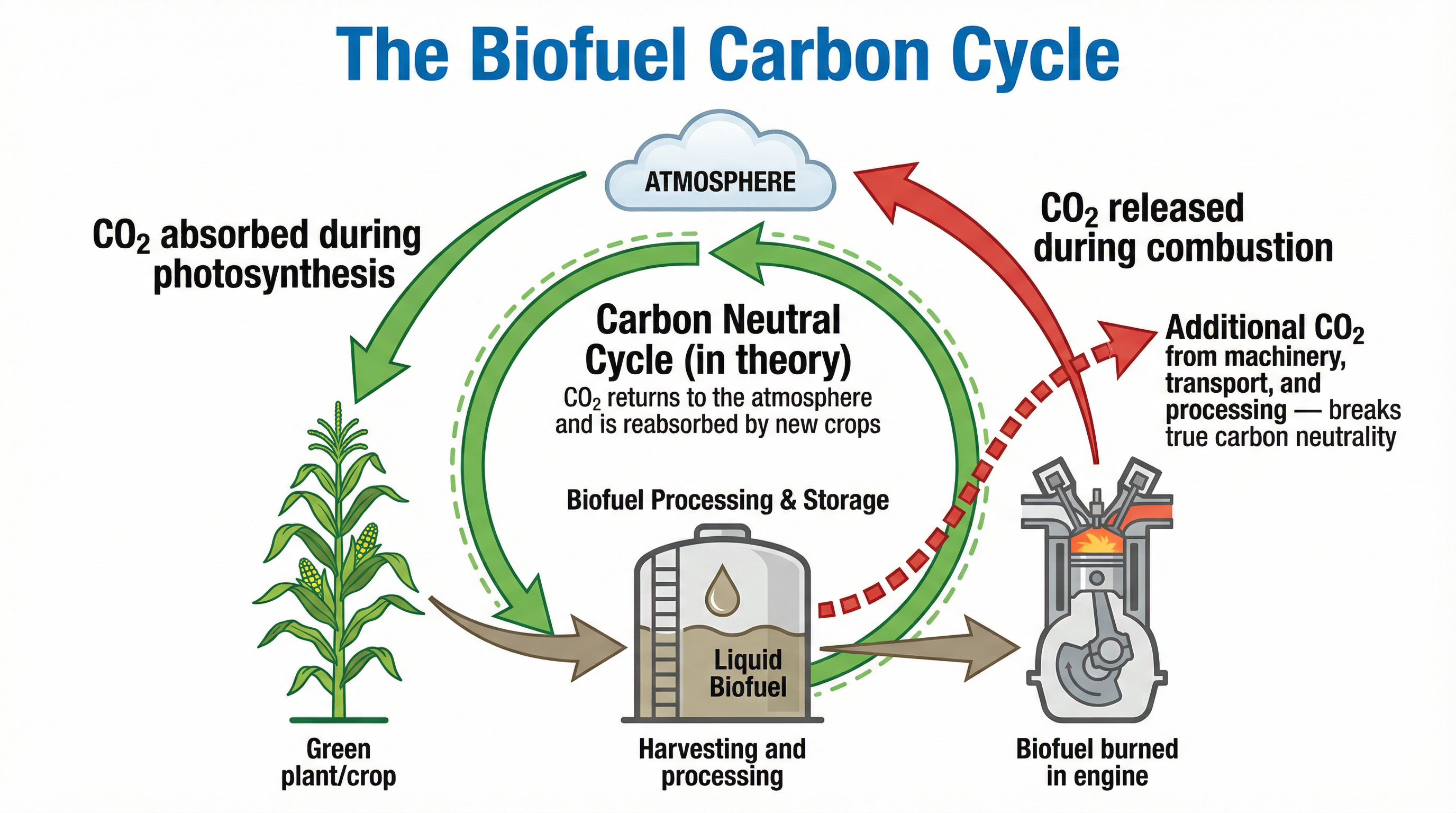
Higher Tier Point: Perfect carbon neutrality is a theoretical ideal, not a practical reality. Energy is required to power the machinery for harvesting, to transport the crops, and to process them in industrial plants. This energy often comes from burning fossil fuels, which releases additional CO2 not accounted for in the simple cycle. Acknowledging this nuance is essential for top-level marks in 'Evaluate' questions.
Concept 3: Reliability and Dispatchability
Compared to other major renewable resources like wind and solar, biofuels have a significant advantage: they are reliable and dispatchable. Wind turbines only generate power when it is windy, and solar panels only work when it is sunny; they are intermittent. Biofuels, however, can be stored in liquid or solid form and then used to generate electricity at any time, day or night, regardless of the weather. This ability to provide power on demand is a key point of comparison that examiners look for.
Concept 4: Environmental and Socio-Economic Impacts
This is where evaluation skills are tested. Candidates must weigh the benefits against the significant drawbacks.
- Environmental Impact: To grow biofuel crops on an industrial scale, vast areas of land are required. This can lead to deforestation, where forests are cleared to make way for plantations. This has two negative effects: it destroys natural habitats, reducing biodiversity, and it releases huge amounts of stored carbon from the felled trees, undermining the carbon neutrality argument.
- Socio-Economic Impact: This is the 'food vs. fuel' debate. The land used to grow energy crops like corn or sugarcane could have been used to grow food. Diverting agricultural land to fuel production reduces the food supply, which can lead to increased food prices and food shortages, particularly affecting developing nations.
Mathematical and Scientific Relationships
There are no specific mathematical formulas you need to memorise exclusively for the biofuels topic. However, questions may link to other areas of the specification:
- Efficiency Calculations (Given on formula sheet): Efficiency = (Useful energy output / Total energy input) x 100%. You might be asked to calculate the efficiency of a biofuel power station.
- Energy Density: While you won't need to calculate it, you should understand that biofuels have a lower energy density than fossil fuels, meaning a larger volume is needed to release the same amount of energy.
Practical Applications
Biofuels are not just a theoretical concept; they are in use today.
- Biodiesel: Made from vegetable oils and animal fats, it can be used in diesel engines, often blended with regular diesel.
- Bioethanol: An alcohol made from fermenting sugars and starches (e.g., from sugarcane or corn). It is often blended with petrol (e.g., E10 petrol in the UK is 10% ethanol).
- Biogas: Produced from the breakdown of organic waste (like animal manure or food scraps) in an anaerobic digester. The resulting methane can be burned to generate electricity or heat.
There are no specific required practicals for this topic, but understanding the principles of combustion and energy transfer is essential.
Visual Resources
4 diagrams and illustrations
Interactive Diagrams
2 interactive diagrams to visualise key concepts
Conceptual Flow Outline
This flowchart shows the theoretical carbon neutral cycle of biofuels, from CO2 absorption during growth to its release during combustion. It also includes the Higher Tier concept of additional CO2 emissions from processing and transport.
Conceptual Flow Outline
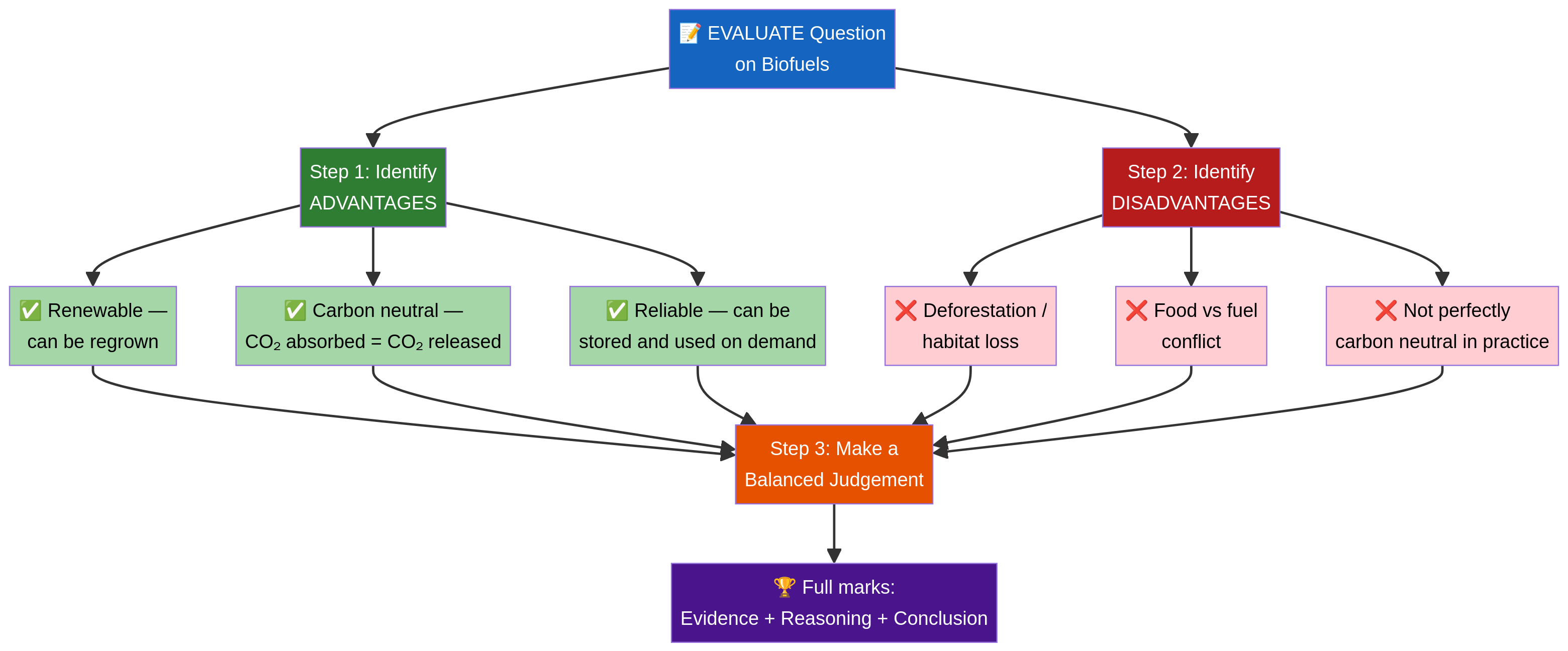
A structured approach to answering a 6-mark 'Evaluate' question on biofuels, demonstrating the need to identify both advantages and disadvantages before forming a balanced conclusion.
Worked Examples
3 worked examples — open one to explore the question and available guidance.
Practice Questions
Test your understanding — click to reveal model answers
State two examples of materials that can be used to produce biofuels. [2 marks]
Hint: Think about the 'bio' part of the word. What living things can be used as source materials?
Explain how the large-scale growing of crops for biofuels can cause environmental problems. [3 marks]
Hint: Think about what the land was used for before. What is the impact of clearing natural habitats?
A wind turbine has an average power output of 2 MW. A biofuel power station has a power output of 500 MW. Compare the advantages and disadvantages of using these two methods to generate electricity. [5 marks]
Hint: Think about reliability, running costs, and environmental impact for both sources. Use comparative language such as 'whereas' and 'unlike'.
Explain why a farmer in a developing country might choose to grow crops for biofuel instead of food, even if it means local food prices increase. [2 marks]
Hint: Think about the economic incentives for the individual farmer, not just the wider community.
A student writes: 'Biofuels are good because they are renewable and don't cause any pollution.' Explain why this statement is not fully correct. [4 marks]
Hint: Break the statement into two parts. Is the 'renewable' part correct? Is the 'don't cause any pollution' part correct?