OCR · GCSE · Physics
Conservation of Momentum
This guide provides a comprehensive overview of the Conservation of Momentum (OCR GCSE Physics 1.13), a fundamental principle governing interactions between objects. It is designed to equip students with the knowledge and skills to tackle exam questions effectively, focusing on mathematical application, conceptual understanding, and exam technique.
- 5 min read
- 3 worked examples
- 5 practice questions
- 6 key terms
Study Notes
Overview
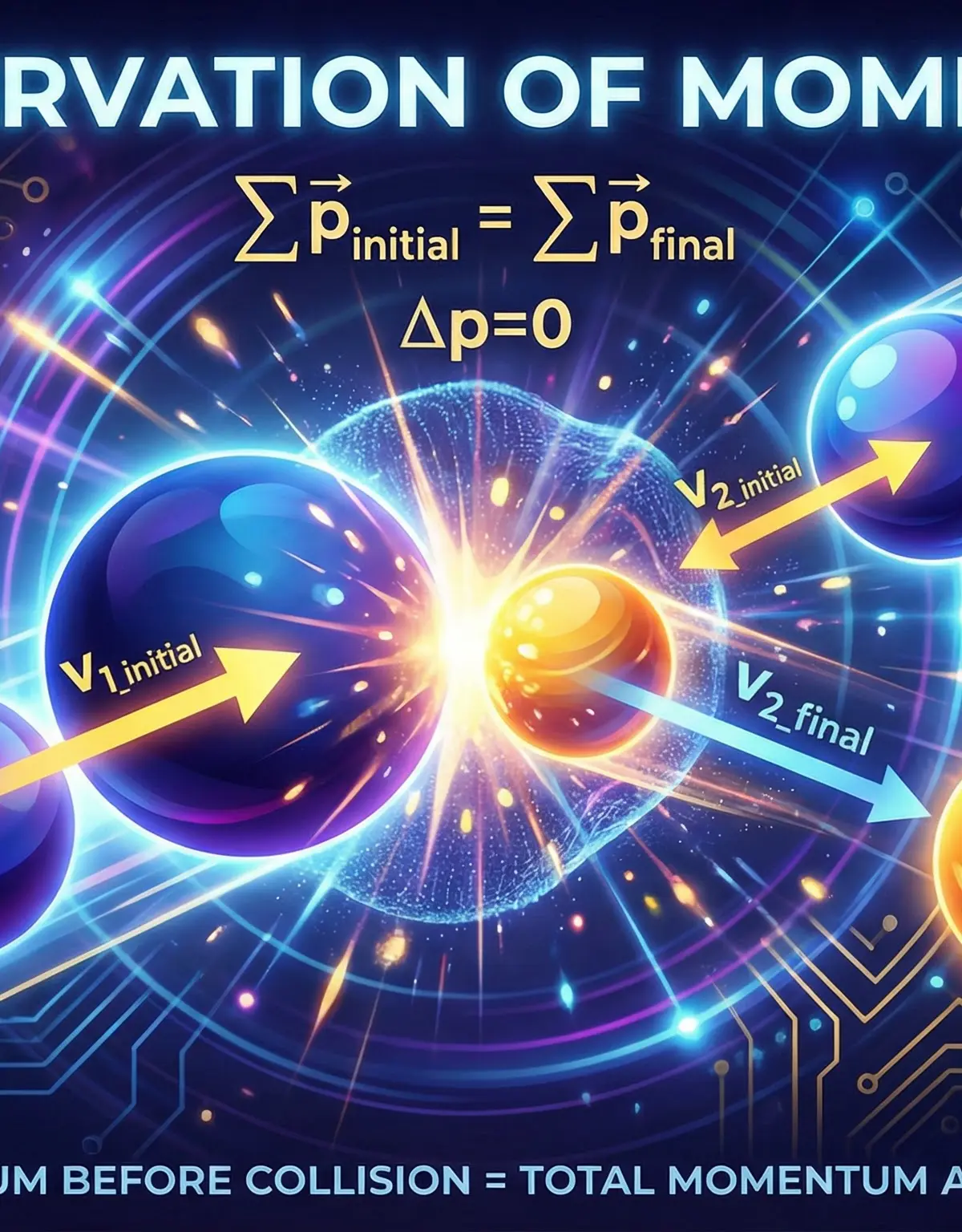
The principle of conservation of momentum is a cornerstone of classical physics, stating that within a closed system, the total momentum remains constant. This means that in any interaction, such as a collision or an explosion, the total momentum of the objects before the event is equal to the total momentum of the objects after the event. For GCSE Physics candidates, mastering this topic is crucial, particularly for Higher Tier papers where it is frequently tested through multi-step calculation questions. Understanding momentum is not just about memorizing an equation; it's about appreciating the vector nature of motion and applying a powerful conservation law to predict the outcome of physical interactions. This topic has strong synoptic links to forces (Newton's Laws), energy, and the application of physics in real-world safety features, such as car crumple zones.

Key Concepts
Concept 1: Momentum as a Vector
Momentum is defined as the product of an object's mass and its velocity (p = m × v). Crucially, velocity is a vector quantity, meaning it has both magnitude (speed) and direction. Therefore, momentum is also a vector. This is the single most important detail to remember in calculations. Examiners will frequently set up questions where objects move in opposite directions. To handle this, you must define a positive direction. Any motion in the opposite direction must be assigned a negative velocity. Forgetting this will lead to incorrect answers, even if your method is otherwise sound.
Example: A 2kg trolley moves to the right at 5 m/s. Its momentum is 2 kg × 5 m/s = +10 kg·m/s. A 3kg trolley moves to the left at 4 m/s. If we define right as positive, its velocity is -4 m/s, and its momentum is 3 kg × (-4 m/s) = -12 kg·m/s. The total momentum of the system is (+10) + (-12) = -2 kg·m/s.
Concept 2: The Principle of Conservation of Momentum
In any interaction between objects in a closed system (one where no external forces like friction are acting), the total momentum before the interaction is equal to the total momentum after the interaction. This can be written as:
Σp_initial = Σp_final
This principle is applied to two main types of scenarios in GCSE questions: collisions and explosions.
Concept 3: Collisions
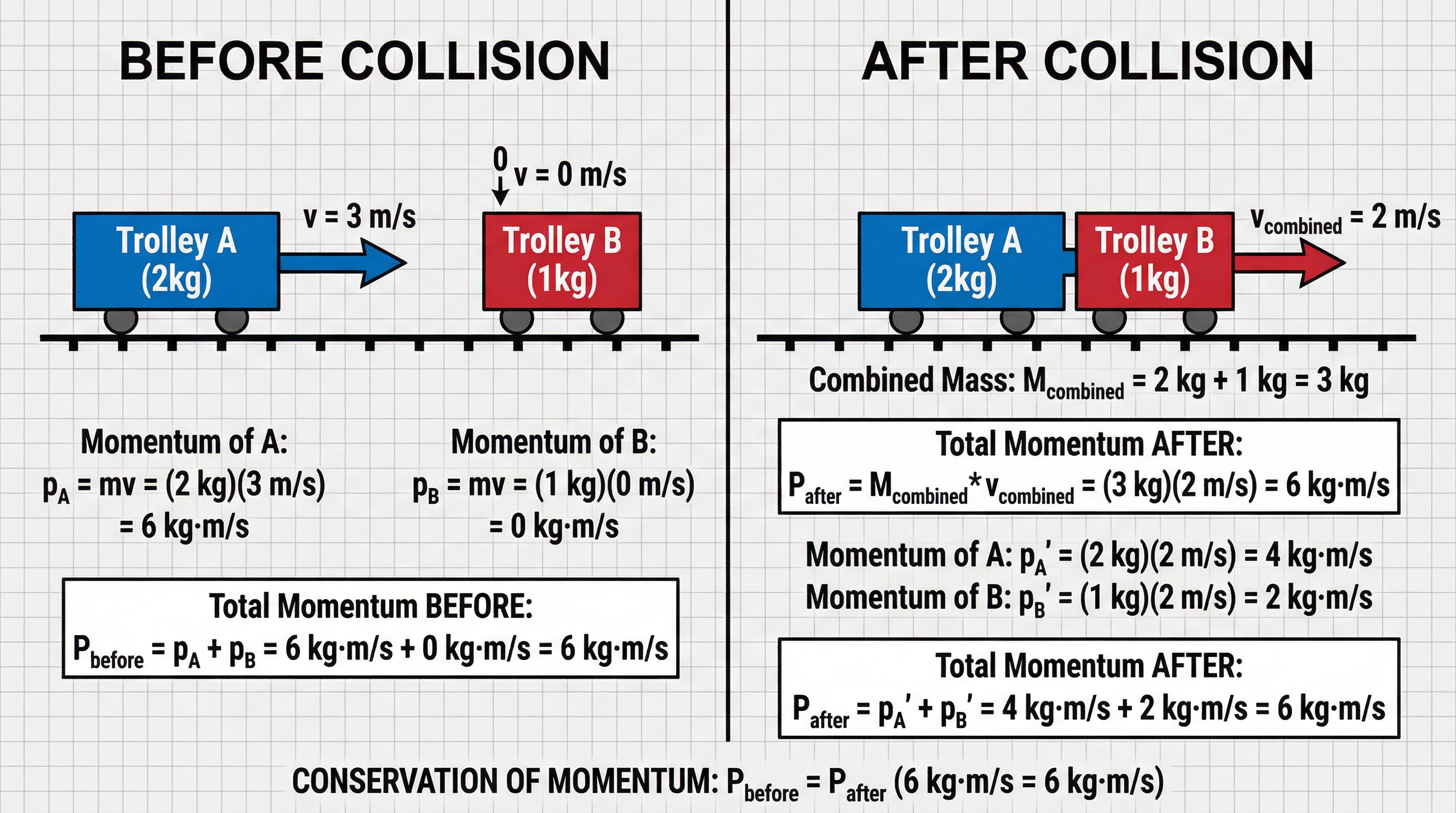
In a collision, two or more objects collide and may either stick together (coalesce) or bounce apart. In both cases, total momentum is conserved.
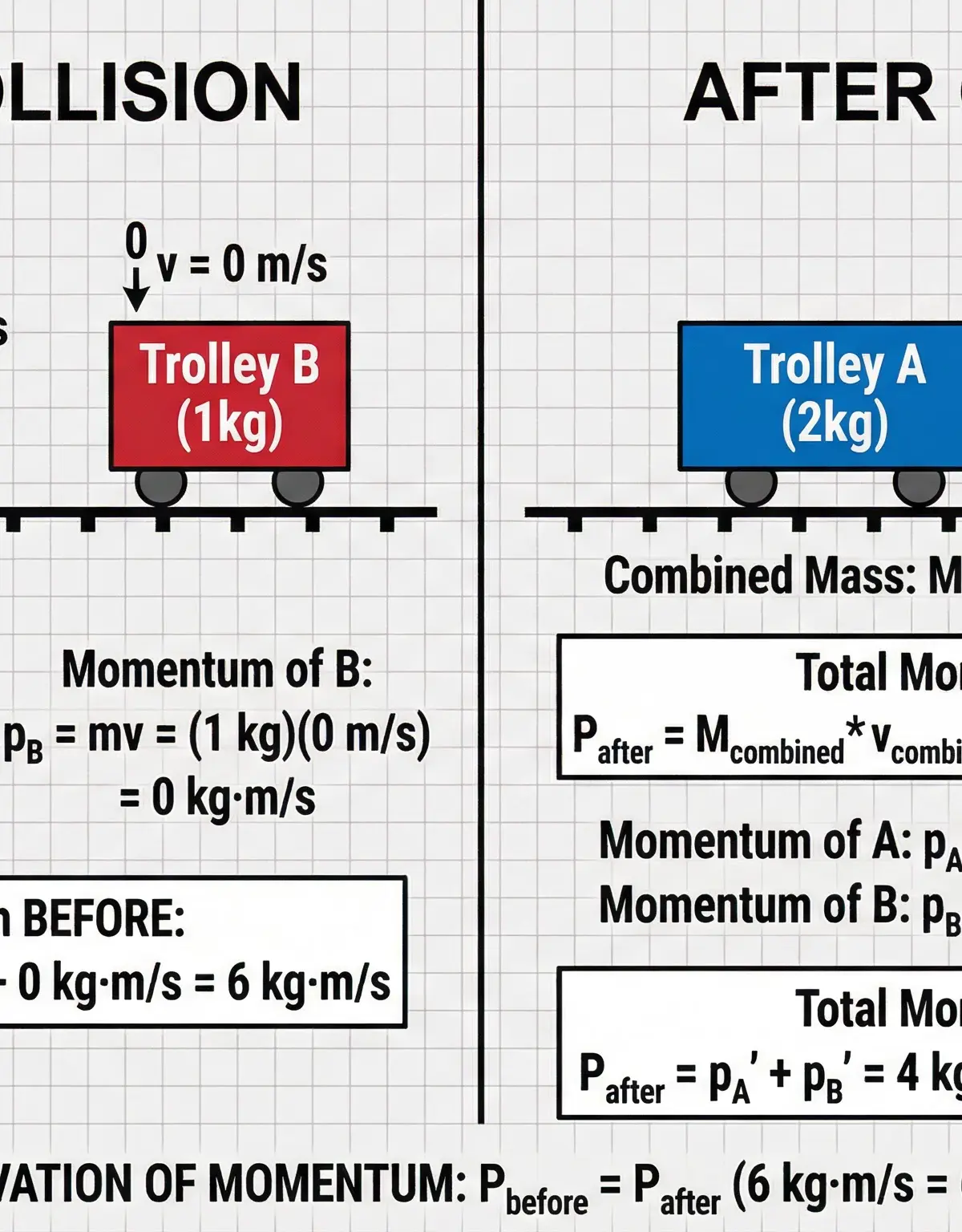
Example (Coalescing): A 2kg trolley (A) moving at 4 m/s collides with a stationary 1kg trolley (B). They stick together. What is their velocity after the collision?
- Before: p_A = 2 kg × 4 m/s = 8 kg·m/s. p_B = 1 kg × 0 m/s = 0 kg·m/s. Total p_initial = 8 kg·m/s.
- After: The combined mass is 2 + 1 = 3 kg. Let their final velocity be v.
- Conservation: 8 kg·m/s = 3 kg × v. So, v = 8/3 ≈ 2.67 m/s.
Concept 4: Explosions and Recoil
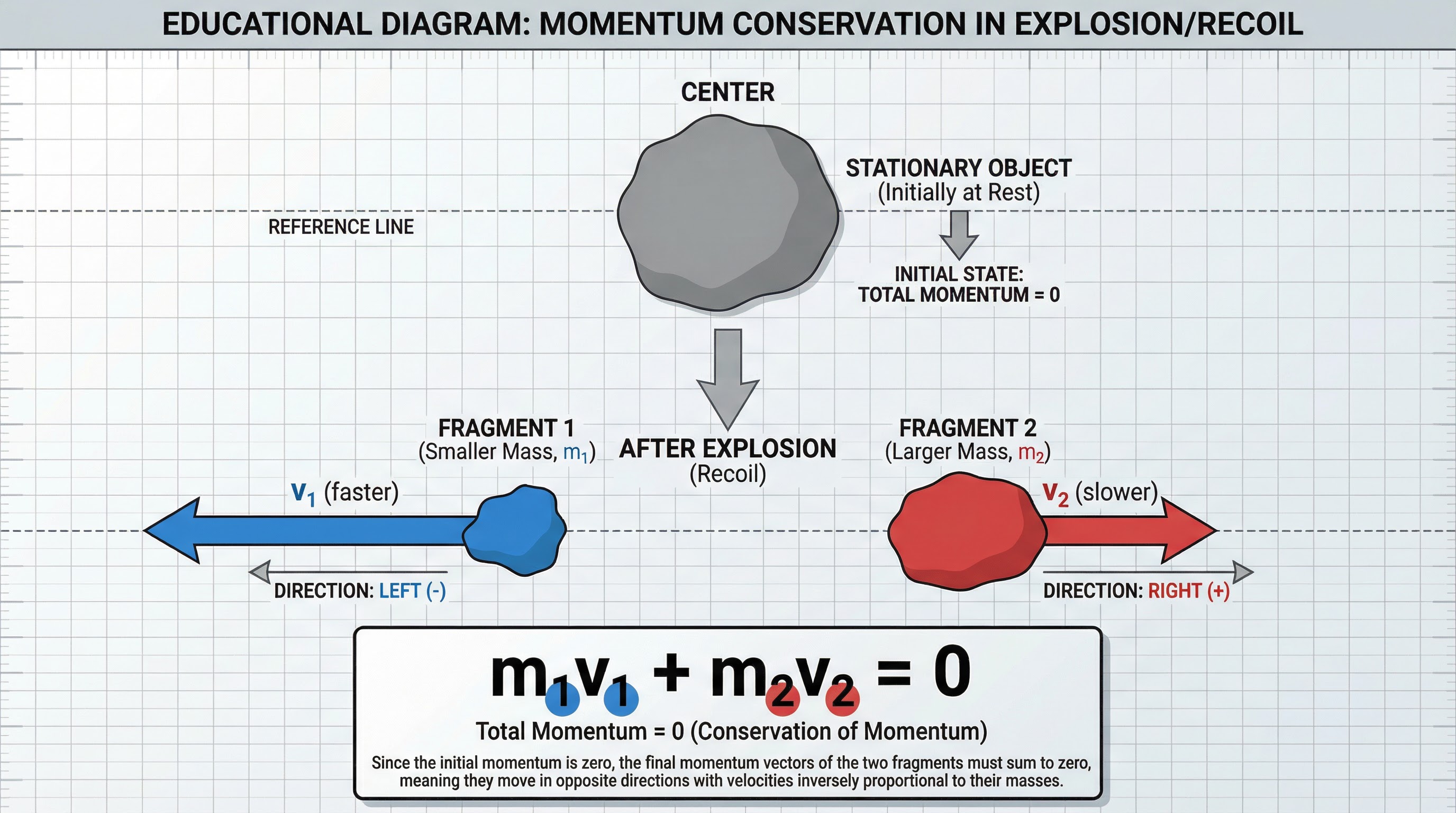
In an explosion, a single stationary object breaks into multiple pieces that move apart. The initial momentum of the system is zero. Therefore, the total momentum of the pieces after the explosion must also be zero. This means the vector sum of the momenta of the fragments is zero. For two fragments, their momenta must be equal in magnitude and opposite in direction.
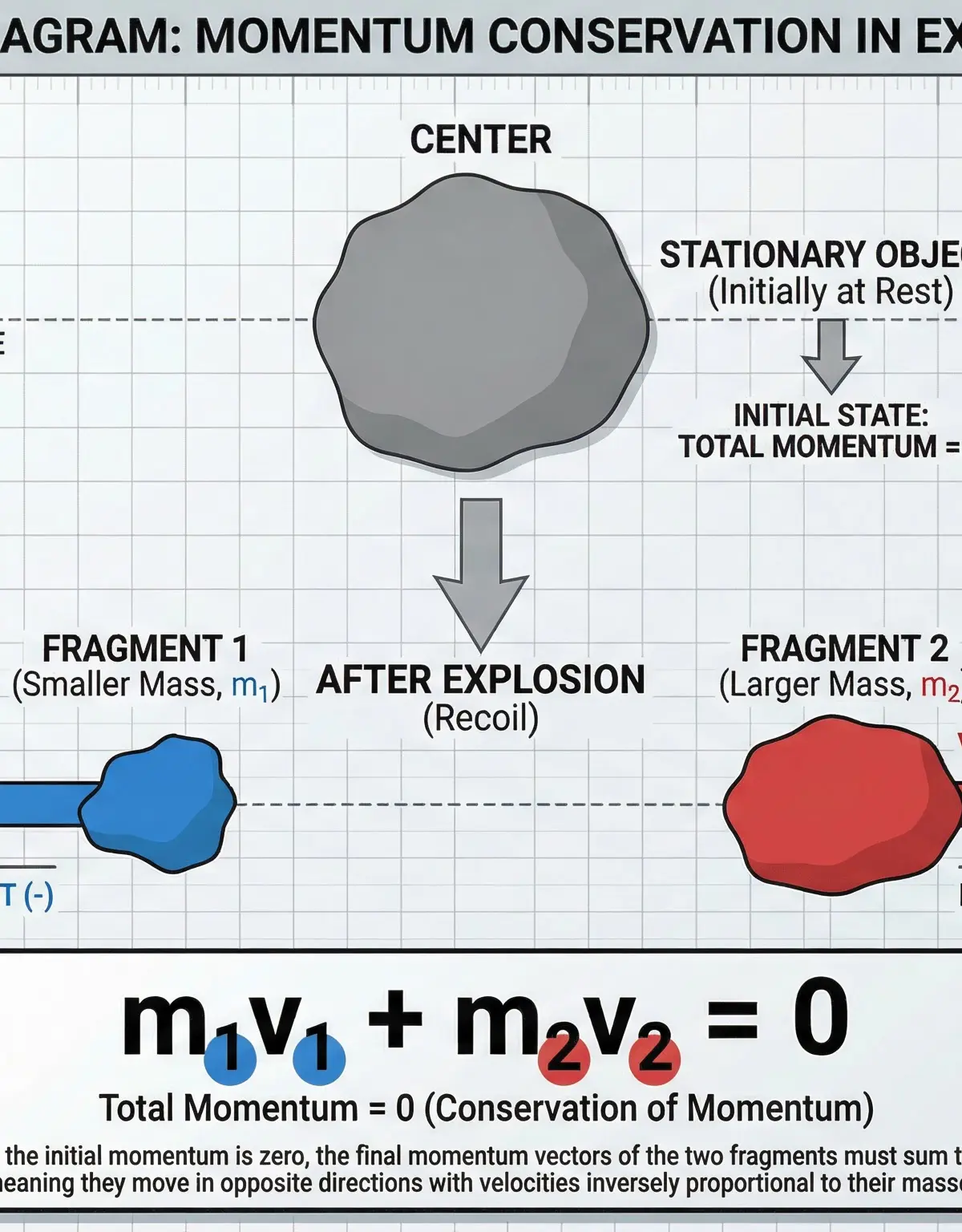
Example (Recoil): A 5 kg rifle fires a 0.02 kg bullet at a velocity of 300 m/s.
- Before: The rifle and bullet are stationary. Total p_initial = 0.
- After: Momentum of bullet = 0.02 kg × 300 m/s = 6 kg·m/s. Let the recoil velocity of the rifle be v.
- Conservation: 0 = (6 kg·m/s) + (5 kg × v). So, 5v = -6, and v = -1.2 m/s. The negative sign indicates the rifle moves in the opposite direction to the bullet.
Mathematical/Scientific Relationships
-
Momentum Formula:
p = m × v(Must memorise)p: momentum (in kilogram metres per second, kg·m/s)m: mass (in kilograms, kg)v: velocity (in metres per second, m/s)
-
Conservation of Momentum Principle:
Σp_initial = Σp_final(Must memorise)- This is the foundational concept for all calculations.
-
Force and Momentum Link:
F = (mv - mu) / torF = Δp / Δt(Given on formula sheet)F: Force (in Newtons, N)Δp: change in momentumt: time (in seconds, s)- This equation is crucial for explaining safety features.
Practical Applications
- Vehicle Safety: Car crumple zones, airbags, and seatbelts are designed to increase the time over which a passenger's momentum changes during a crash. According to F = Δp / Δt, increasing the time (t) for the same change in momentum (Δp) drastically reduces the force (F) exerted on the passenger, reducing the risk of serious injury.
- Rocket Propulsion: Rockets work by expelling hot gas at high velocity. The rocket and gas form a closed system. The rocket pushes the gas backwards (giving it momentum in one direction), and the gas pushes the rocket forwards (giving it equal and opposite momentum), causing it to accelerate.
- Billiard and Snooker: The principles of momentum conservation govern every collision between the balls on the table, allowing skilled players to predict the outcomes of their shots.
Visual Resources
2 diagrams and illustrations
Interactive Diagrams
2 interactive diagrams to visualise key concepts
Conceptual Flow Outline
A flowchart showing the decision-making process for solving momentum problems.
Diagram could not be rendered
A sequence diagram illustrating how a seatbelt acts to reduce the force on a passenger during a collision by increasing the time of impact.
Worked Examples
3 worked examples — open one to explore the question and available guidance.
Practice Questions
Test your understanding — click to reveal model answers
State the principle of conservation of momentum.
Hint: Think about what stays the same before and after an interaction, and under what condition.
A 0.5 kg ball moving at 10 m/s collides with a stationary 1.0 kg ball. The two balls stick together. Calculate their velocity after the collision.
Hint: First, find the total momentum of the system before the collision. This value must be the same after the collision.
A 2 kg trolley moving at 4 m/s to the right collides with a 1 kg trolley moving at 2 m/s to the left. They stick together. Calculate their final velocity.
Hint: Define a positive direction (e.g., right). The trolley moving left will have a negative velocity.
A skater of mass 60 kg throws a 5 kg ball forwards with a velocity of 8 m/s. Calculate the recoil velocity of the skater.
In the collision in the previous question, show that the collision was inelastic.
Hint: Calculate the total kinetic energy before the collision and the total kinetic energy after. If they are not equal, the collision is inelastic.