OCR · GCSE · Physics
Contact and Non-Contact Forces
This guide provides a comprehensive, exam-focused breakdown of Contact and Non-Contact Forces for OCR GCSE Physics (2.1). It covers everything from fundamental definitions and free-body diagrams to mastering Newton's Third Law, ensuring candidates can secure maximum marks.
- 7 min read
- 3 worked examples
- 5 practice questions
- 6 key terms
Study Notes
Overview
Welcome to your definitive guide for OCR GCSE Physics Topic 2.1: Contact and Non-Contact Forces. This topic forms the bedrock of mechanics, and a solid understanding here is crucial for success across the entire Physics paper. In this guide, we will deconstruct the essential distinction between forces that act through touch (contact) and those that act across a distance (non-contact). We will master the art of drawing precise, mark-scoring free-body diagrams and unravel the often-misunderstood Newton's Third Law. Examiners frequently test these concepts through structured questions requiring both clear definitions and the application of vector analysis. Expect to see questions asking you to categorise forces, calculate resultant forces, and explain the interactions between objects. This guide will equip you with the language, techniques, and confidence to tackle any question the exam throws at you.

Key Concepts
Concept 1: The Fundamental Force Distinction
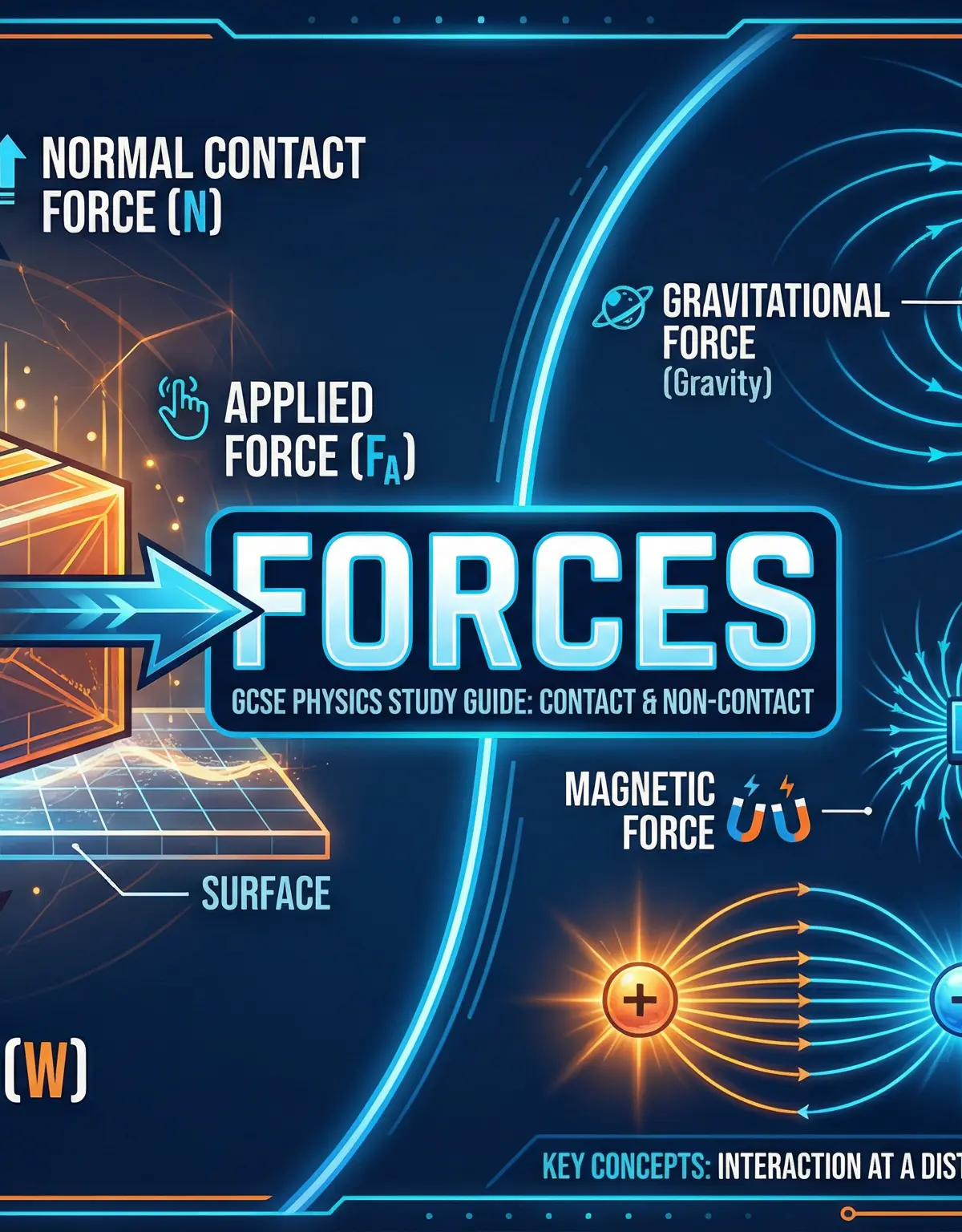
In physics, a force is simply a push or a pull. Every interaction in the universe can be described by forces. For your GCSE, all forces are sorted into two distinct categories. Understanding this categorisation is a common source of early marks in an exam question.
Contact Forces: These forces require objects to be physically touching. There is a point of interaction where the force is applied.
- Friction (F): A force that opposes the motion (or attempted motion) between two surfaces in contact. For example, the force between your brake pads and your bike wheel.
- Air Resistance (or Drag): A specific type of friction that acts on objects moving through the air. It always opposes the direction of motion.
- Tension (T): The pulling force transmitted through a string, rope, cable, or wire when it is pulled tight by forces acting from opposite ends.
- Normal Contact Force (N or R): The support force exerted by a surface on an object resting on it. It acts perpendicular (or 'normal') to the surface. It is the force that stops you from falling through the floor.
Non-Contact Forces: These forces act over a distance, without any physical contact between the objects. They are mediated by fields.
- Gravitational Force (or Weight, W): The force of attraction between any two objects with mass. The Earth exerts a gravitational force on you, which we call your weight. This force acts towards the centre of the Earth.
- Electrostatic Force: The force between two electrically charged objects. Like charges repel, and opposite charges attract.
- Magnetic Force: The force exerted by magnets on magnetic materials or other magnets. It can be attractive or repulsive.
Concept 2: Free-Body Diagrams
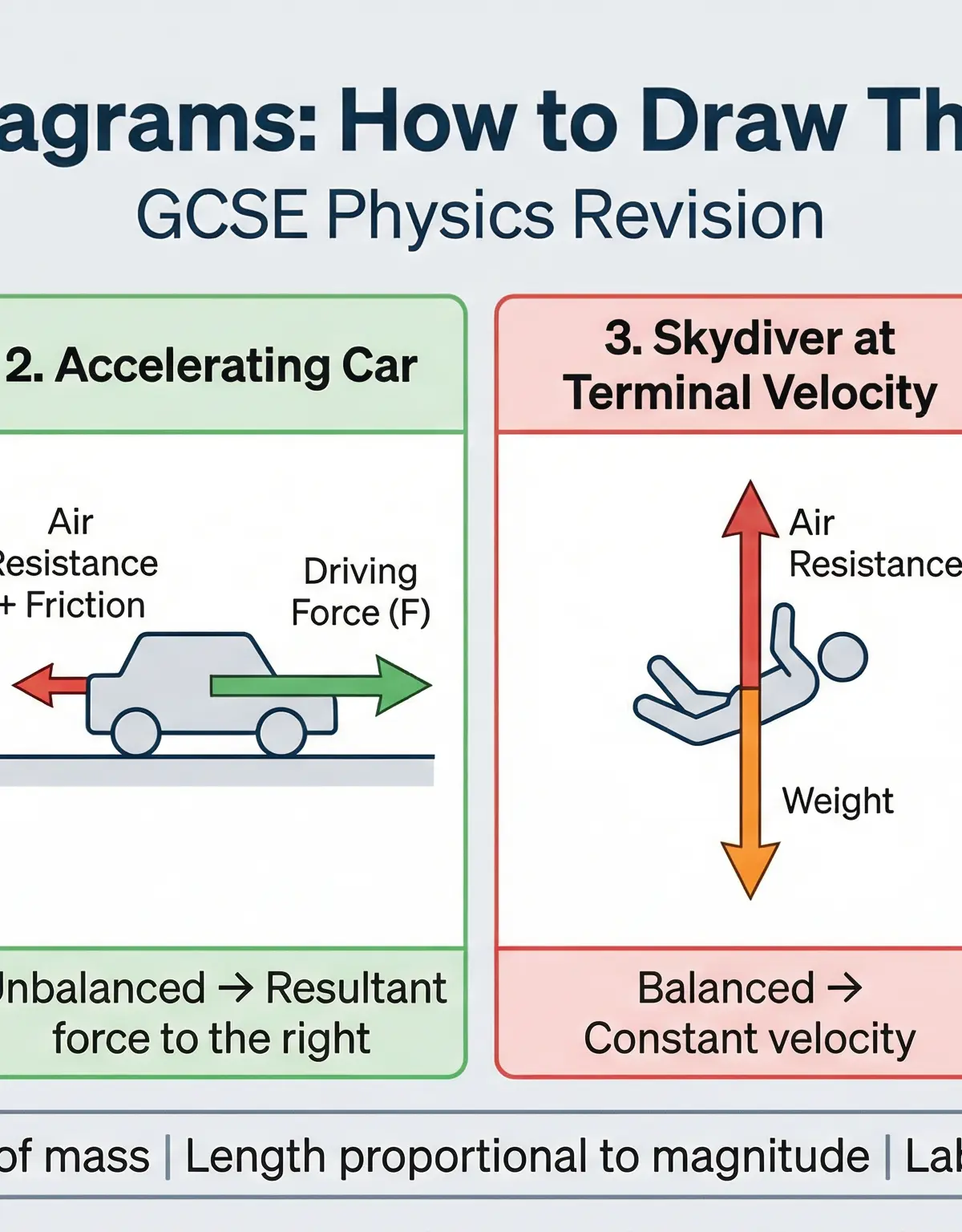
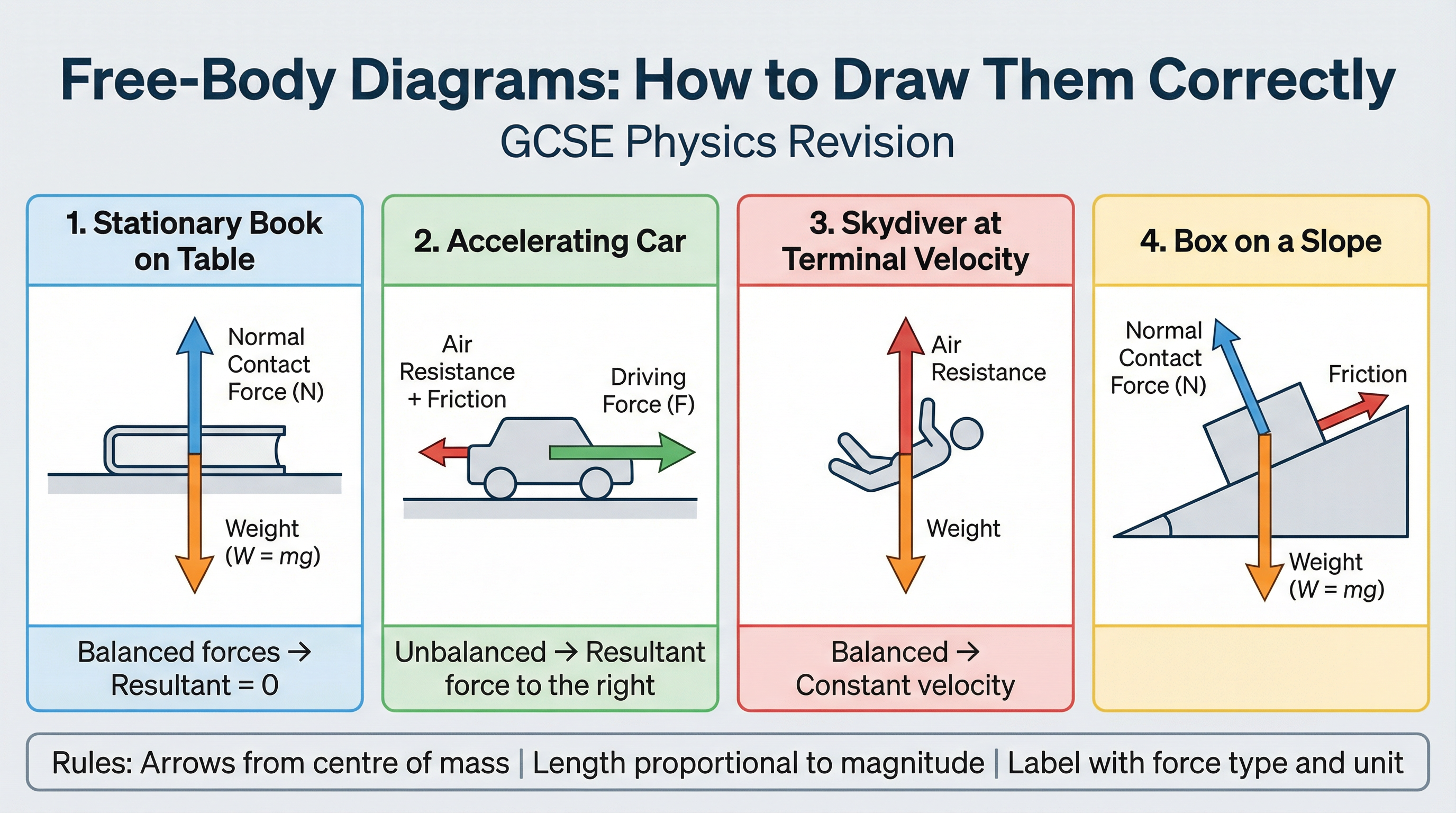
A free-body diagram is a simplified representation used to analyse the forces acting on an object. Getting these right is a core skill that examiners look for. Credit is given for diagrams that are clear, correctly labelled, and follow specific conventions.
Rules for Drawing Free-Body Diagrams:
- Represent the object as a simple box or circle.
- Draw force arrows starting from the centre of mass of the object and pointing outwards.
- Arrow length should be proportional to the magnitude of the force (a bigger force needs a longer arrow).
- Label each arrow clearly with the name of the force (e.g., 'Weight', 'Tension') and its magnitude in Newtons (N) if known.
Concept 3: Resultant Force
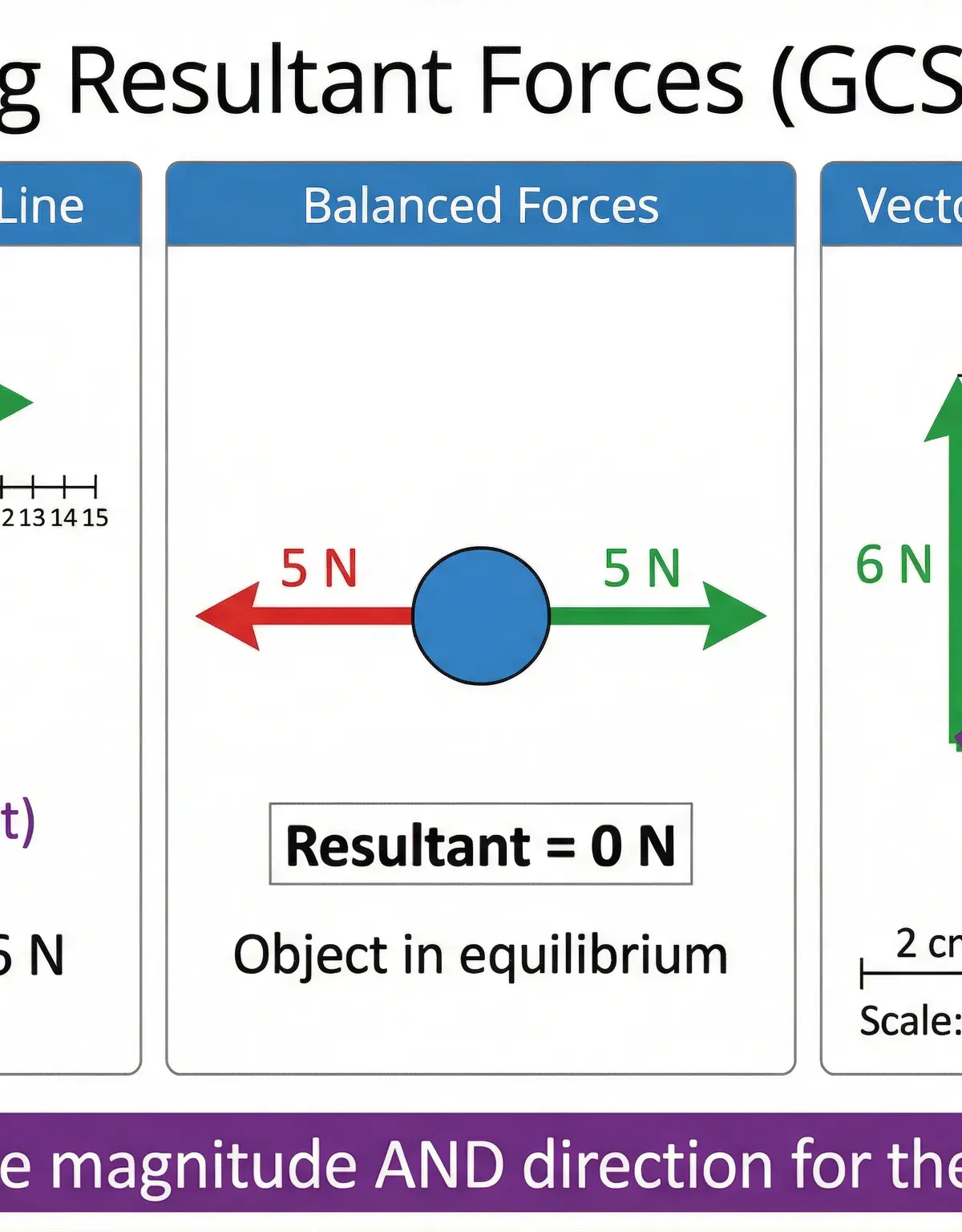
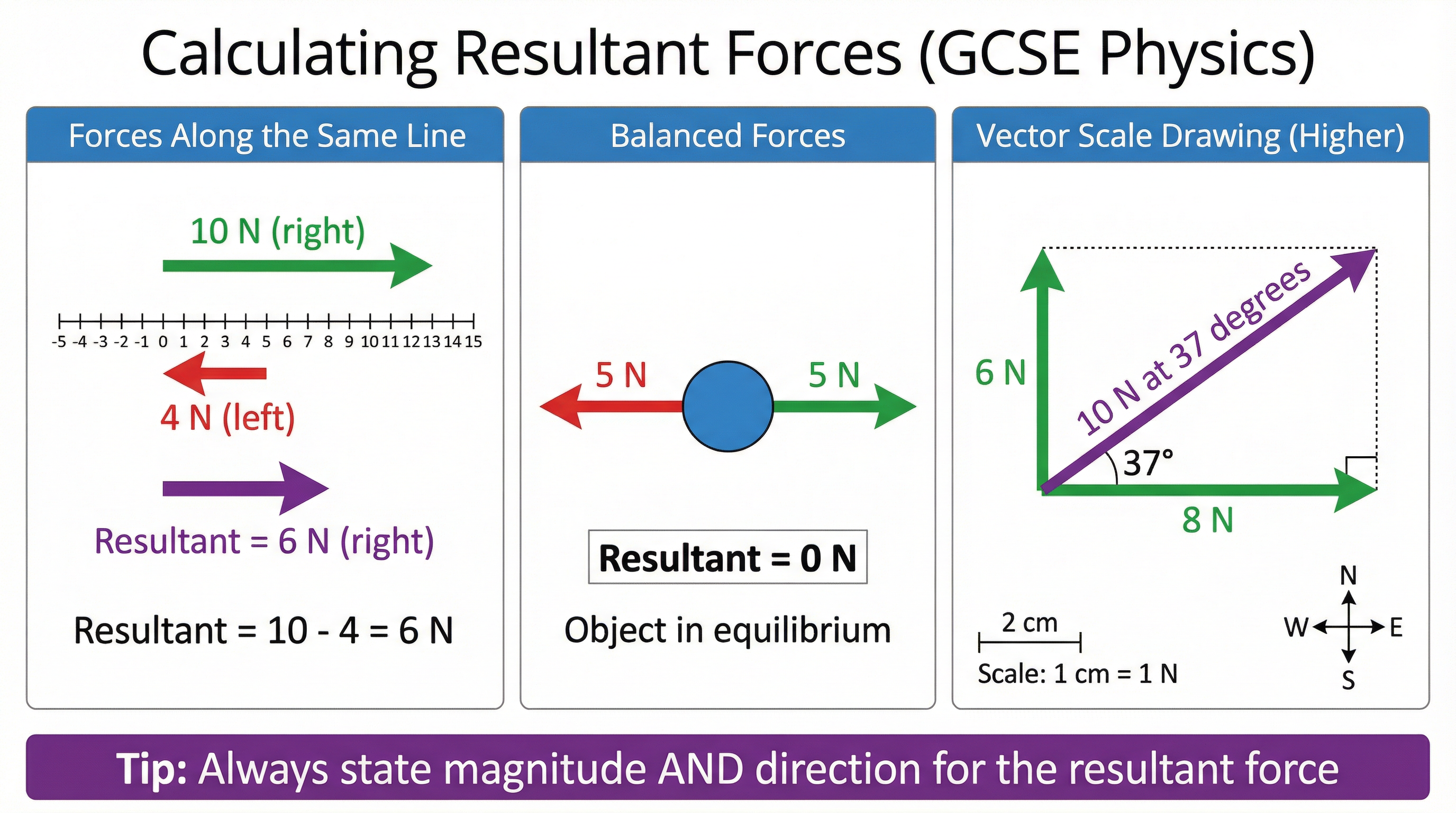
Often, more than one force acts on an object. The resultant force is the single force that has the same effect as all the individual forces acting together.
- If forces act in the same direction, you add them.
- If forces act in opposite directions, you subtract the smaller from the larger.
- If the resultant force is zero, the forces are balanced. The object is in equilibrium - it is either stationary or moving at a constant velocity.
- If the resultant force is non-zero, the forces are unbalanced. The object will accelerate in the direction of the resultant force (Newton's Second Law).
Concept 4: Newton's Third Law
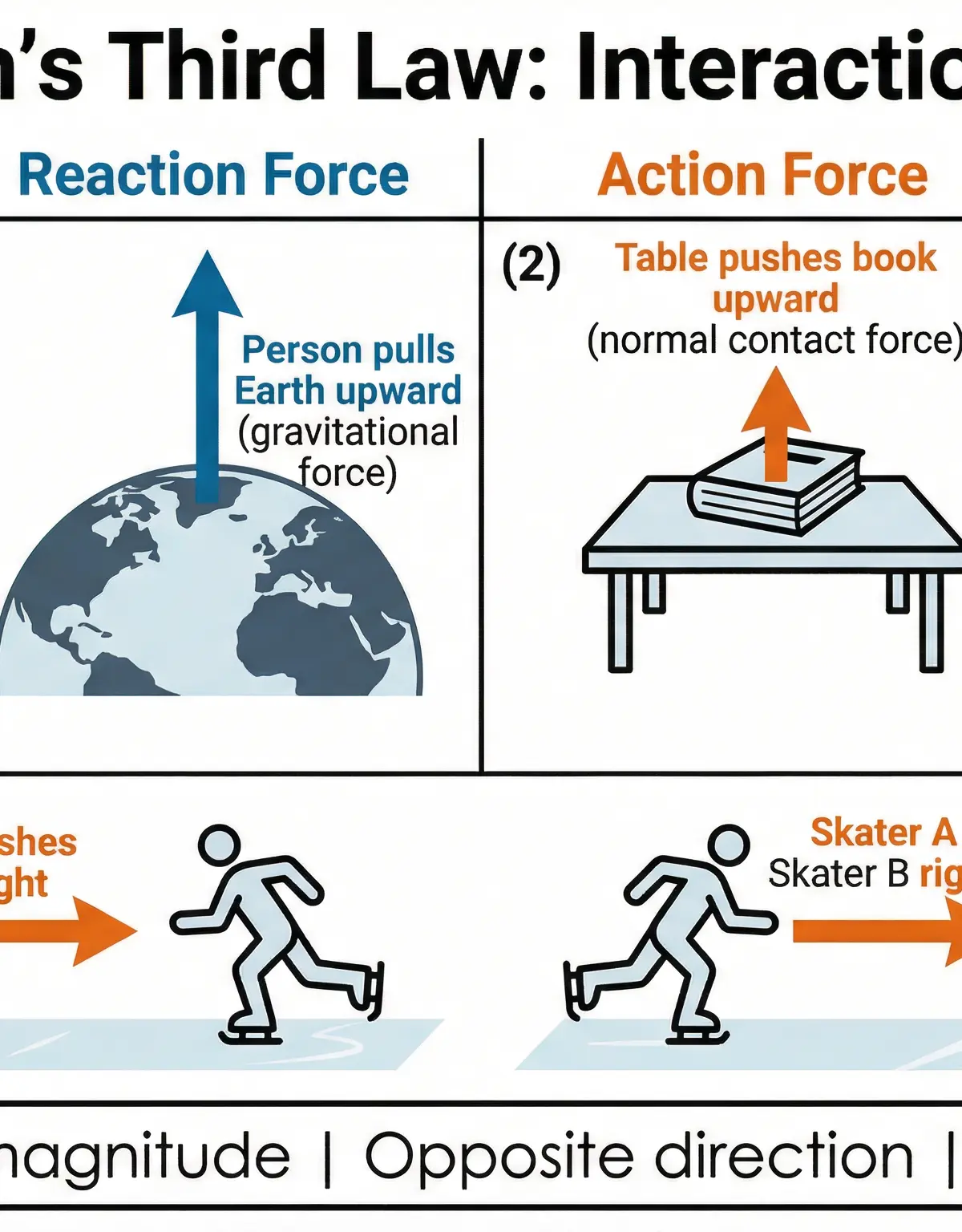
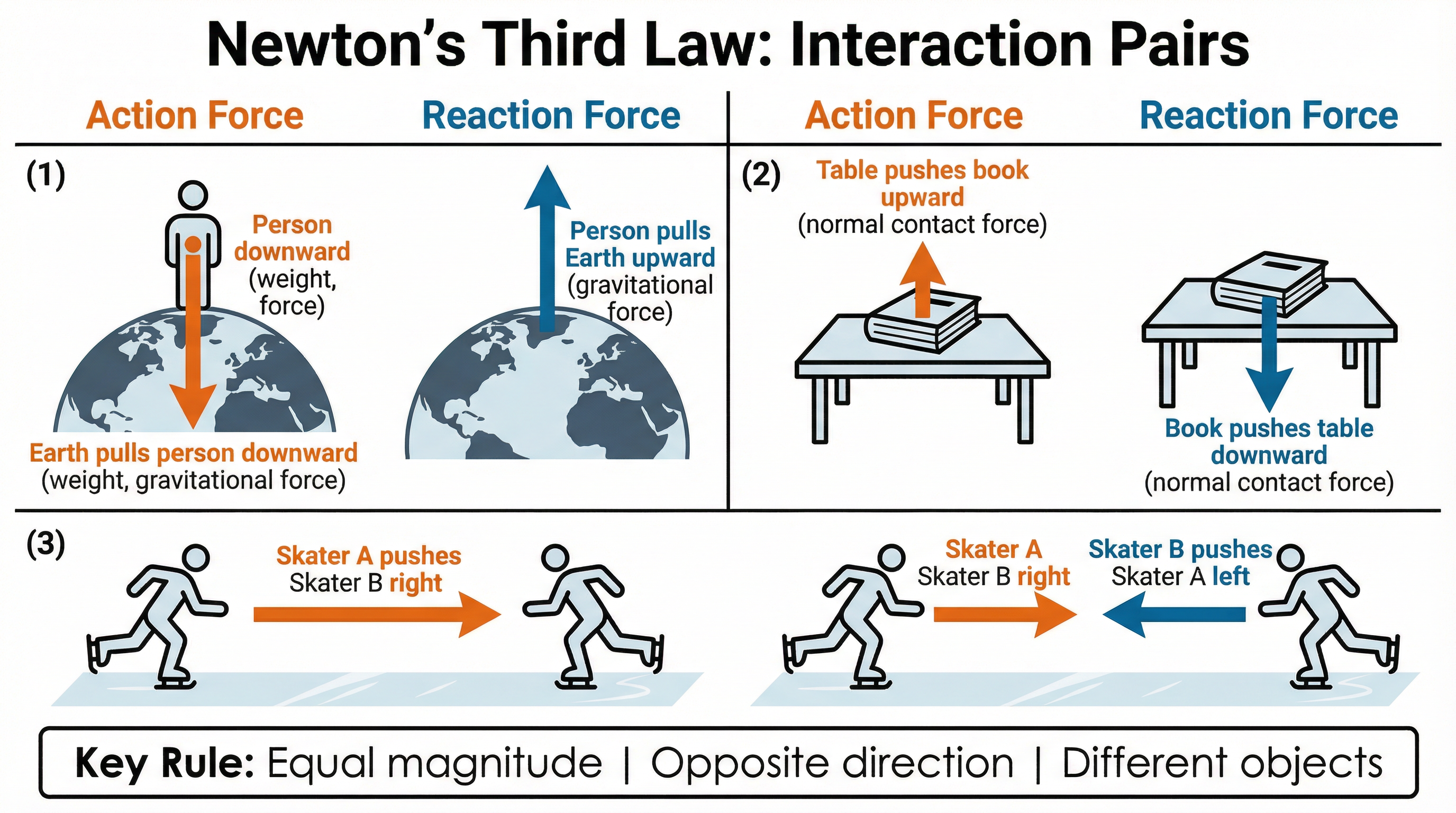
This is one of the most important and most misunderstood laws in physics. It states: **"For every action, there is an equal and opposite reaction."**This means that forces always occur in pairs. If Object A exerts a force on Object B, then Object B simultaneously exerts a force on Object A. These two forces are:
- Equal in magnitude.
- Opposite in direction.
- Of the same type (e.g., both gravitational or both contact).
- Acting on different objects.
This last point is the crucial one that candidates often miss. The balanced forces on a book on a table (weight down, normal force up) are NOT a Newton's Third Law pair because they both act on the same object (the book). The real pair for the book's weight is the gravitational pull of the book on the Earth.
Mathematical/Scientific Relationships
Weight, Mass, and Gravitational Field Strength
This is a fundamental equation you must memorise.
- Formula:
Weight (N) = Mass (kg) × Gravitational Field Strength (N/kg) - Symbols:
W = m × g - On Earth, the gravitational field strength (
g) is approximately 9.8 N/kg. In your GCSE exam, you will often be told to use 10 N/kg to simplify calculations. - Status: Must memorise.
Resultant Force, Mass, and Acceleration (Newton's Second Law)
This formula links the concepts of force and motion.
- Formula:
Resultant Force (N) = Mass (kg) × Acceleration (m/s²) - Symbols:
F = m × a - Status: Given on the formula sheet.
Practical Applications
This topic is fundamental to almost every area of physics and engineering. Understanding forces allows us to design safe bridges and buildings (analysing tension and compression), build fast cars (minimising air resistance and maximising driving force), and launch satellites into orbit (calculating gravitational forces and trajectories). The required practicals involving dynamics carts, light gates, and friction blocks are all direct applications of the principles covered in this topic. When analysing data from these experiments, candidates must be able to draw free-body diagrams for the moving object and calculate the resultant force to explain its acceleration.
Visual Resources
3 diagrams and illustrations
Interactive Diagrams
2 interactive diagrams to visualise key concepts
Conceptual Flow Outline
A flowchart showing the relationship between resultant force and an object's motion (Newton's First and Second Laws).
Conceptual Flow Outline
A concept map illustrating the classification of common forces as either contact or non-contact.
Worked Examples
3 worked examples — open one to explore the question and available guidance.
Practice Questions
Test your understanding — click to reveal model answers
State the names of two contact forces and two non-contact forces.
Hint: Think about which forces need objects to be touching, and which can act across space.
A ball of weight 5 N is held stationary in a person's hand. Draw a free-body diagram for the ball.
Hint: The ball is not moving, so what must be true about the forces acting on it?
A rocket of mass 50,000 kg has an engine that provides a thrust of 1,200,000 N. Calculate its initial acceleration. (You can ignore air resistance for the initial calculation).
Hint: You need to consider two forces acting on the rocket at launch. Then use Newton's Second Law.
A rugby player passes a ball. Explain the Newton's Third Law force pair involved in this action.
Hint: Remember: equal, opposite, same type, different objects.
A boat is being pulled by a rope with a tension of 500 N at an angle. The forward component of the tension is 400 N. The resistive force from the water is 150 N. Calculate the resultant horizontal force on the boat.
Hint: Only the horizontal forces affect the horizontal motion.