OCR · GCSE · Physics
Distance and displacement
Master the crucial difference between scalar distance and vector displacement, a fundamental concept in OCR GCSE Physics. This guide provides examiner-level insights, worked examples, and multi-modal resources to help you secure top marks on questions from Topic P2 (Forces).
- 6 min read
- 3 worked examples
- 5 practice questions
- 7 key terms
Study Notes
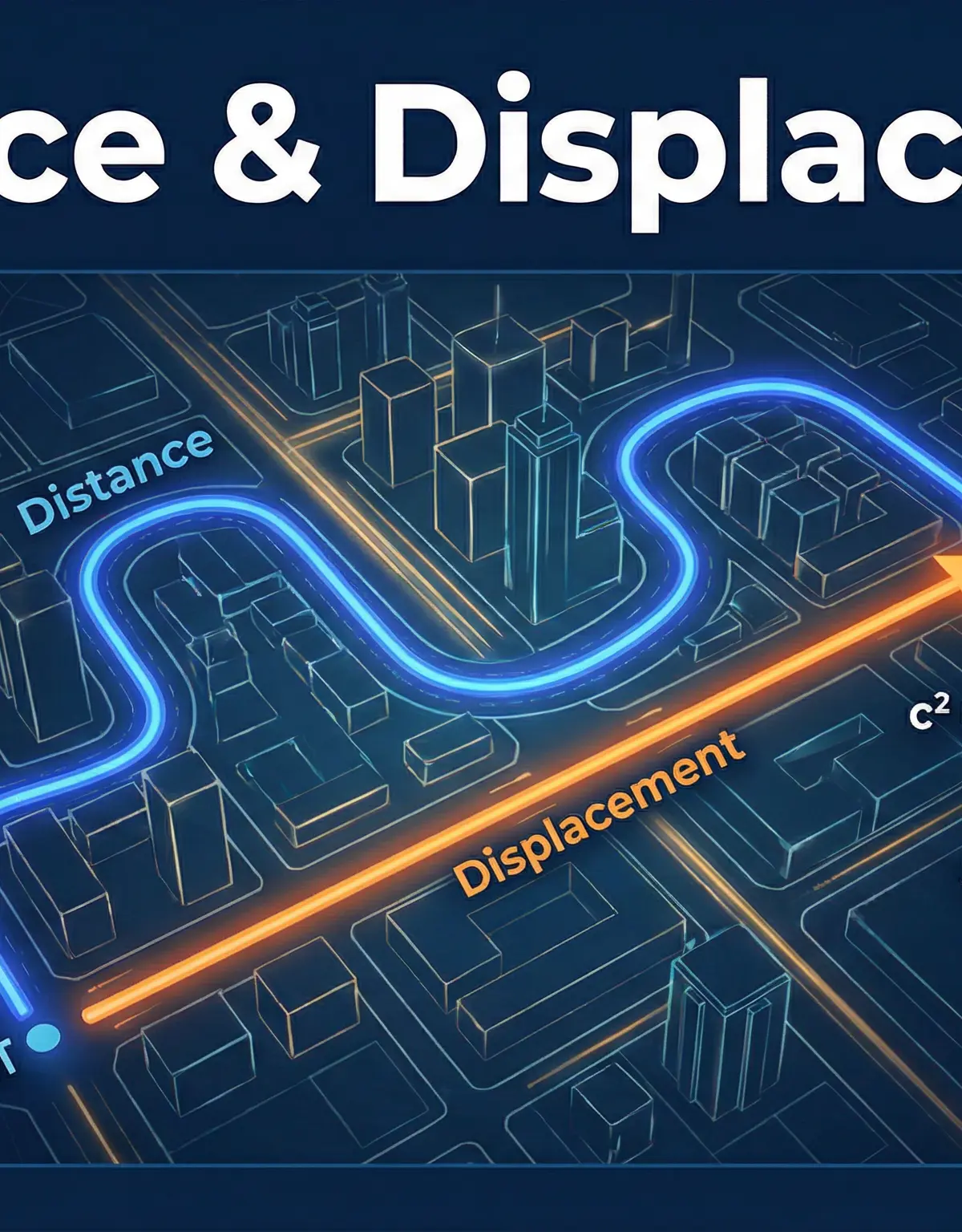
Overview
Welcome to a deep dive into one of the foundational concepts of mechanics: Distance and Displacement. While they might sound like the same thing in everyday language, in Physics, they are critically different. Understanding this difference is not just about memorising definitions; it's about unlocking the language of motion and forces. OCR examiners frequently test this distinction in Topic P2 (Forces), often in questions that combine graphical skills, mathematical calculations, and precise use of terminology. Candidates who can confidently distinguish between a scalar quantity (like distance) and a vector quantity (like displacement) are better equipped to tackle more advanced topics like velocity, acceleration, and momentum. This guide will equip you with the knowledge, techniques, and exam strategies to move beyond common pitfalls and answer any question on this topic with confidence and precision.
Key Concepts
Concept 1: Scalar vs. Vector — The Fundamental Difference
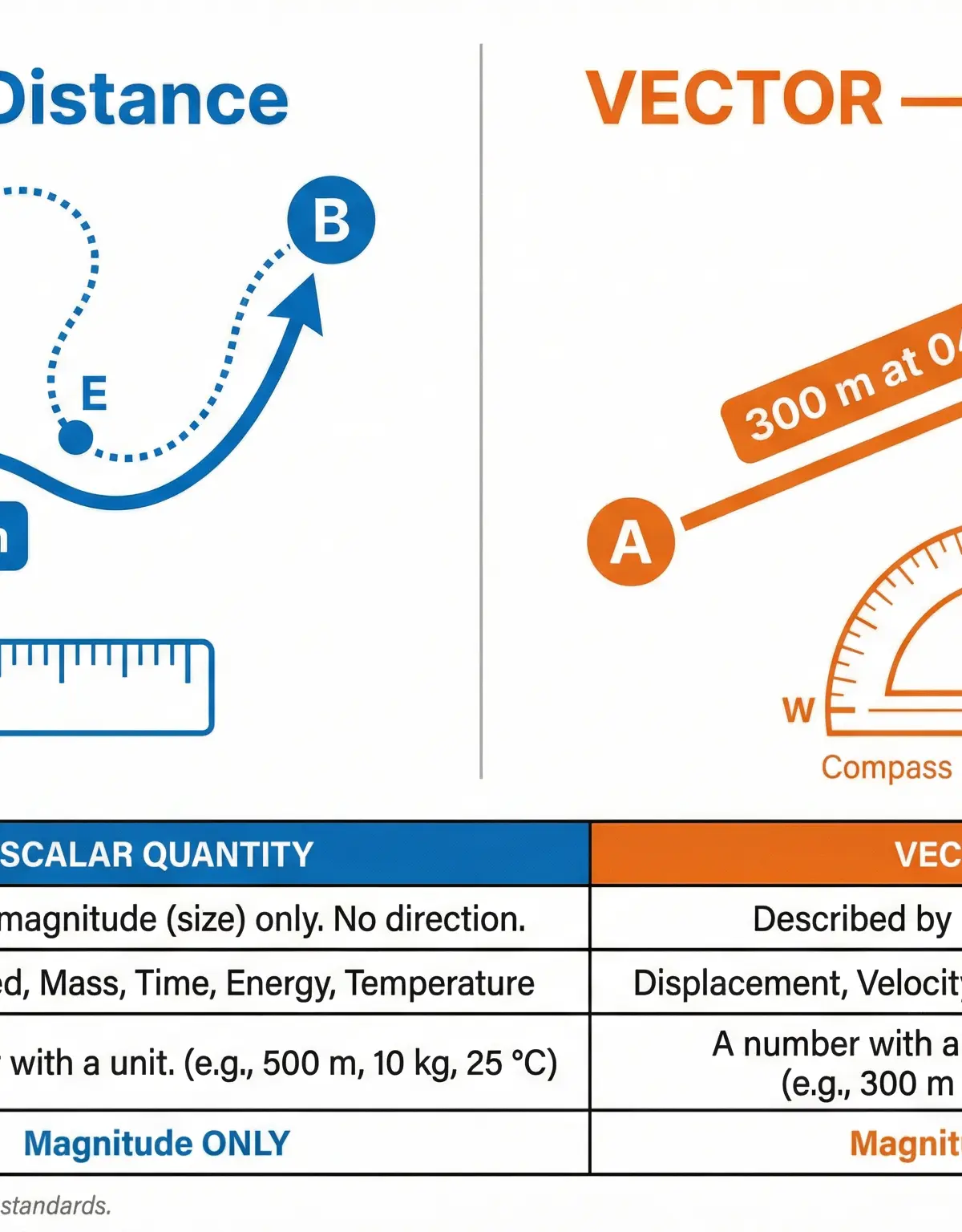
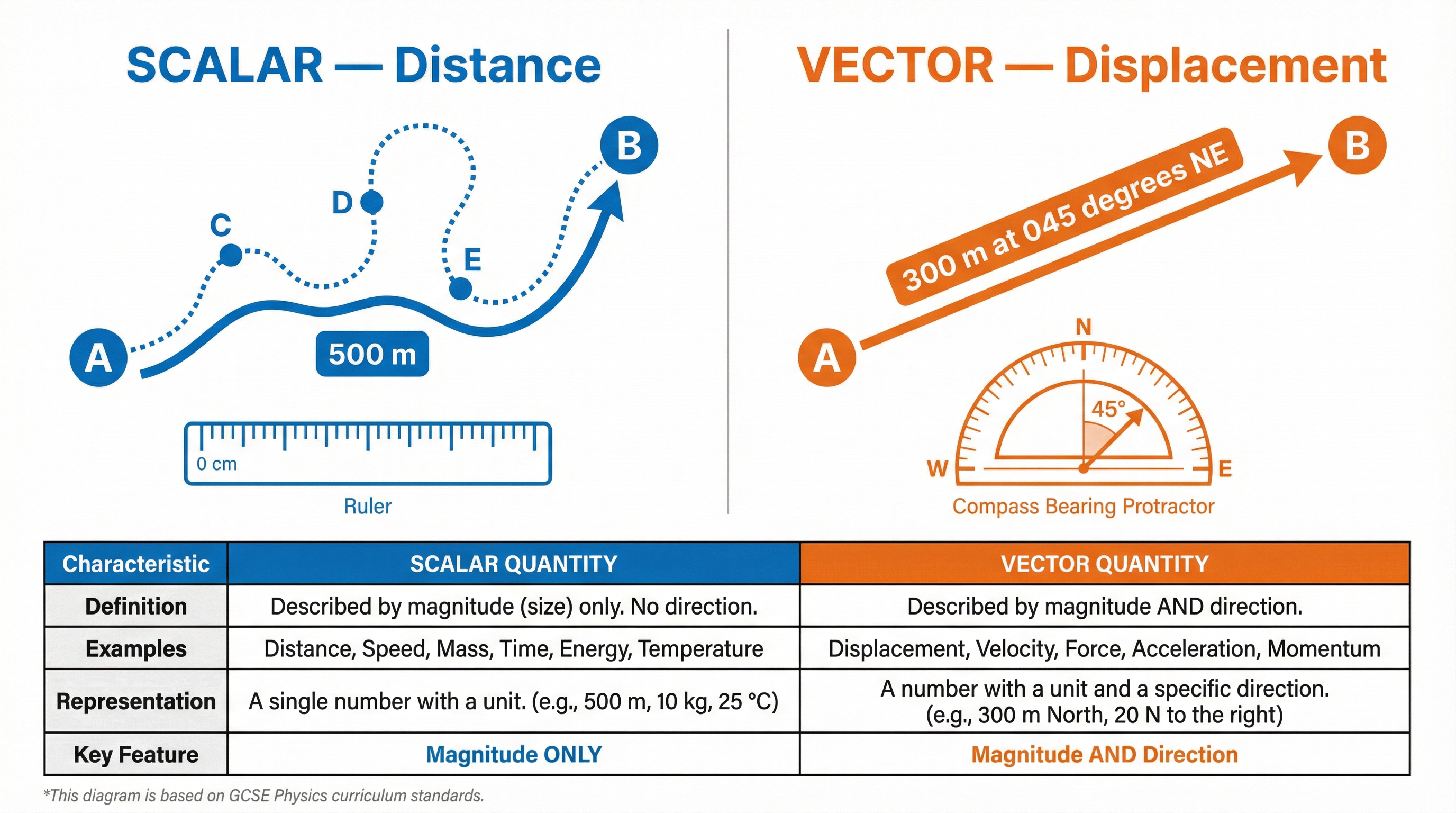
At the heart of this topic is the distinction between scalar and vector quantities. This is a concept that applies across all of Physics, so mastering it here is essential.
-
A scalar quantity is defined by its magnitude (size) only. It tells you "how much" of something there is. Examples you'll encounter frequently are distance, speed, mass, energy, and temperature. If you say you walked 500 metres, you have stated a distance — a scalar value.
-
A vector quantity is defined by both its magnitude AND its direction. It tells you not only "how much" but also "which way". Examples include displacement, velocity, force, and acceleration. To describe a displacement fully, you must say, for instance, "500 metres due East." Without the direction, the information is incomplete.
Examiner's Tip: A common way to lose marks is to treat displacement as a scalar. If a question asks for displacement, your final answer MUST have a direction. Credit is specifically awarded for this component.
Concept 2: Calculating Resultant Displacement
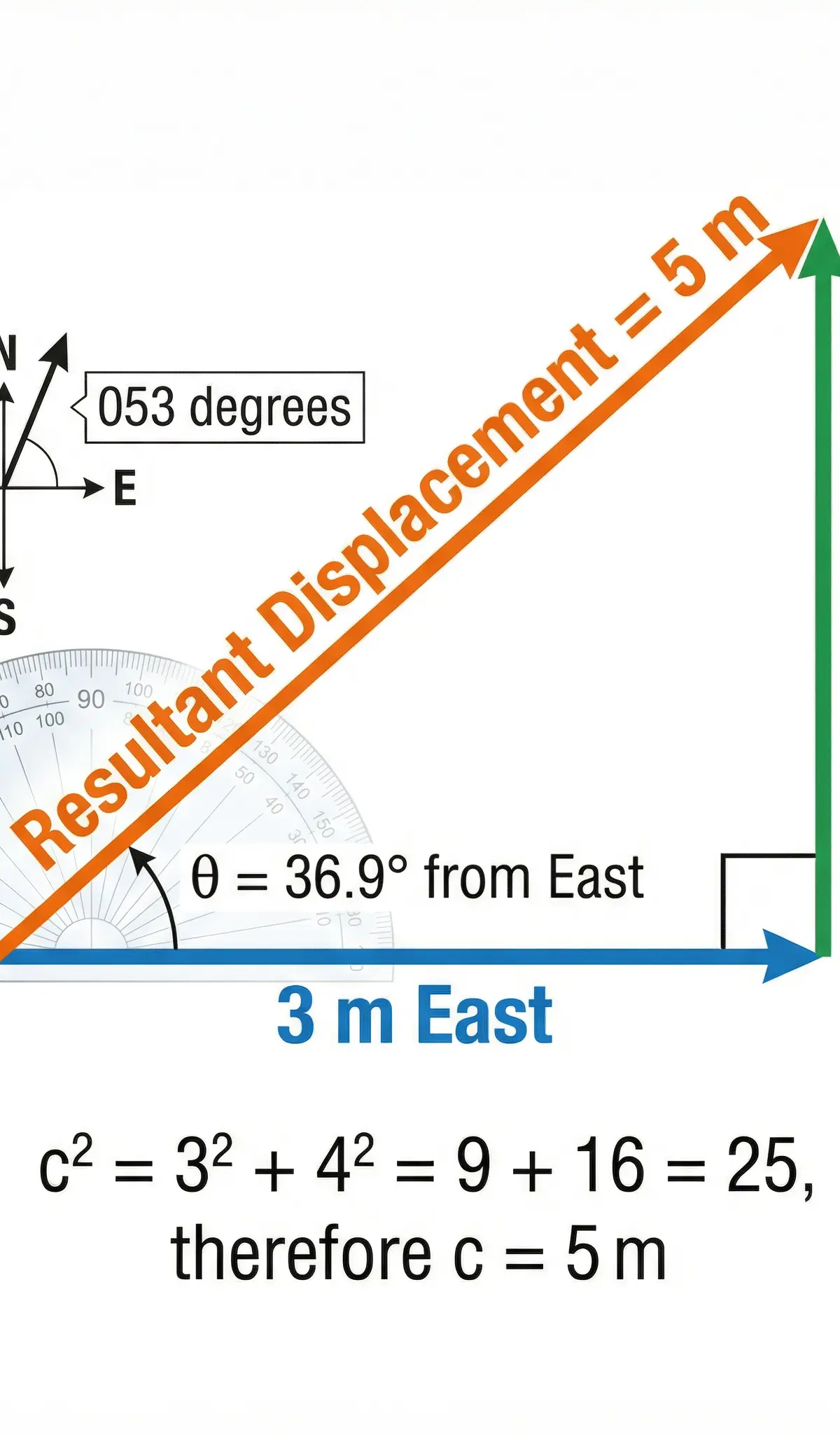
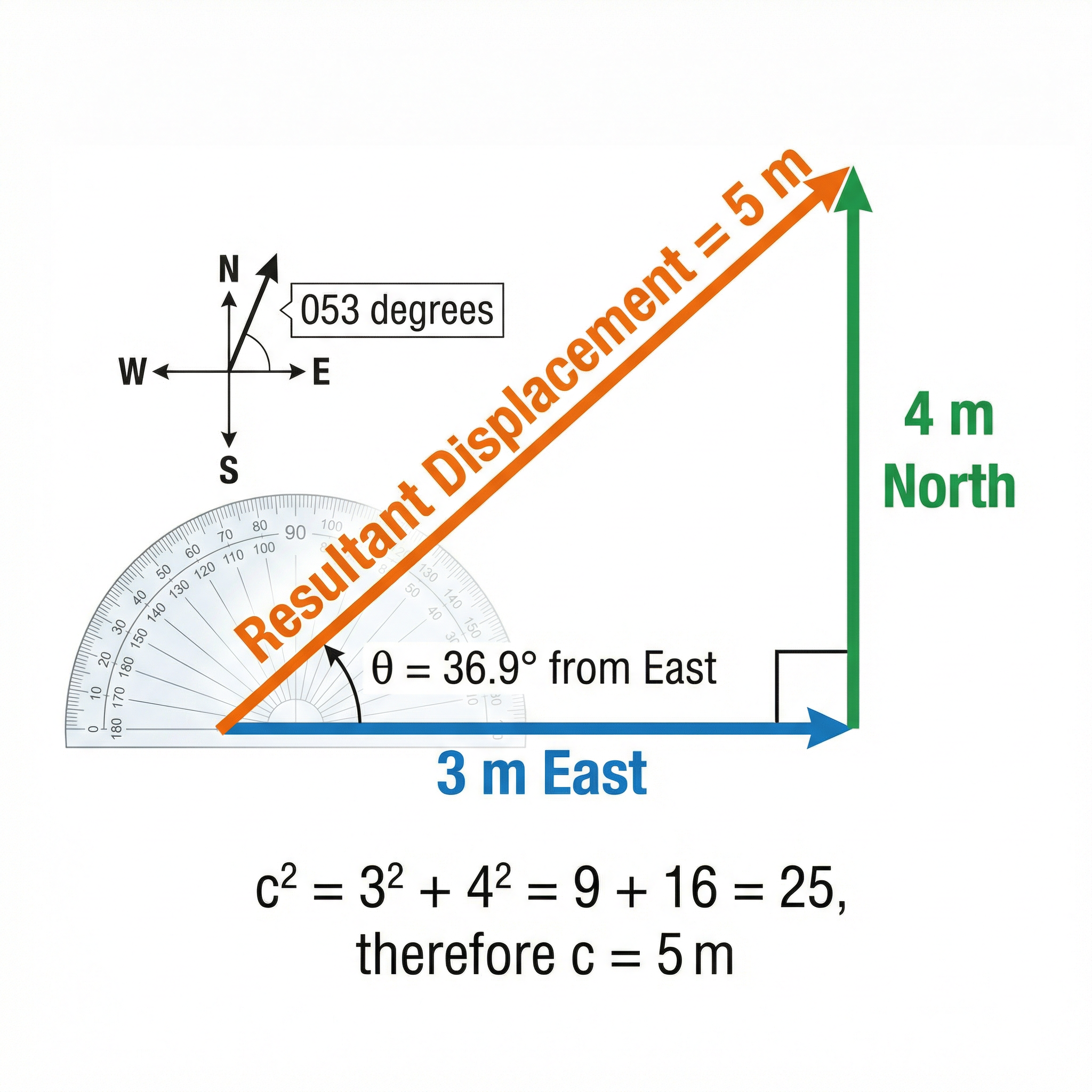
Often, an object undergoes more than one displacement (e.g., walking 30m North, then 40m East). The resultant displacement is the single displacement that would take the object from its starting point to its final point in a straight line. There are two key methods for finding this.
**1. Perpendicular Vectors (Pythagoras' Theorem - Higher & Foundation)**When two displacement vectors are at right angles (90°) to each other, they form a right-angled triangle. The resultant displacement is the hypotenuse of this triangle.
- Magnitude: You calculate the magnitude using Pythagoras' Theorem: a² + b² = c².
- Direction: You find the direction using trigonometry (SOH CAH TOA). You will need to calculate the angle relative to a starting direction (e.g., North or East) and, for full marks, convert this to a three-figure bearing.
**2. Non-Perpendicular Vectors (Scale Drawing - Higher & Foundation)**When vectors are not at right angles, you must use a scale drawing. Precision is key to gaining marks here.
- Step 1: State your scale. Write it clearly on your page (e.g., 1 cm = 5 m). This is a mark-able point.
- Step 2: Draw the first vector. Use a ruler and protractor to draw the first arrow to the correct length and in the correct direction.
- Step 3: Draw the second vector. From the tip of the first arrow (a 'tip-to-tail' diagram), draw the second vector to scale and in the correct direction.
- Step 4: Draw the resultant. The resultant is the arrow drawn from the start of the first vector to the tip of the second. Measure its length and angle.
- Step 5: Convert back. Use your scale to find the magnitude of the resultant displacement and state its direction as a bearing.
Concept 3: The Special Case of Circular Motion
A favourite exam question involves an object moving in a circle and returning to its starting point. Consider a runner on a 400m athletics track.
- Distance after one lap: The runner has covered 400m of ground. The distance is 400 m.
- Displacement after one lap: The runner is back exactly where they started. The straight-line distance and direction from start to finish is zero. The displacement is 0 m.
This highlights the difference perfectly. Do not confuse zero displacement with zero distance.
Mathematical & Scientific Relationships
-
Pythagoras' Theorem (Must memorise):
a² + b² = c²
Used to find the magnitude of the resultant of two perpendicular vectors. -
Trigonometric Ratios (SOH CAH TOA) (Given on formula sheet):
sin(θ) = Opposite / Hypotenusecos(θ) = Adjacent / Hypotenusetan(θ) = Opposite / Adjacent
Used to find the direction (angle) of a resultant vector.
-
Circumference of a Circle (Given on formula sheet):
C = 2πr
Used to calculate the distance travelled in one full circle.
Podcast: Deep Dive into Distance & Displacement
For an audio breakdown of these concepts, including exam tips and a quick-fire quiz, listen to our dedicated 10-minute podcast episode.

Practical Applications
While there isn't a specific required practical for this topic, the principles are fundamental to many others. For example, in the Forces and Motion required practical, you will measure the time taken for a trolley to travel a certain distance to calculate its speed and acceleration. Understanding that the tape measure measures distance is a basic but crucial point. Similarly, navigation systems in cars or on your phone constantly calculate the most efficient route (a distance problem) but also show you the direct displacement to your destination ("as the crow flies"). Air traffic controllers rely entirely on vector displacement to manage aircraft safely, ensuring they maintain separation in three-dimensional space.
Unit Conversions
Examiners may try to catch you out with units. Be prepared to convert:
- Kilometres to metres: 1 km = 1000 m
- Centimetres to metres: 100 cm = 1 m
- Millimetres to metres: 1000 mm = 1 m
Always convert all values to standard SI units (metres for distance/displacement) before you begin any calculation.
Visual Resources
2 diagrams and illustrations
Interactive Diagrams
2 interactive diagrams to visualise key concepts
Conceptual Flow Outline
A concept map showing the path of the rambler. The individual journey legs (distance) are shown with solid lines, while the final resultant displacement is shown with a dashed line.
Conceptual Flow Outline
A flowchart illustrating the fundamental difference between scalar quantities (like distance) and vector quantities (like displacement).
Worked Examples
3 worked examples — open one to explore the question and available guidance.
Practice Questions
Test your understanding — click to reveal model answers
A student walks 50 m North and then 120 m West. What is the total distance travelled and the magnitude of the final displacement?
Hint: Remember that distance is the total path length, while displacement will require using a theorem for right-angled triangles.
Describe the difference between a scalar and a vector quantity, using distance and displacement as examples.
Hint: Your answer needs two parts: a general definition for scalar/vector, and then a specific application to the two examples.
A boat travels 5.0 km on a bearing of 060°, then 5.0 km due East (a bearing of 090°). By constructing a scale diagram, find the magnitude and bearing of the resultant displacement.
Hint: These vectors are not perpendicular. You must use a scale drawing. Remember to state your scale and be precise with your protractor.
A ball is thrown up 5m vertically into the air and caught at the same point it was thrown from. What is the total distance travelled by the ball and what is its final displacement?
Hint: Think about the ball's complete journey, up and down.
Explain, using the idea of vectors, why two forces of 5N and 3N acting on a point can produce a resultant force of anywhere between 2N and 8N.
Hint: This is a synoptic question linking to forces. Think about the two extreme cases: what happens when the vectors are in the same direction, and what happens when they are in opposite directions?