OCR · GCSE · Physics
Efficiency
Efficiency is one of the most reliably tested quantitative topics in OCR GCSE Physics, requiring candidates to calculate the ratio of useful energy output to total energy input and to apply the law of conservation of energy to explain what happens to wasted energy. Mastering this topic means understanding not only the mathematics but also the precise scientific language examiners demand — particularly the term 'dissipated' — and being able to suggest specific, mechanistically justified improvements to real-world devices. With questions appearing on both Foundation and Higher tier papers and spanning AO1 recall, AO2 application, and AO3 analysis, a thorough command of Efficiency can reliably secure marks across every assessment objective.
- 9 min read
- 4 worked examples
- 5 practice questions
- 9 key terms
Study Notes
Overview
Efficiency sits at the heart of OCR GCSE Physics Topic 2, Energy. It is the quantitative expression of a principle that underpins all of modern engineering and environmental science: no real device transfers all of its input energy into a useful output. Understanding efficiency means understanding where energy goes, why it matters, and how engineers and scientists work to minimise waste. For the exam, this topic rewards candidates who combine accurate calculation with precise scientific language — two skills that this guide will develop in parallel.
Exam questions on efficiency appear in a variety of formats. Candidates may be asked to calculate efficiency from given data (AO2, typically 2–3 marks), explain how to improve efficiency using specific mechanisms (AO2/AO3, typically 3–4 marks), or evaluate the effectiveness of a proposed improvement (AO3, typically 4–5 marks). The topic connects directly to energy stores and transfers, Sankey diagrams, the law of conservation of energy, and the broader context of energy resources and sustainability — all of which examiners exploit in synoptic questions.
This guide covers every aspect of Efficiency as assessed by OCR: the core equation, its application with both energy (joules) and power (watts), the language of energy dissipation, and the four key mechanisms for improving efficiency. Worked examples, memory hooks, and practice questions are included to build both confidence and exam technique.
Key Concepts
Concept 1: The Efficiency Equation
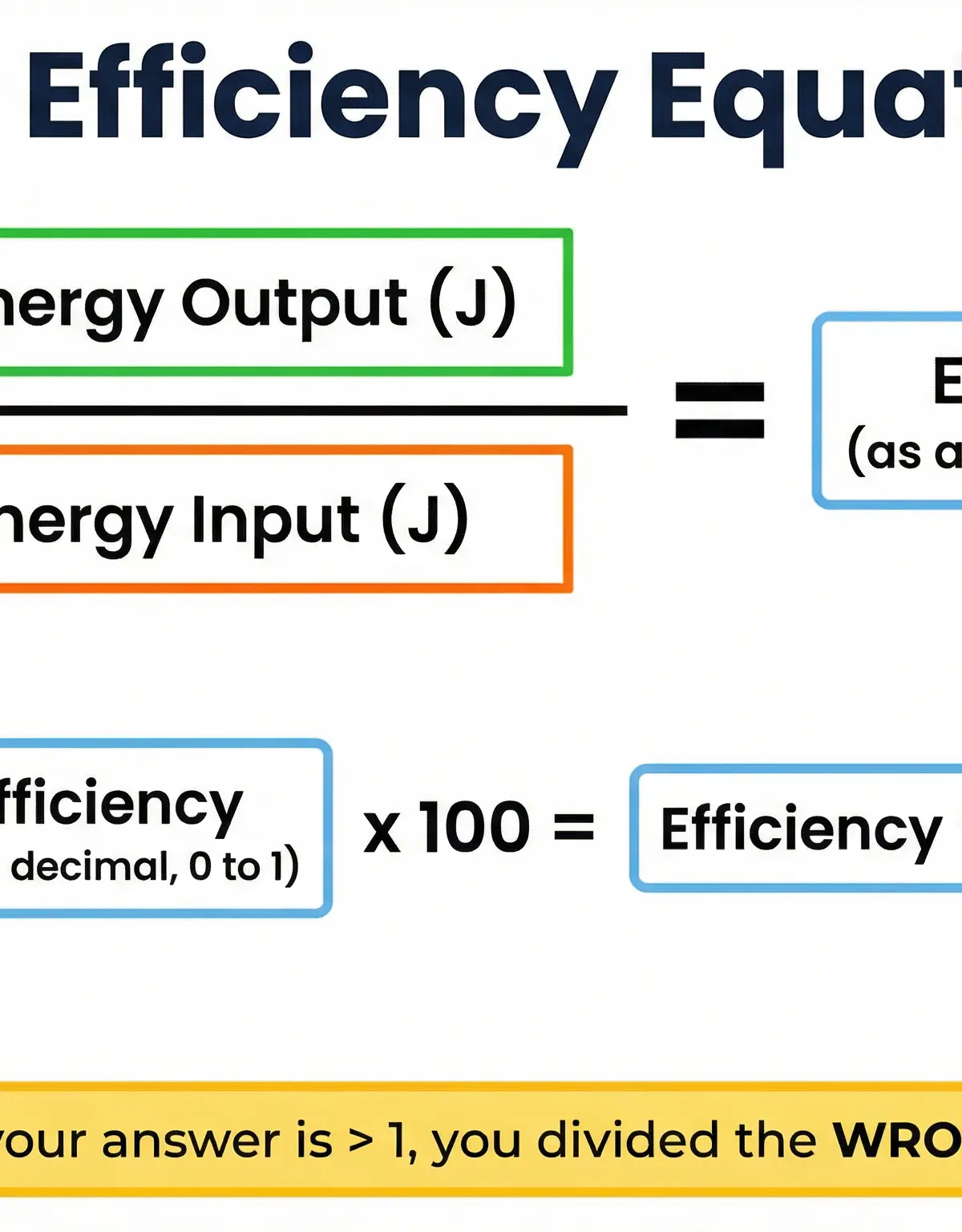
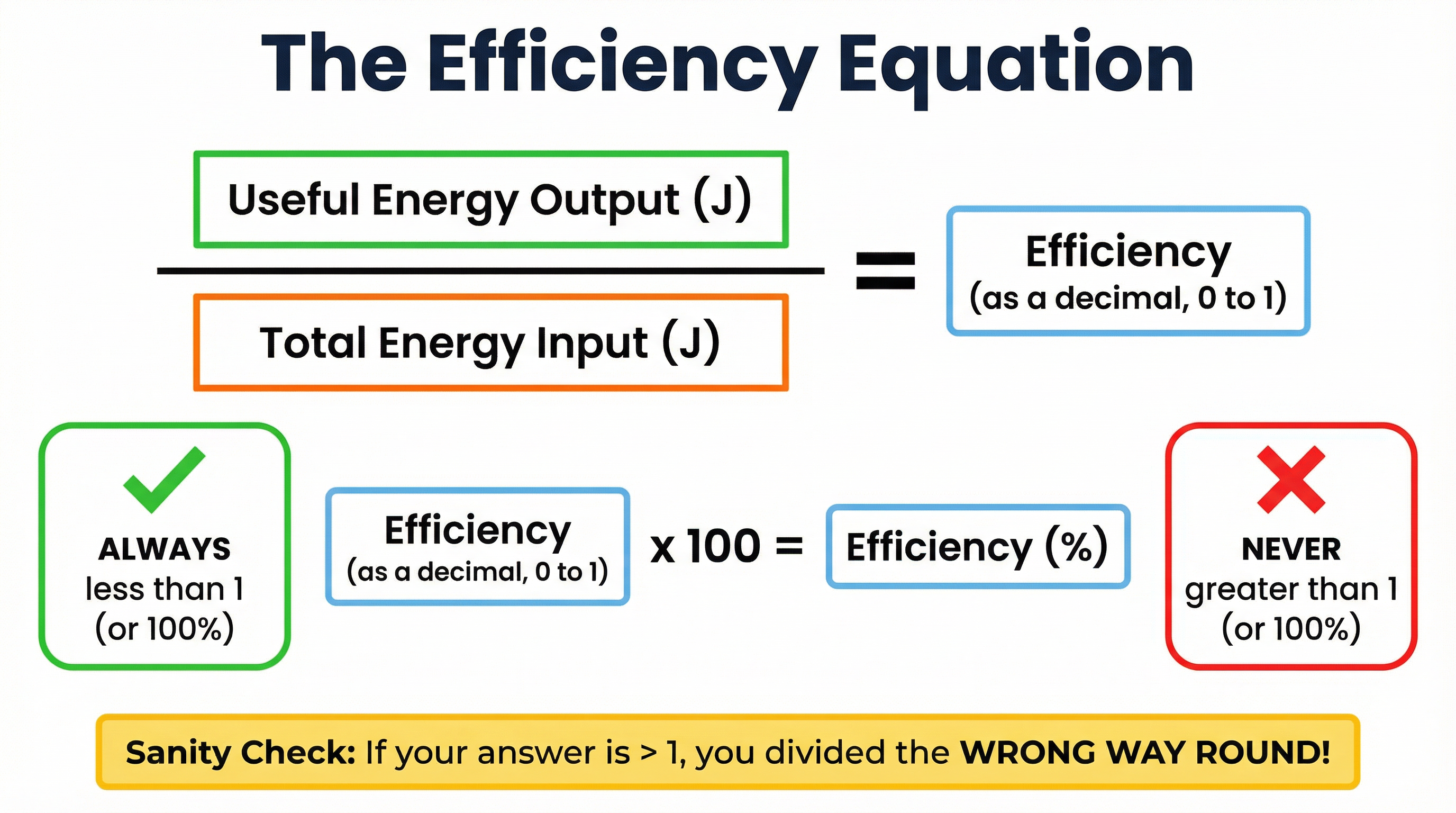
Efficiency is defined as the proportion of total input energy that is transferred to a useful energy store. The equation is:
**Efficiency = Useful Energy Output (J) ÷ Total Energy Input (J)**This produces a decimal between 0 and 1. To express efficiency as a percentage, multiply the decimal by 100:
Efficiency (%) = (Useful Energy Output ÷ Total Energy Input) × 100The critical constraint is that efficiency can never exceed 1 (or 100%). This is a direct consequence of the law of conservation of energy: you cannot get more useful energy out of a device than you put in. If a calculation produces a value greater than 1, the candidate has inverted the fraction — dividing total input by useful output rather than the other way round. Examiners award zero marks for a final answer greater than 1 and will not apply error carried forward in such cases.
Real-world analogy: Think of efficiency as the 'hit rate' of a basketball player. If they take 10 shots and score 7 baskets, their hit rate is 7/10 = 0.70 or 70%. They cannot score more baskets than they take shots — just as a device cannot output more useful energy than it receives as input.
Concept 2: Using Power Instead of Energy
A common source of confusion is that exam questions sometimes provide power (in watts, W) rather than energy (in joules, J). The efficiency formula applies identically:
**Efficiency = Useful Power Output (W) ÷ Total Power Input (W)**This works because power is simply energy per unit time (P = E/t). When you divide useful power by total power, the time cancels out, leaving the same ratio as the energy version. Candidates who recognise this can solve power-based efficiency questions without any additional steps.
Example: A motor has a total power input of 800 W and a useful mechanical power output of 600 W. Efficiency = 600 ÷ 800 = 0.75 = 75%.
Concept 3: Energy Dissipation — The Language of Wasted Energy
When a device is less than 100% efficient, the 'missing' energy is not destroyed. The law of conservation of energy states that energy cannot be created or destroyed, only transferred between stores. Wasted energy is dissipated — it spreads out into the thermal energy store of the surroundings, causing a very slight increase in temperature of the environment.
The word 'dissipated' is non-negotiable in exam answers. Examiners will not award marks for responses that state energy is 'lost', 'disappears', or is 'destroyed'. The correct phrasing is:
"The wasted energy is dissipated to the thermal energy store of the surroundings."
This matters because it reflects a genuine physical understanding: the energy still exists, it has simply been transferred to a store (the thermal store of the surroundings) from which it is extremely difficult to recover for useful purposes. This concept of energy becoming increasingly 'spread out' and less useful is related to the idea of entropy, though this is not required at GCSE level.
Concept 4: Calculating Wasted Energy
Candidates must be able to work fluently in both directions. Given total input and useful output, wasted energy is found by subtraction:
Wasted Energy = Total Energy Input − Useful Energy OutputConversely, if a question provides total input and wasted energy, the useful output must be calculated first before the efficiency formula is applied. This is a deliberate exam technique: questions that give wasted energy instead of useful output are specifically designed to test whether candidates understand the distinction. Misidentifying wasted energy as useful output is one of the most frequently penalised errors in OCR mark schemes.
Concept 5: Sankey Diagrams
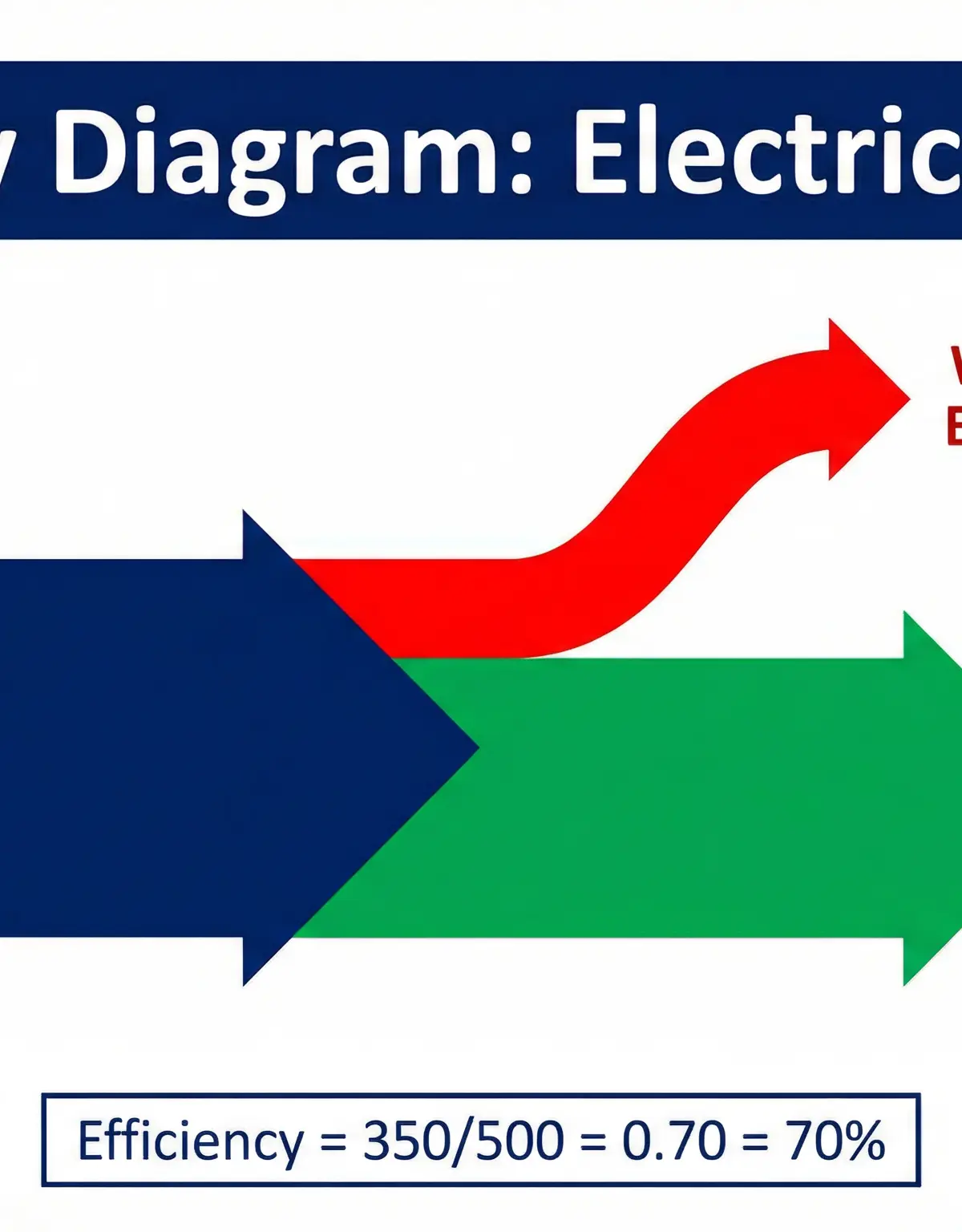
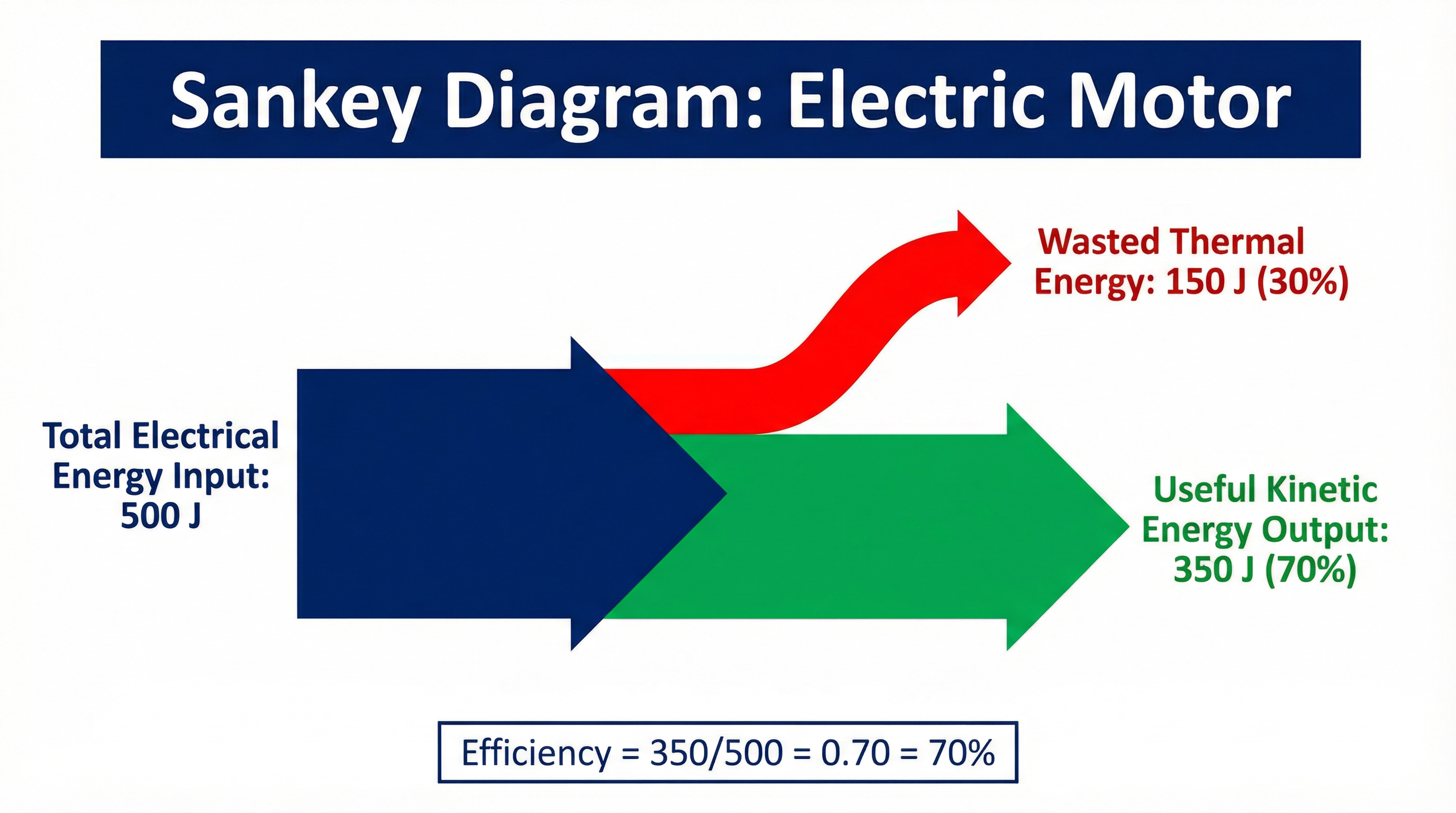
Sankey diagrams are a visual representation of energy flow through a device. The width of each arrow is proportional to the amount of energy it represents. The input arrow enters from the left; useful output continues to the right; wasted outputs branch off (typically upward or downward). Key skills for Sankey diagrams include: reading off energy values from arrow widths, calculating efficiency from the diagram, and sketching a Sankey diagram for a described device. Examiners frequently ask candidates to compare two Sankey diagrams and identify which device is more efficient.
Concept 6: Improving Efficiency
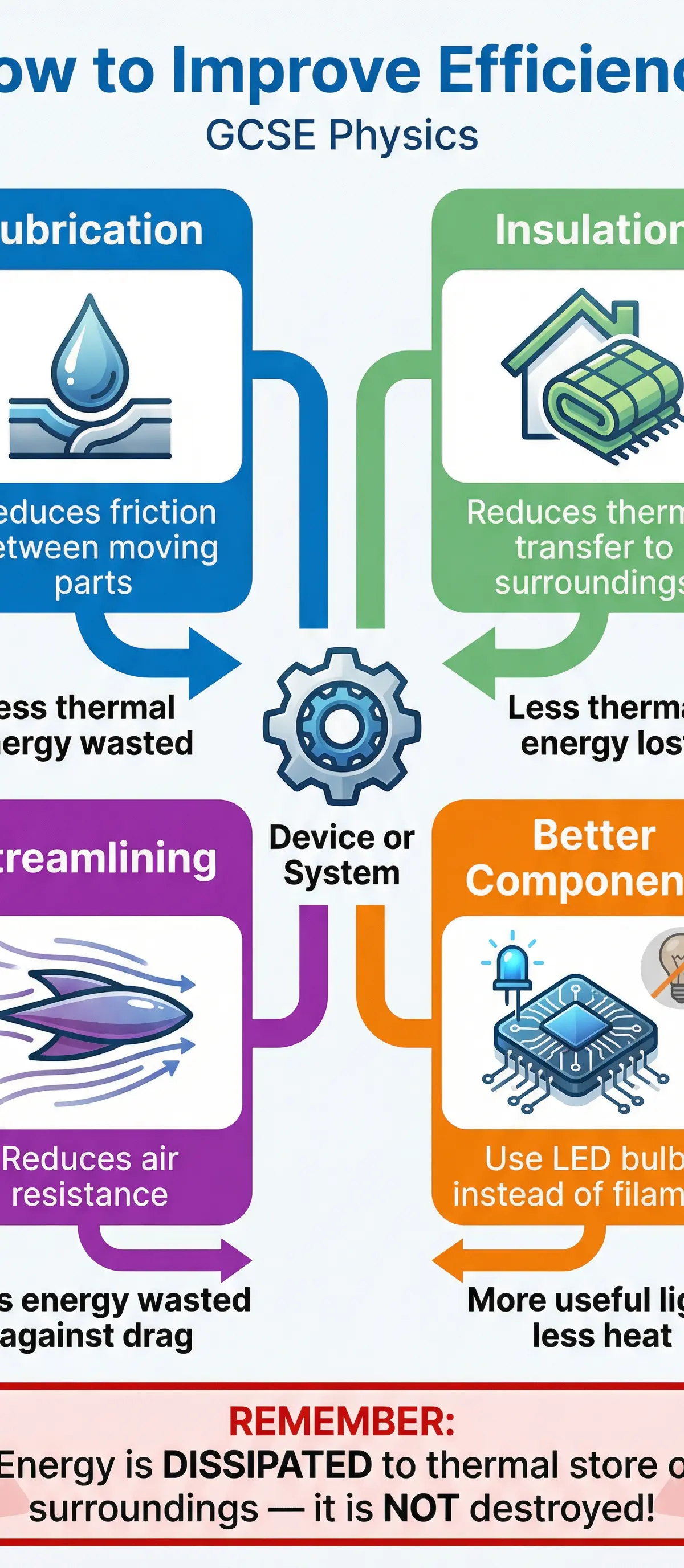
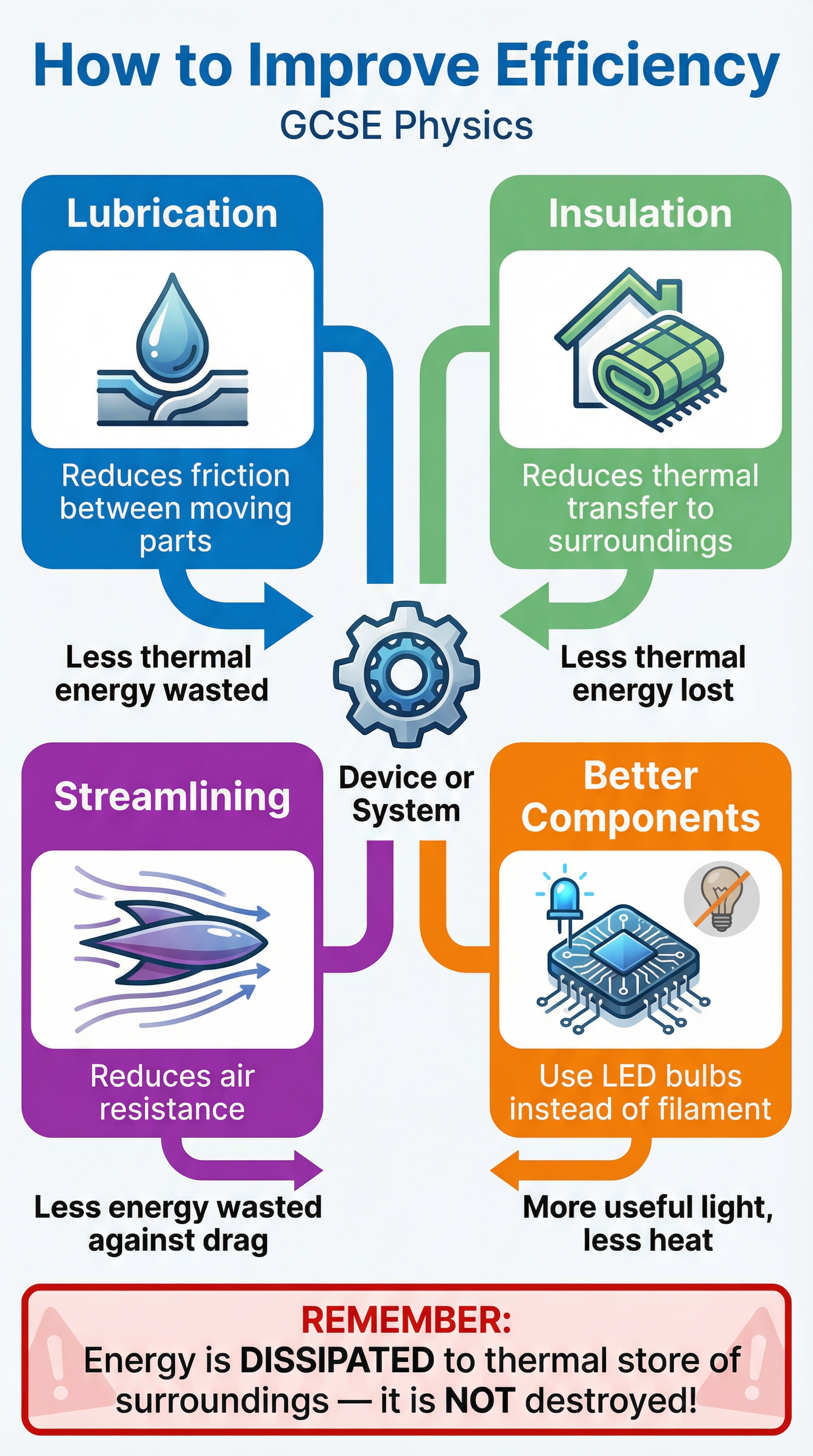
Exam questions asking candidates to 'suggest how efficiency could be improved' require specific, mechanistically justified answers. Four key mechanisms must be known:
| Mechanism | How it works | Energy effect |
|---|---|---|
| Lubrication | Oil/grease reduces friction between moving surfaces | Less energy dissipated to thermal store |
| Insulation | Insulating material reduces thermal transfer to surroundings | Less energy dissipated to thermal store |
| Streamlining | Aerodynamic shape reduces air resistance | Less energy wasted against drag |
| Better components | e.g., LED instead of filament bulb | Higher proportion of input transferred usefully |
In every case, the answer must state the mechanism AND explicitly link it to reduced energy dissipation. A response that says only 'use insulation' without explaining the energy consequence will typically earn only 1 of 2 available marks.
Mathematical Relationships
Formula 1 — Efficiency (decimal form):
Efficiency = Useful Energy Output (J) / Total Energy Input (J)
Must memorise — not given on OCR formula sheet
Formula 2 — Efficiency (percentage form):
Efficiency (%) = [Useful Energy Output / Total Energy Input] × 100
Derived from Formula 1 — not separately given
Formula 3 — Power version:
Efficiency = Useful Power Output (W) / Total Power Input (W)
Same formula, different quantities — applies identically
Formula 4 — Wasted energy:
Wasted Energy = Total Energy Input − Useful Energy Output
Derived from conservation of energy
Unit note: Energy is always in joules (J); power is always in watts (W). Efficiency itself is dimensionless (no unit) as a decimal, or expressed in % as a percentage. Candidates frequently lose marks by attaching incorrect units to the efficiency value.
Practical Applications
Efficiency is not a purely theoretical concept — it has profound real-world significance. The transition from incandescent filament bulbs (approximately 5–10% efficient) to LED bulbs (approximately 80–90% efficient) represents one of the most impactful efficiency improvements in domestic energy use. In transport, the development of hybrid and electric vehicles addresses the relatively low efficiency of internal combustion engines (typically 25–40%). Industrial motors, power stations, and heating systems are all designed with efficiency as a central engineering constraint.
For OCR GCSE, candidates are not required to complete a specific required practical on efficiency, but they may encounter data from investigations involving ramps, pulleys, or electrical circuits in which efficiency is calculated from measured input and output energies. Graph skills relevant to this topic include plotting efficiency against a variable (such as load mass) and interpreting the shape of the resulting curve.
Visual Resources
3 diagrams and illustrations
Interactive Diagrams
3 interactive diagrams to visualise key concepts
Conceptual Flow Outline
Energy flow through a device: from total input, through the device, to useful output and wasted (dissipated) energy. The efficiency calculation is shown at the bottom right.
Conceptual Flow Outline
Decision flowchart for solving any OCR efficiency calculation question. Follow each branch based on what data is given in the question, then apply the sanity check before writing your final answer.
Conceptual Flow Outline
The four mechanisms for improving efficiency and their shared pathway: each mechanism reduces energy dissipation to the thermal store, which increases the proportion of input energy transferred usefully.
Worked Examples
4 worked examples — open one to explore the question and available guidance.
Practice Questions
Test your understanding — click to reveal model answers
State the equation used to calculate efficiency. [1 mark]
Hint: Think about what you want (useful output) compared to what you put in (total input).
A washing machine uses 3600 J of electrical energy during one cycle. It transfers 2700 J of energy usefully to the kinetic store of the drum. Calculate the efficiency of the washing machine. Give your answer as a percentage. [3 marks]
Hint: Write out the formula first, then substitute the correct values. Check: is useful output on top?
A car engine has a total energy input of 12,000 J. The wasted thermal energy dissipated to the surroundings is 8,400 J. Calculate the efficiency of the engine as a decimal. [3 marks]
Hint: The question gives you wasted energy, not useful output. You must subtract first before applying the efficiency formula.
A student suggests that fitting a car with a more aerodynamic body shape would improve its fuel efficiency. Explain how this would increase the efficiency of the car. [3 marks]
Hint: Use the chain structure: What does the aerodynamic shape do? → What effect does this have on energy? → How does this affect efficiency?
A power station burns fuel to generate electricity. The total energy input from burning fuel is 500,000 J. The useful electrical energy output is 165,000 J. (a) Calculate the efficiency of the power station as a percentage. [2 marks] (b) The engineers propose two improvements: fitting better insulation around the steam pipes, and using a more efficient turbine. Evaluate which improvement is likely to have the greater effect on efficiency. [4 marks]
Hint: For part (b), consider what each improvement does to the energy transfers in the system, and think about where the largest energy losses occur in a power station.