OCR · GCSE · Physics
Elastic and Inelastic Deformation
Master the difference between elastic and inelastic deformation, a core concept in OCR GCSE Physics. This guide breaks down Hooke's Law, force-extension graphs, and energy calculations to help you secure top marks in your exams by focusing on examiner expectations and common pitfalls.
- 8 min read
- 3 worked examples
- 5 practice questions
- 6 key terms
Study Notes
Overview
Welcome to your deep dive into Elastic and Inelastic Deformation, topic 2.6 of the OCR GCSE Physics specification. This topic is fundamental to understanding how materials behave under forces, a cornerstone of engineering and materials science. In your exam, you'll be expected to move beyond simple definitions and apply your knowledge to interpret graphs, perform precise calculations, and analyse practical experiments. Examiners are looking for candidates who can clearly distinguish between elastic and inelastic behaviour, not just in words, but through the language of graphs and equations. This guide will equip you with the detailed knowledge and exam technique required to explain the behaviour of springs and other materials, calculate stored energy, and describe the associated required practical with the precision needed to achieve full marks. We will also connect this topic to the wider physics curriculum, highlighting synoptic links that examiners reward.

Key Concepts
Concept 1: Elastic vs. Inelastic Deformation
At its heart, this topic is about what happens when you apply a force to an object and change its shape. The key distinction you must master is how the object responds after the force is removed.
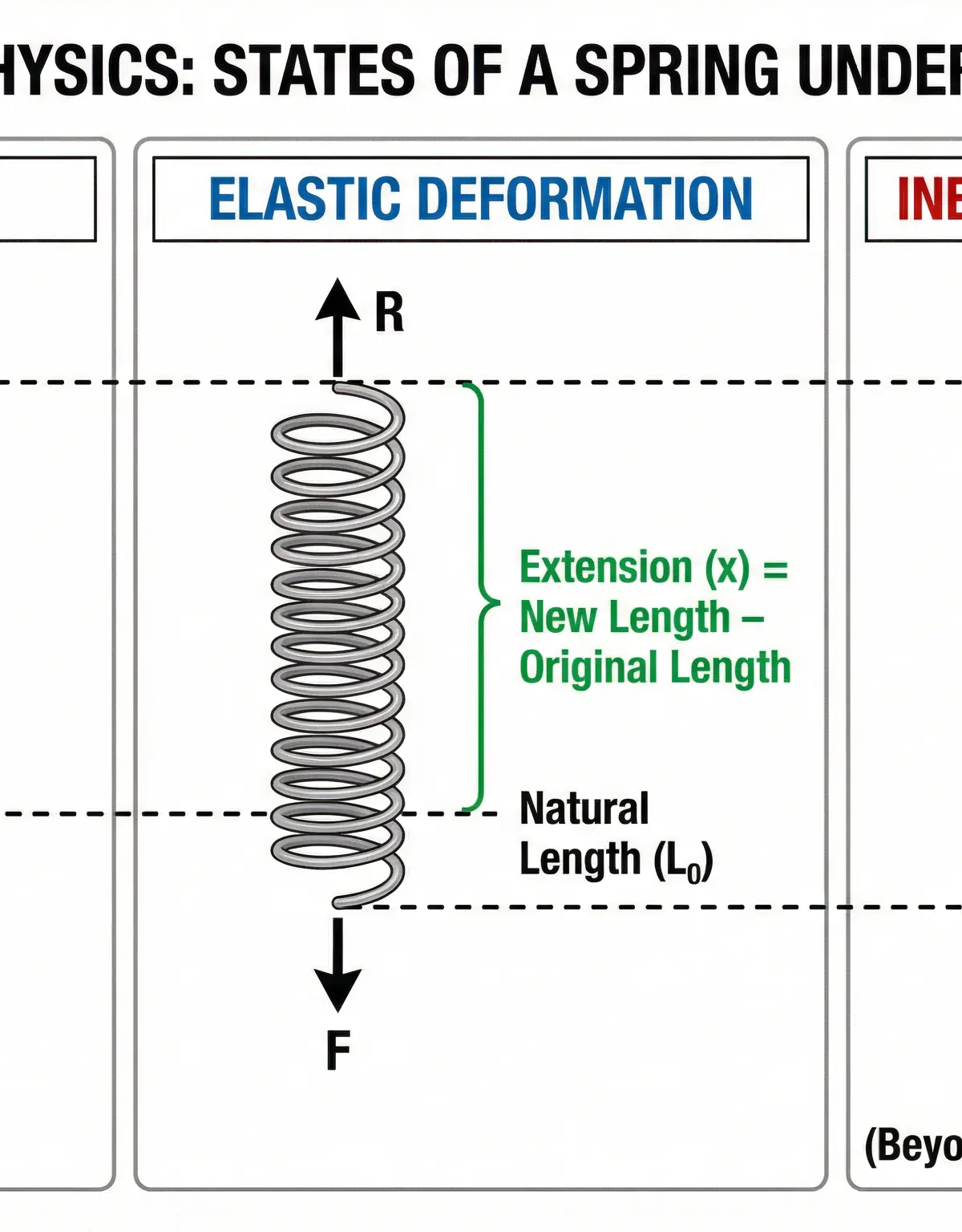
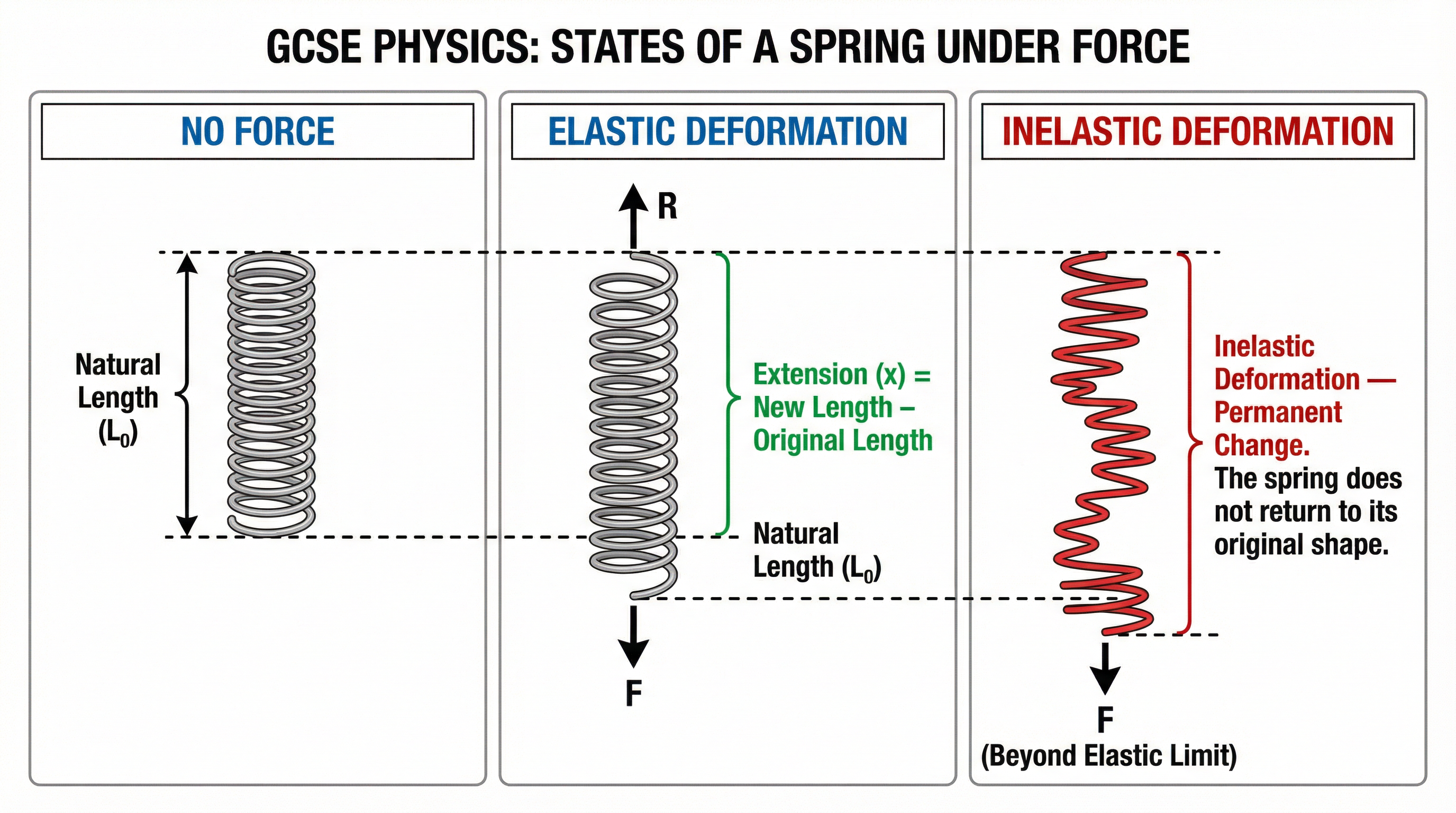
Elastic deformation is a reversible change. When the deforming force is removed, the object returns to its original shape and size. No permanent change has occurred. Think of a squash ball being hit and bouncing back, or a guitar string being plucked.
Inelastic deformation (also known as plastic deformation) is a permanent change. When the deforming force is removed, the object does not return to its original shape. It has been permanently altered. Think of a car body crumpling in a collision, or a piece of clay being moulded.
For the exam, you must use the words reversible and permanent in your definitions to be awarded marks. Simply saying "it goes back" is not sufficient.
Concept 2: Hooke's Law and the Spring Constant (k)
For many materials undergoing elastic deformation, the relationship between the applied force and the resulting extension is governed by Hooke's Law. This is a critical relationship that forms the basis of many calculation questions.
Hooke's Law states that the extension of an elastic object is directly proportional to the force applied, provided that the limit of proportionality is not exceeded.
This linear relationship gives us the famous equation:
F = kx
- F is the applied Force in Newtons (N).
- k is the Spring Constant in Newtons per metre (N/m). This is a measure of the object's stiffness. A higher value of k means the spring is stiffer and harder to stretch.
- x is the Extension in metres (m). Crucially, this is the change in length, not the total length. (Extension = New Length - Original Length).
Example: A spring with a spring constant of 200 N/m is stretched by 10 cm. What force is required?
Step 1: Convert extension to metres. x = 10 cm = 0.10 m.
Step 2: Apply Hooke's Law. F = kx = 200 N/m * 0.10 m = 20 N.
Concept 3: The Force-Extension Graph
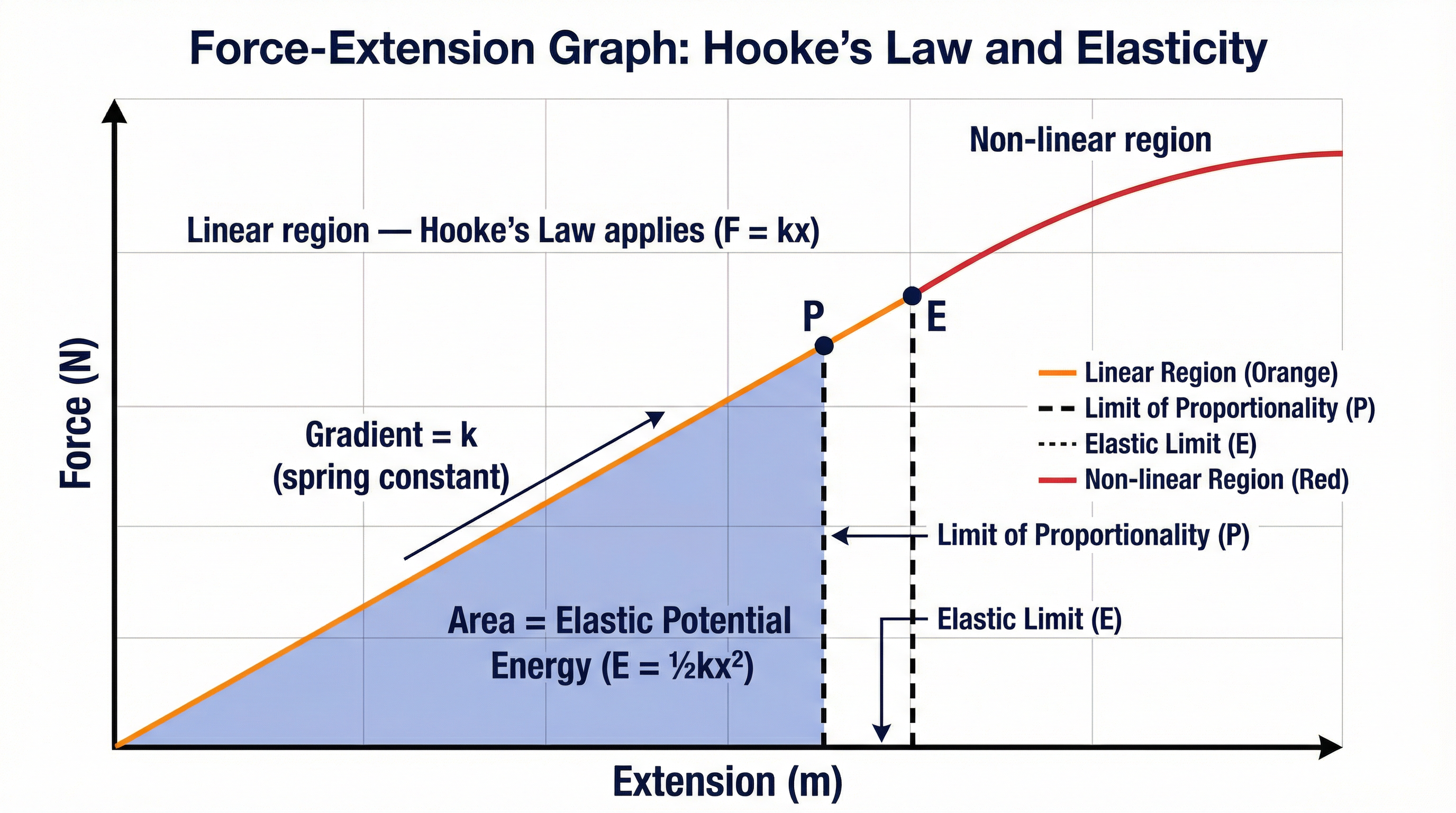
This graph is the single most important diagram in this topic. You must be able to draw, interpret, and extract data from it. It plots Force (y-axis) against Extension (x-axis).
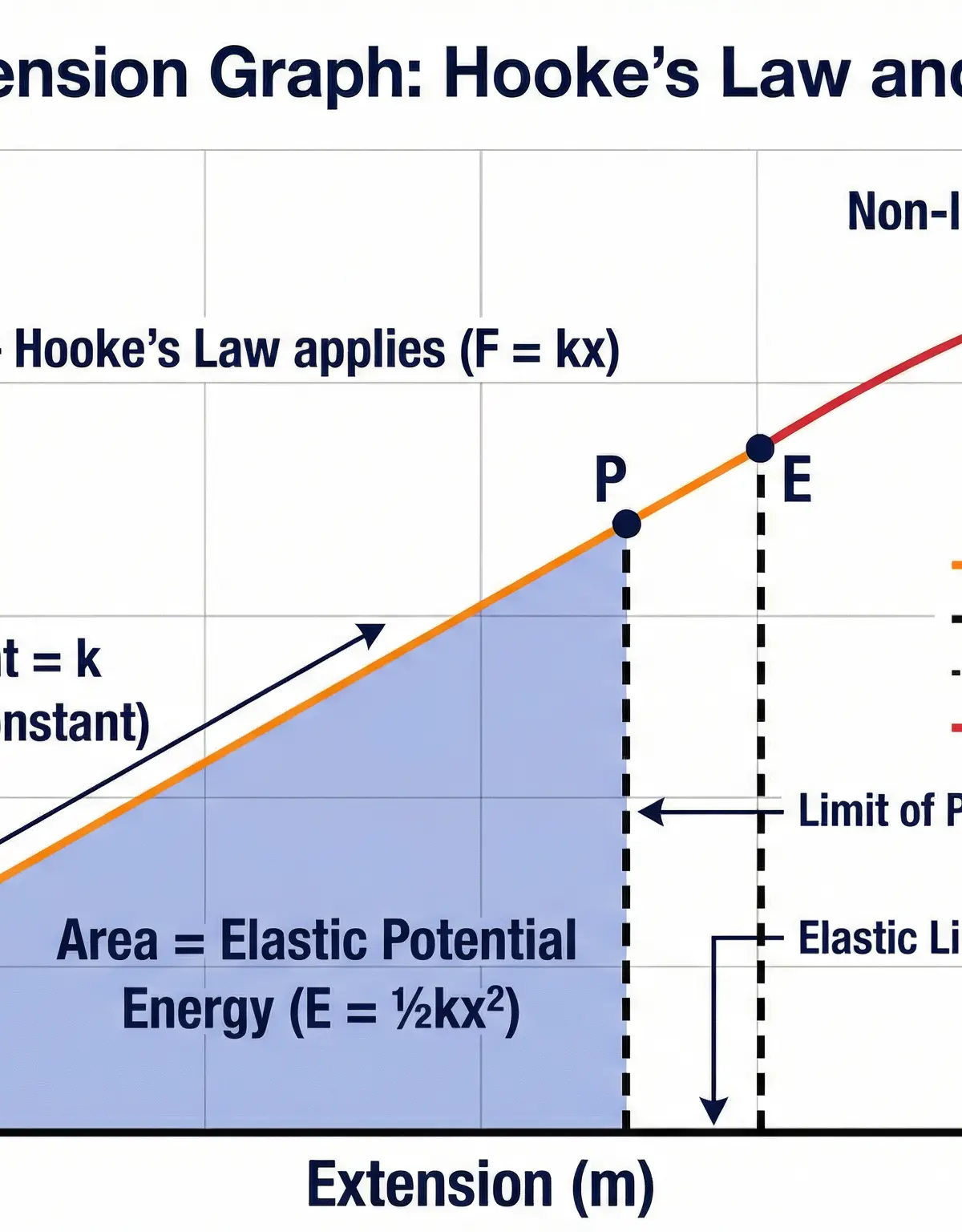
- The Linear Region (O to P): The graph starts as a straight line through the origin. In this region, force is directly proportional to extension, and Hooke's Law is obeyed. The material is behaving elastically.
- The Gradient: The gradient (rise/run) of this linear section is equal to the spring constant (k). To calculate it, pick two points on the straight line that are far apart to minimise percentage error.
- The Limit of Proportionality (P): This is the point where the graph stops being a straight line and starts to curve. Beyond this point, force is no longer directly proportional to extension. Hooke's Law no longer applies.
- The Elastic Limit (E): This is the point beyond which the material is permanently deformed. If the force is removed before the elastic limit, the object will return to its original length. If the force is taken beyond the elastic limit, the deformation is inelastic/permanent. The elastic limit is often very close to, but slightly after, the limit of proportionality.
- The Non-Linear Region: The curved part of the graph shows the material stretching more for each unit of force. This is the region of inelastic deformation.
Concept 4: Work Done and Elastic Potential Energy
Stretching or compressing a spring requires work to be done. This work done is stored as elastic potential energy (E_e) in the spring, which is released when the spring returns to its original shape.
The work done is represented by the area under the force-extension graph.
For the linear region where Hooke's Law is obeyed, this area is a triangle, which gives us the equation:
E_e = ½ kx²
- E_e is the Elastic Potential Energy in Joules (J).
- k is the Spring Constant in Newtons per metre (N/m).
- x is the Extension in metres (m).
Crucial Exam Point: This formula can only be used for calculations within the linear region (i.e., up to the limit of proportionality). If you are asked for the work done for a material stretched into its inelastic region, you must find the total area under the graph, often by counting squares.
Mathematical/Scientific Relationships
| Formula | Symbols | Meaning | Given on Formula Sheet? |
|---|---|---|---|
| F = kx | F = Force (N)<br>k = Spring Constant (N/m)<br>x = Extension (m) | Hooke's Law: Relates force, stiffness, and extension for an elastic object. | Yes |
| E_e = ½ kx² | E_e = Elastic Potential Energy (J)<br>k = Spring Constant (N/m)<br>x = Extension (m) | Elastic Potential Energy: Calculates the energy stored in a stretched/compressed elastic object. | Yes |
| Work Done = Fd | Work Done (J)<br>F = Force (N)<br>d = distance (m) | Work Done: The fundamental energy transfer equation. The area under the F-x graph represents work done. | Yes |
Required Practical: Investigating Springs
This practical is a common source of 6-mark questions. You need to know the method, the safety precautions, and how to analyse the results.
Objective: To investigate the relationship between force and extension for a spring.
Apparatus:
- Spring
- Clamp stand, boss, and clamp
- Set of slotted masses (e.g., 100g each, which is ~1N of weight)
- Metre ruler
- Fiducial marker (e.g., a pin or tape attached to the bottom of the spring)
- Goggles (safety precaution in case the spring snaps)
Method:
- Set up the apparatus by hanging the spring from the clamp.
- Measure the original length of the spring with the ruler, from the top of the spring to the fiducial marker.
- Add one 100g mass to the spring. Measure the new length of the spring.
- Calculate the extension (new length - original length).
- Repeat step 3 and 4, adding one mass at a time, until you have at least 6 different measurements.
- Record your results in a table with columns for Force (N) and Extension (m).
- Plot a graph of Force (y-axis) against Extension (x-axis).
Analysis and Examiner Points:
- Reducing Error: A fiducial marker is used to get a clear point to measure from, and the ruler should be placed as close as possible to the spring to reduce parallax error. These are key phrases that gain marks.
- Graph: The graph should be a straight line through the origin, confirming Hooke's Law.
- Calculating k: The spring constant k is calculated from the gradient of the straight-line portion of the graph.
- Safety: Goggles must be worn as the spring could snap when under tension.
Visual Resources
4 diagrams and illustrations
Interactive Diagrams
2 interactive diagrams to visualise key concepts
Conceptual Flow Outline
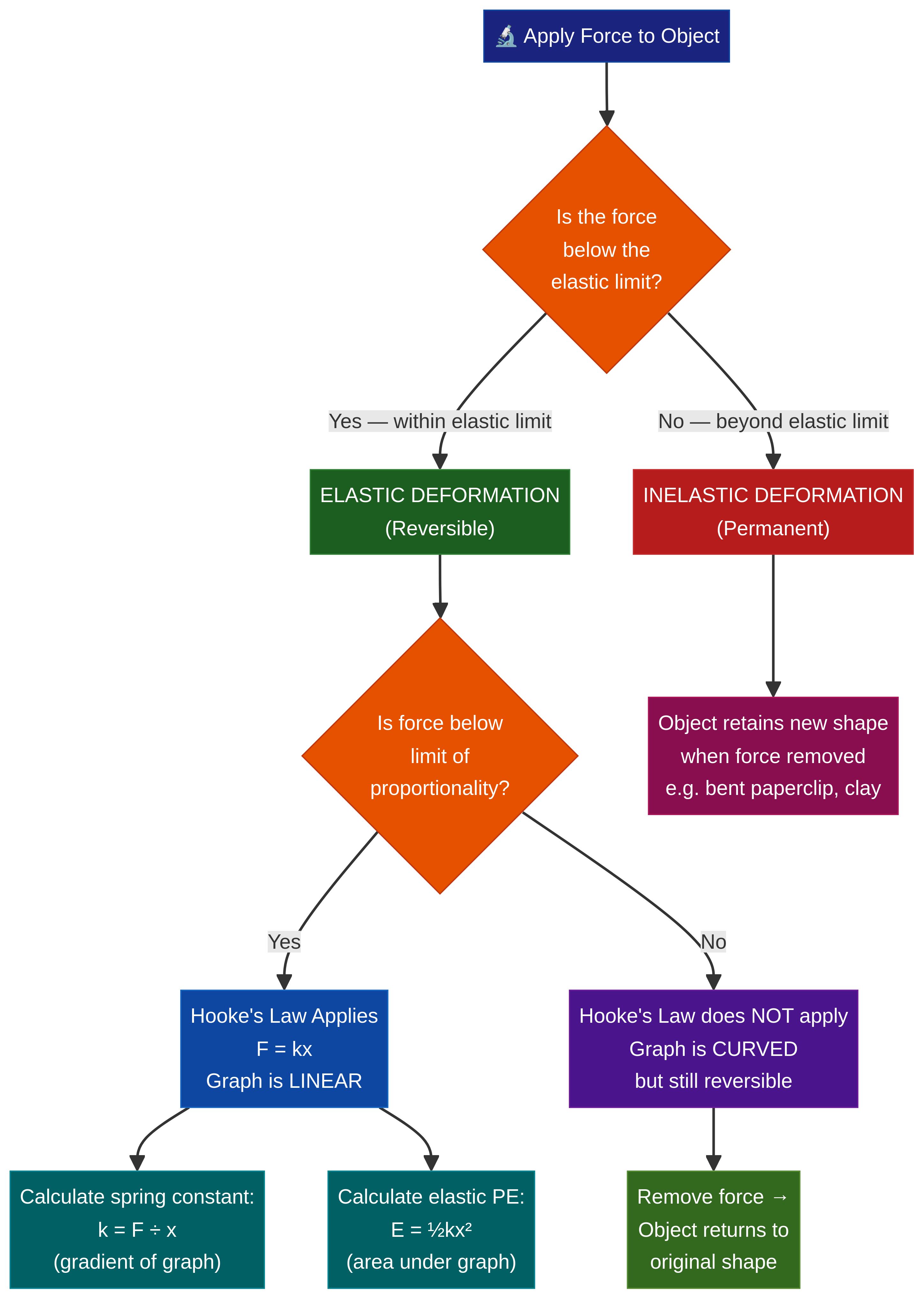
A flowchart showing the decision process for determining the type of deformation and which physical laws and formulas apply at each stage. {{asset:deformation_flowchart.png}}
Conceptual Flow Outline
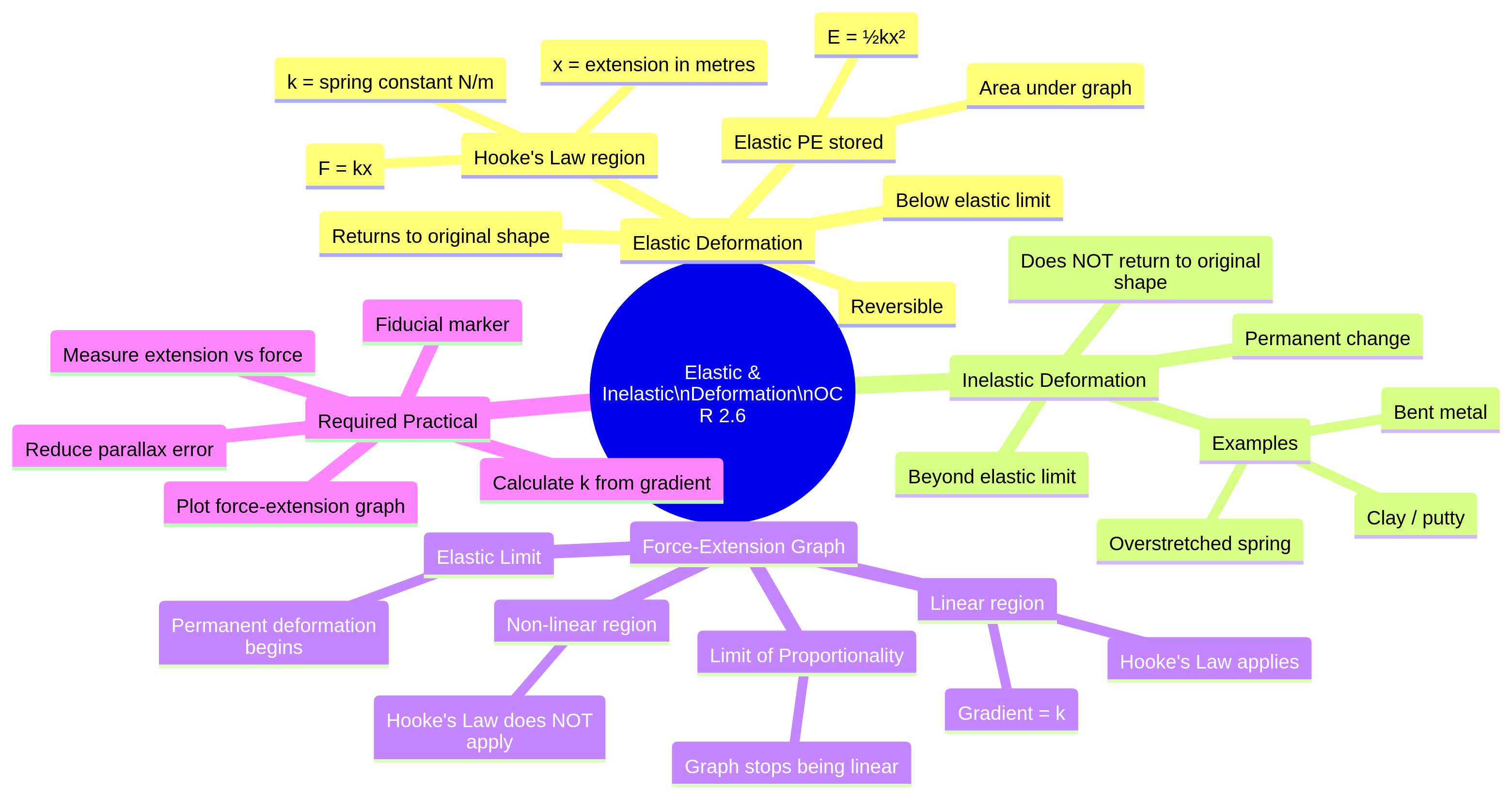
A concept map summarising the key ideas, relationships, formulas, and practical elements of the Elastic and Inelastic Deformation topic. {{asset:concept_map.png}}
Worked Examples
3 worked examples — open one to explore the question and available guidance.
Practice Questions
Test your understanding — click to reveal model answers
A spring has a spring constant of 50 N/m. Calculate the work done to stretch the spring by 20 cm. [3 marks]
Hint: Remember to use the correct formula for energy stored in a spring, and make sure your units are correct before you start.
Compare the limit of proportionality and the elastic limit for a material shown on a force-extension graph. [2 marks]
Hint: Think about what each point signifies. One is about the graph's shape, the other is about the material's physical behaviour.
A force-extension graph for a metal wire is shown. Explain how you would use the graph to find the work done in stretching the wire to an extension of 0.5 mm, given that this is in the inelastic region. [2 marks]
Hint: You cannot use the E=½kx² formula in the inelastic region. What does the area under the graph represent?
A rock climber's rope is designed to be 'dynamic', meaning it stretches a lot. Explain, in terms of energy, why this is a useful safety feature. [3 marks]
Hint: Think about the work done to stop the climber. How does stretching the rope affect the force on the climber?
A spring has an unstretched length of 12.0 cm. When a load of 3.0 N is added, its total length becomes 16.5 cm. Calculate the force that would be required to give a total length of 20.0 cm. Assume the spring obeys Hooke's Law. [4 marks]
Hint: This is a two-step problem. First, find the spring constant, k. Then use k to find the new force.