Transverse and longitudinal waves
Waves are the mechanism by which energy is transferred across space and matter, and this topic sits at the heart of OCR GCSE Physics. Candidates must master the precise distinction between transverse and longitudinal waves, command the wave equation v = fλ with confidence, and interpret both displacement-distance and displacement-time graphs accurately. Examiners consistently award marks for exact language — particularly the terms 'perpendicular', 'parallel', 'compression', and 'rarefaction' — making this a topic where precision of expression is as important as conceptual understanding.
Study Notes
Overview
Waves are one of the most pervasive phenomena in the physical universe, and OCR GCSE Physics dedicates a substantial portion of Topic 4 to ensuring candidates understand them with rigour. At its core, this topic asks a deceptively simple question: how does energy travel from one place to another? The answer — through wave motion — underpins everything from the warmth of sunlight to the sound of music, from the diagnosis of broken bones via ultrasound to the detection of earthquakes thousands of kilometres away.
For the OCR specification, candidates are assessed on two principal wave types — transverse and longitudinal — and on the quantitative relationship between wave speed, frequency, and wavelength. The topic also encompasses the required practical PAG P8, in which candidates investigate wave properties using a ripple tank or vibration transducer. Exam questions on this topic range from 1-mark definition recalls to 6-mark extended responses describing experimental methods. Assessment Objective 1 (knowledge recall) accounts for 40% of marks, AO2 (application) for 40%, and AO3 (analysis and evaluation) for 20%, meaning candidates must be equally comfortable defining terms, performing calculations, and critically evaluating experimental data.
This topic connects synoptically to the electromagnetic spectrum (Topic 4.2), sound and ultrasound (Topic 4.3), seismic waves (Topic 4.5), and the properties of light including reflection and refraction (Topic 4.4). Mastery here creates a strong foundation for the entire waves section of the specification.
Key Concepts
Concept 1: What All Waves Have in Common
Before distinguishing between wave types, it is essential to understand what all waves share. Every wave transfers energy from one location to another without the permanent bulk transfer of matter. This is a fundamental principle: the particles or fields through which a wave travels oscillate about their equilibrium positions, but they do not travel with the wave. The analogy of a Mexican wave in a stadium is instructive — spectators (particles) move up and down, but the wave pattern travels around the ground.
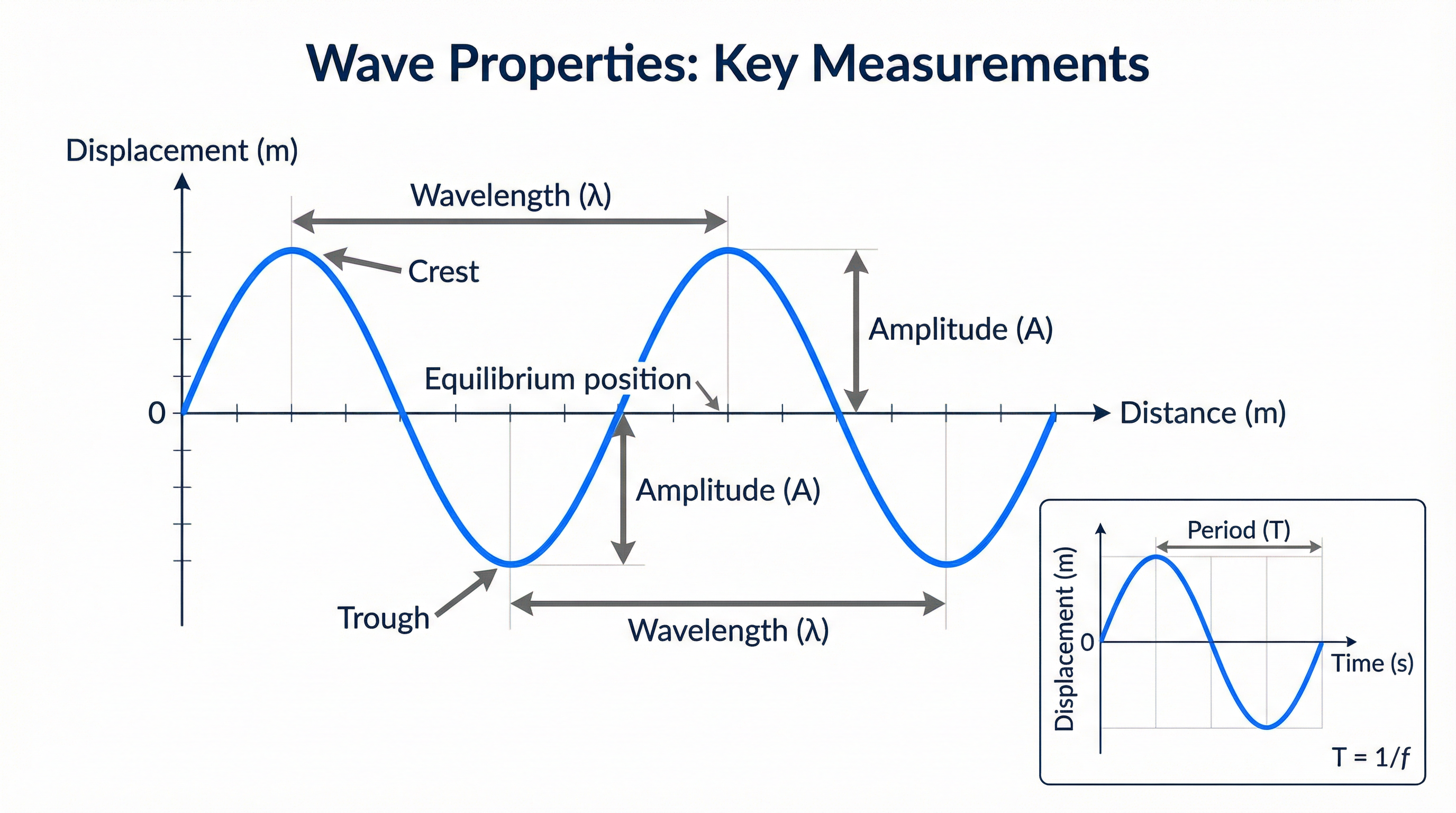
All waves are characterised by four measurable properties. Wavelength (λ) is the distance between two consecutive corresponding points on a wave — for instance, from one crest to the next, or from one compression to the next. It is measured in metres (m). Amplitude (A) is the maximum displacement of a particle from its equilibrium (rest) position, also measured in metres. A larger amplitude indicates greater energy being transferred. Frequency (f) is the number of complete wave cycles passing a fixed point per second, measured in Hertz (Hz). Period (T) is the time taken for one complete wave cycle to pass a fixed point, measured in seconds (s). Period and frequency are reciprocals: T = 1/f.
A critical examination skill is distinguishing between a displacement-distance graph and a displacement-time graph. Both produce an identical sinusoidal shape, but they measure fundamentally different things. The displacement-distance graph allows candidates to read off the wavelength directly from the x-axis. The displacement-time graph allows candidates to read off the period from the x-axis. Confusing these two graphs is one of the most frequently penalised errors at GCSE level.
Concept 2: Transverse Waves
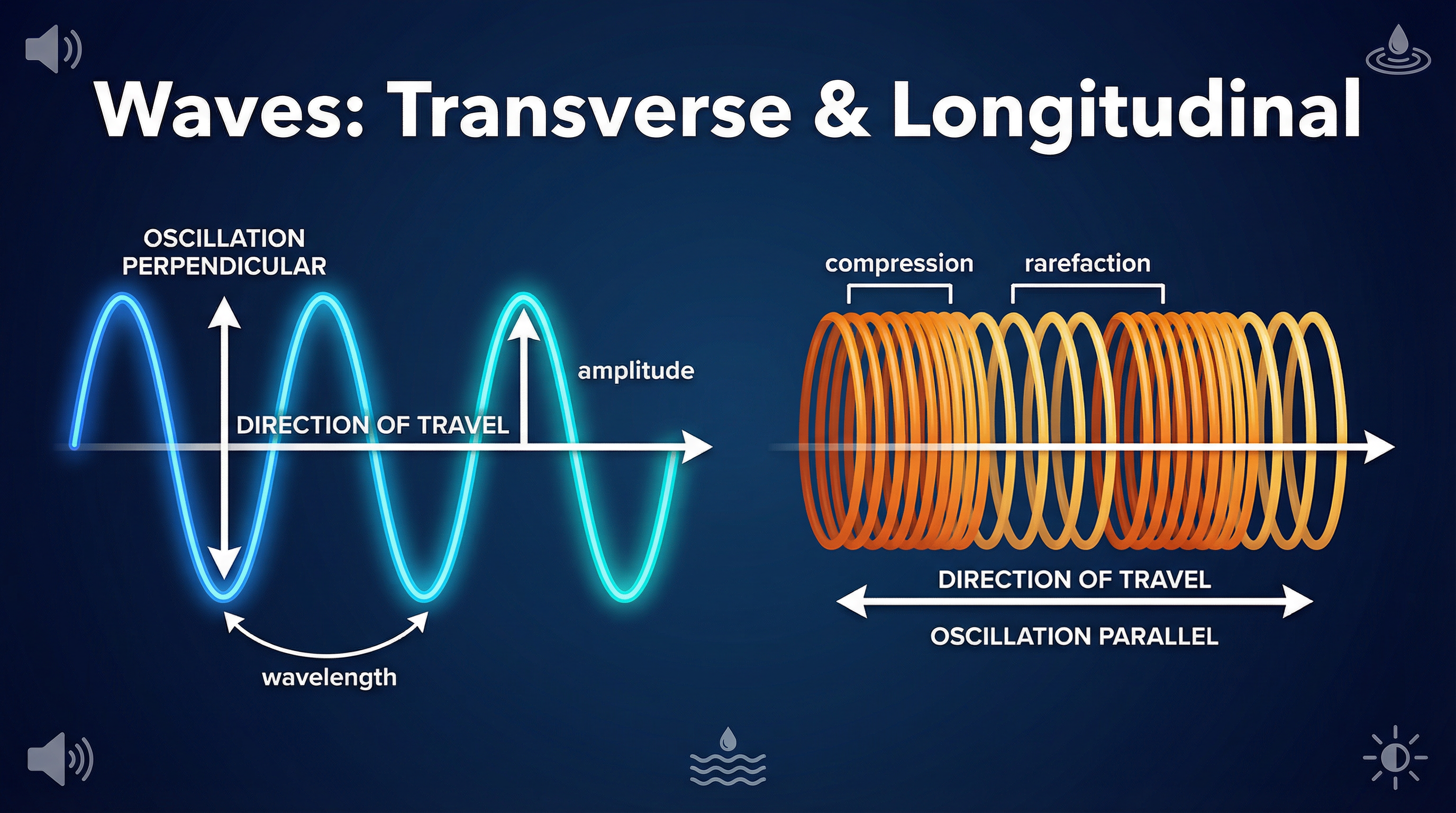
In a transverse wave, the oscillations of the particles (or fields) are perpendicular — at 90 degrees — to the direction of energy transfer. This is the mark-scheme definition, and candidates must use the word 'perpendicular' or state '90 degrees' explicitly to earn the mark. Saying that 'the wave moves at right angles to the vibration' is acceptable, but stating that 'the wave moves perpendicular to itself' is not — the reference must be to the direction of energy transfer.
Examples of transverse waves include all electromagnetic waves (light, radio waves, X-rays, microwaves, infrared, ultraviolet, and gamma rays) and water surface waves. In electromagnetic waves, it is the oscillating electric and magnetic fields that are perpendicular to the direction of travel — there is no physical medium required. Water surface waves are modelled as transverse at GCSE, with the water surface moving vertically while wave energy travels horizontally.
On a diagram, a transverse wave appears as a sinusoidal curve. The highest points are crests and the lowest points are troughs. The amplitude is measured from the equilibrium line to a crest (or trough). The wavelength spans from one crest to the next, or equivalently from any point to the next corresponding point in the cycle.
Concept 3: Longitudinal Waves
In a longitudinal wave, the oscillations of the particles are parallel to the direction of energy transfer — they vibrate back and forth along the same line as the wave travels. The essential mnemonic here is: 'Longitudinal is Along'. This single phrase encodes the parallel relationship and has helped countless candidates secure definition marks.
The primary example of a longitudinal wave is sound. When a loudspeaker cone vibrates, it pushes air molecules back and forth in the direction the sound is travelling. This creates alternating regions of high and low pressure that propagate outward from the source.
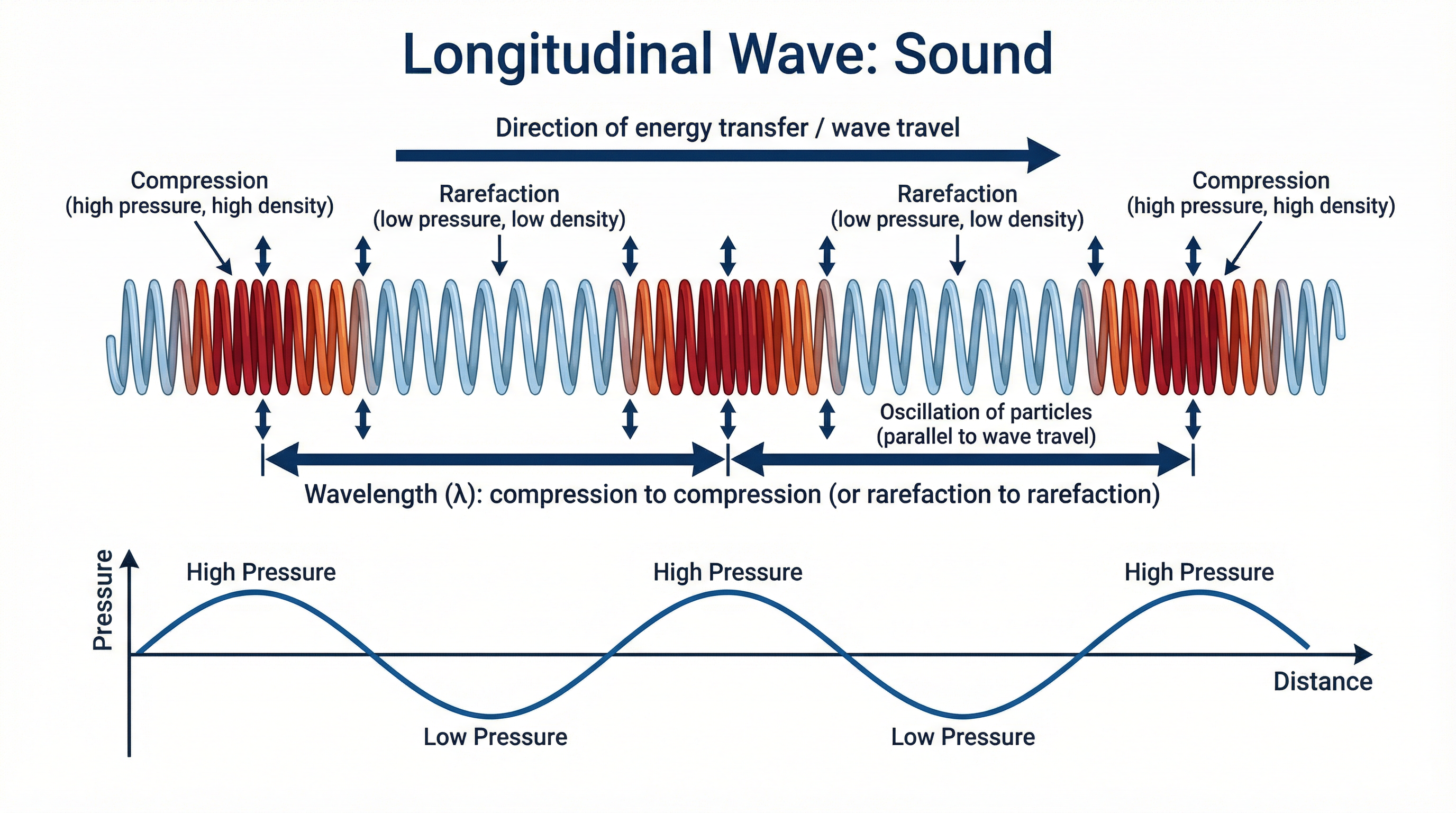
These alternating regions are called compressions and rarefactions. A compression is a region where particles are closer together than their normal spacing, resulting in high pressure and high density. A rarefaction is a region where particles are further apart than normal, resulting in low pressure and low density. Candidates must include both the pressure and the density description for full marks — stating only 'high pressure' for a compression may not attract credit if the mark scheme requires density to be mentioned.
The wavelength of a longitudinal wave is measured from one compression to the next compression (or from one rarefaction to the next rarefaction) — the distance between two consecutive corresponding points, exactly as with transverse waves.
Concept 4: The Wave Equation
The wave equation is the single most important quantitative relationship in this topic:
v = fλWhere v is wave speed in metres per second (m/s), f is frequency in Hertz (Hz), and λ is wavelength in metres (m). This equation is not provided on the OCR formula sheet and must be memorised.
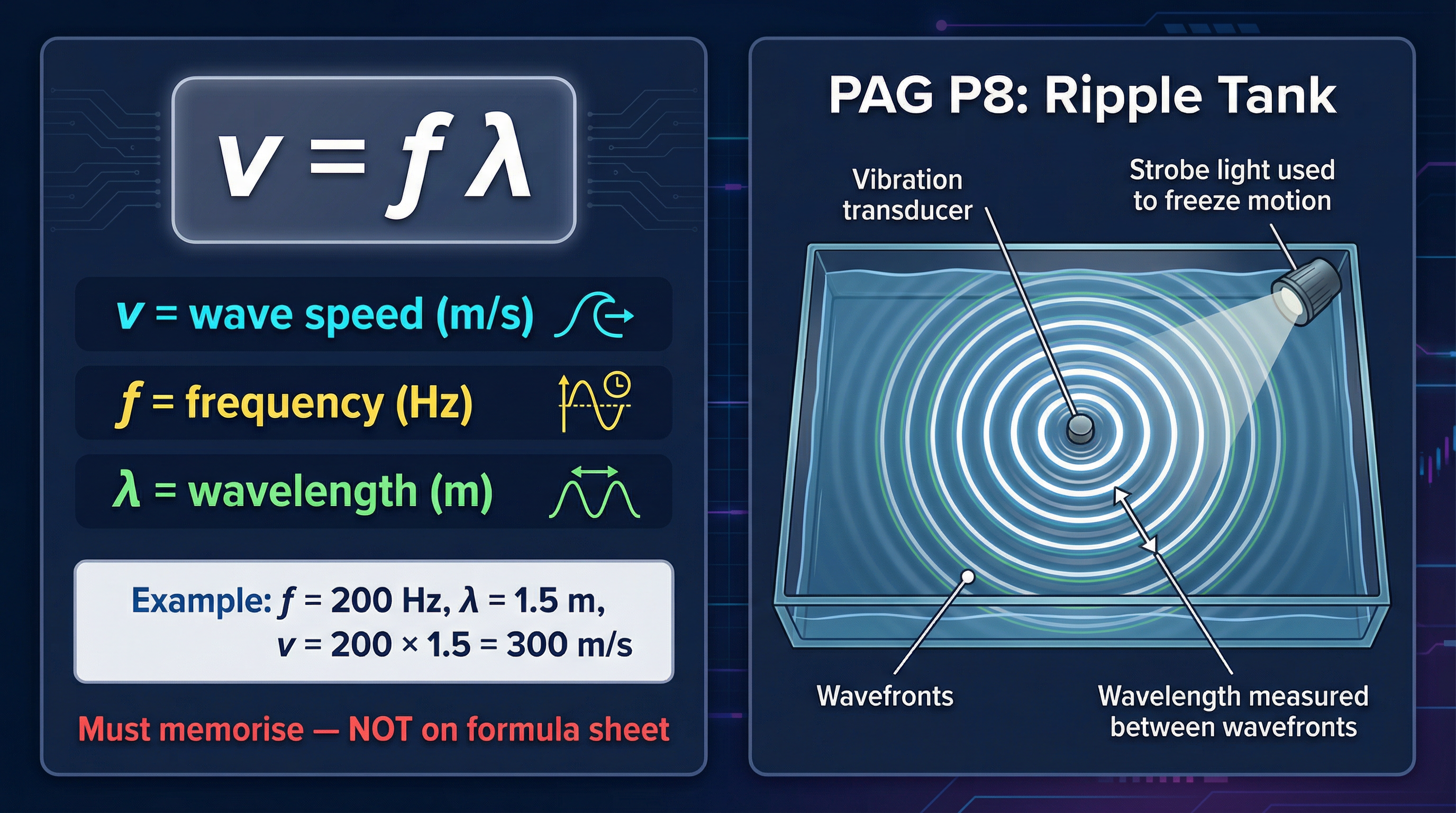
The examiner's recommended method for applying this equation is a strict three-step process. First, write down the equation in its standard form. Second, substitute the known values with their units. Third, rearrange and calculate. This approach secures method marks even if the arithmetic is incorrect, because OCR mark schemes award a mark for correct substitution prior to any rearrangement.
Unit conversion is a critical skill here. Frequency may be given in kilohertz (kHz) — multiply by 1,000 to convert to Hz. Wavelength may be given in centimetres (cm) — divide by 100 to convert to metres. Failing to convert units before substituting is the single most common source of power-of-ten errors in wave calculations.
Mathematical Relationships
| Equation | Variables | Formula Sheet? | Notes |
|---|---|---|---|
| v = fλ | v (m/s), f (Hz), λ (m) | Must memorise | Core wave equation |
| T = 1/f | T (s), f (Hz) | Must memorise | Period-frequency relationship |
| f = 1/T | f (Hz), T (s) | Must memorise | Frequency from period |
Unit Conversion Reference:
| Given Unit | Convert To | Operation |
|---|---|---|
| kHz (kilohertz) | Hz | × 1,000 |
| MHz (megahertz) | Hz | × 1,000,000 |
| cm (centimetres) | m | ÷ 100 |
| mm (millimetres) | m | ÷ 1,000 |
| nm (nanometres) | m | ÷ 1,000,000,000 |
Practical Applications and Required Practical (PAG P8)
The OCR required practical for this topic is PAG P8: Investigating Waves. Candidates may be assessed on this in the written examination, and 6-mark questions describing the method are common.
Apparatus: Ripple tank, vibration transducer (dipper), signal generator, strobe light, metre ruler, stopwatch, white paper or screen beneath the tank.
Method: Fill the ripple tank with a shallow, uniform depth of water. Connect the vibration transducer to the signal generator and set a known frequency. Use the strobe light to 'freeze' the wavefronts by matching the strobe frequency to the wave frequency. Measure the distance across multiple wavelengths using a metre ruler, then divide by the number of wavelengths to calculate the mean wavelength. This reduces percentage uncertainty. Record the frequency from the signal generator display. Calculate wave speed using v = fλ.
Key Examiner Expectations for 6-mark Questions: Name specific instruments (strobe light, metre ruler, signal generator). Explain how uncertainty is reduced (measuring multiple wavelengths and finding the mean). State what is measured and how. Describe a safety consideration if relevant (e.g., electrical equipment near water — keep signal generator away from the tank).
Graph/Data Skills: When plotting wave data, candidates should be able to plot wavelength against 1/frequency and recognise that the gradient of this graph equals the wave speed. They should also be able to read wavelength from a displacement-distance graph by identifying the distance between two consecutive crests or troughs, and read period from a displacement-time graph by identifying the time for one complete cycle.
Visual Resources
3 diagrams and illustrations
Interactive Diagrams
3 interactive diagrams to visualise key concepts
Conceptual Flow Outline
Decision flowchart for classifying wave types. Starting from the fundamental property shared by all waves, candidates follow the oscillation direction to determine whether a wave is transverse or longitudinal, with examples and key features for each.
Conceptual Flow Outline
Step-by-step flowchart for solving wave equation calculations. This process guarantees method marks even if the arithmetic is incorrect, because OCR mark schemes award marks for correct equation writing and substitution independently of the final answer.
Conceptual Flow Outline
Side-by-side comparison map of transverse and longitudinal wave properties. Use this diagram to revise the key differences and check that you can recall examples, oscillation directions, and mnemonics for both wave types.
Worked Examples
5 detailed examples with solutions and examiner commentary
Practice Questions
Test your understanding — click to reveal model answers
State what is meant by the wavelength of a wave. [1 mark]
Hint: Think about two points on the wave that are in the same position in their cycle.
A water wave has a frequency of 2.5 Hz and a wavelength of 0.40 m. Calculate the speed of the wave. [3 marks]
Hint: Write the wave equation first, then substitute the values. Check your units.
Explain the difference between a compression and a rarefaction in a sound wave. [4 marks]
Hint: Think about particle spacing and what this means for pressure and density in each region.
A student measures the speed of sound in air using two microphones connected to a data logger. The student finds that a sound wave has a period of 0.002 s and a wavelength of 0.66 m. (a) Calculate the frequency of the sound wave. [2 marks] (b) Calculate the speed of the sound wave. [2 marks]
Hint: For part (a), use the relationship between period and frequency. For part (b), use the wave equation.
A student investigates waves using a ripple tank. Describe how the student could use a ripple tank to measure the speed of water waves. Your answer should include the measurements taken and how the wave speed is calculated. [6 marks]
Hint: Think about what apparatus is needed, what measurements are taken (wavelength and frequency), how uncertainty is reduced, and how wave speed is calculated from these measurements.
A microwave oven uses microwaves with a frequency of 2450 MHz. The speed of microwaves is 3.0 × 10⁸ m/s. Calculate the wavelength of the microwaves. Give your answer in centimetres. [4 marks]
Hint: Convert MHz to Hz first. Rearrange v = fλ for wavelength. Convert your answer from metres to centimetres at the end.