OCR · GCSE · Physics
Course version: J249 · Version from Sept 2018
Recall that different substances may absorb, transmit, refract, or reflect…
Full specification wording
Wave interactions: recall that different substances may absorb, transmit, refract, or reflect electromagnetic waves in ways that vary with wavelength (Higher tier only)
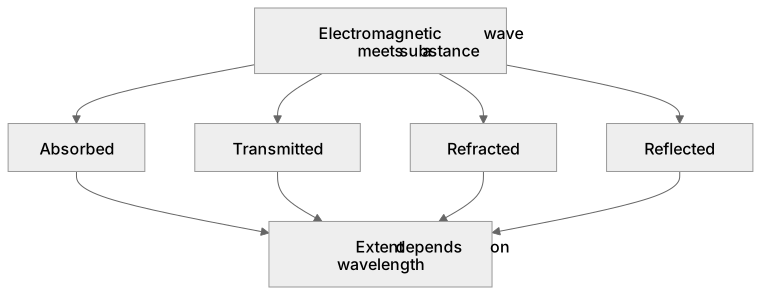
When an electromagnetic wave meets a substance, one or more things happen: the substance absorbs the wave, transmits it through, refracts it as it changes speed at a boundary, or reflects it at a…
Checked against the OCR J249 specification (opens in a new tab) on .
- Point 1 of 2
- 4 key terms
Study notes
From the checked teaching notes for this specification point.
The idea
When an electromagnetic wave meets a substance, one or more things happen: the substance absorbs the wave, transmits it through, refracts it as it changes speed at a boundary, or reflects it at a surface. The key Higher-tier idea is that how strongly each of these occurs depends on the wavelength of the wave, not just on the substance. A familiar example is a glass window: it transmits visible light well, yet absorbs much of the ultraviolet beyond the visible range and blocks some infrared. A coloured filter absorbs some visible wavelengths and transmits others, which is why it looks coloured. A shiny metal surface reflects a broad range of wavelengths, while a radio aerial responds to long wavelengths.
What earns the marks
- Identifies absorption as the transfer of electromagnetic wave energy into a substance, often raising its temperature.
- Recognises transmission as electromagnetic waves passing through a substance rather than being absorbed or reflected.
- Describes refraction as the change in direction of electromagnetic waves when their velocity changes on entering a different substance.
- States that reflection occurs when electromagnetic waves bounce off a surface or boundary.
- Explains that the extent of absorption, transmission, refraction or reflection depends on the wavelength of the electromagnetic wave.
- Selects the option that correctly links a named process to a wavelength-dependent example, such as a filter transmitting some visible wavelengths and absorbing others.
Common mistakes and how to put them right
Confuses refraction with reflection.
Put it right: Keep refraction as a change of direction caused by a change of velocity inside a new substance, and reflection as bouncing off a surface.
Assumes a substance treats all wavelengths identically.
Put it right: Recognise that absorption, transmission, refraction and reflection all vary with wavelength.
Treats transmission as the wave being absorbed and re-emitted.
Put it right: Describe transmission as the wave passing through the substance.
Ignores the wavelength clause and picks an option that is only about the substance.
Put it right: Check that the chosen option mentions how the effect varies with wavelength.
Exam tips
- Read each option and underline the named process (absorb, transmit, refract, reflect); eliminate any option that describes the wrong process.
- Check the wavelength clause: a correct option must show the effect changing with wavelength, not just with the substance.
- Use a concrete example such as a coloured filter or a glass window to test whether an option makes physical sense before selecting it.
Try the lesson
The start of the Wave interactions: recall that different substances may absorb, transmit, refract, or reflect electromagnetic waves in ways that vary with wavelength (Higher tier only) lesson, made from checked teaching notes for this specification point.
Have a go first
A sheet of ordinary window glass lets visible light pass through but blocks most ultraviolet. Which statement best explains this difference?
Listen
When an electromagnetic wave meets a substance, one or more things happen: the substance absorbs the wave, transmits it through, refracts it as it changes speed at a boundary, or reflects it at a surface. The key Higher-tier idea is that how strongly each of these occurs depends on the wavelength of the wave, not just on the substance. A familiar example is a glass window: it transmits visible light well, yet absorbs much of the ultraviolet beyond the visible range and blocks some infrared. A coloured filter absorbs some visible wavelengths and transmits others, which is why it looks coloured. A shiny metal surface reflects a broad range of wavelengths, while a radio aerial responds to long wavelengths. A strong answer earns marks for these points. Identifies absorption as the transfer of electromagnetic wave energy into a substance, often raising its temperature. Recognises transmission as electromagnetic waves passing through a substance rather than being absorbed or reflected. Describes refraction as the change in direction of electromagnetic waves when their velocity changes on entering a different substance. States that reflection occurs when electromagnetic waves bounce off a surface or boundary. Exam tip: Read each option and underline the named process (absorb, transmit, refract, reflect); eliminate any option that describes the wrong process.
See it
Key words
Say what each word means before you turn the card.
Absorption
Try answering aloud or in your head before turning the card.
Transmission
Try answering aloud or in your head before turning the card.
Refraction
Try answering aloud or in your head before turning the card.
Reflection
Try answering aloud or in your head before turning the card.
See every definition
- Absorption
- The transfer of electromagnetic wave energy into a substance, often raising its temperature.
- Transmission
- Electromagnetic waves passing through a substance rather than being absorbed or reflected.
- Refraction
- The change in direction of electromagnetic waves when their velocity changes on entering a different substance.
- Reflection
- Occurs when electromagnetic waves bounce off a surface or boundary.
Label the diagram
Some boxes have lost their names. Pick the right name for each number.
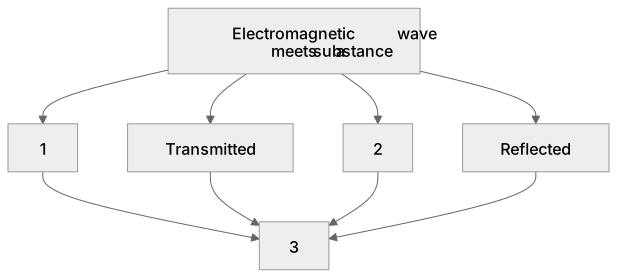
1Box 1
2Box 2
3Box 3
There is more to this lesson
The full lesson goes on to check your understanding and help you earn the marks. Create a free account to carry on, with your progress saved.
A week of Premium from your first lesson · Then the free plan continues · No card, no charge
Test your understanding of Wave interactions: recall that different substances may absorb, transmit, refract, or reflect electromagnetic waves in ways that vary with wavelength (Higher tier only)
Active recall beats re-reading. Take an instant quiz now to test what you’ve learned and lock it into long-term memory.
A week of Premium from your first lesson · Then the free plan continues · No card, no charge