OCR · GCSE · Physics
Work Done
Work Done is the mechanical pathway through which energy is transferred, defined precisely as the product of force and the distance moved in the direction of that force. Mastering this topic unlocks a chain of connected concepts — from gravitational potential energy to power — and is assessed across both Foundation and Higher tiers in OCR GCSE Physics. Candidates who understand the distinction between mass and weight, and who apply rigorous unit discipline, consistently earn full marks on these calculation-heavy questions.
- 9 min read
- 5 worked examples
- 5 practice questions
- 9 key terms
Study Notes

Overview
Work Done is one of the most fundamental and frequently examined topics in OCR GCSE Physics, sitting at the heart of the Energy chapter (Topic 2.5). At its core, the concept describes how energy is transferred mechanically: whenever a force causes an object to move, energy is transferred from one store to another, and the quantity of energy transferred is precisely what physicists call "work done." This deceptively simple idea underpins a remarkable range of real-world phenomena — from a crane lifting steel beams on a construction site to the brakes of a car converting kinetic energy into heat.
For OCR GCSE candidates, this topic is assessed on both Foundation and Higher tier papers. Foundation tier questions typically involve direct application of the equation W = F × d, while Higher tier questions demand multi-step reasoning, often requiring candidates to first calculate the weight of an object from its mass before proceeding to a work done calculation. The topic also serves as a gateway to Power (P = W/t) and Gravitational Potential Energy (GPE = mgh), both of which are deeply connected and frequently appear in the same examination question.
Examiners consistently reward candidates who treat "work done" and "energy transferred" as synonymous, who demonstrate rigorous unit discipline, and who show clear, step-by-step working. Questions on this topic appear in every series of the OCR GCSE Physics paper, typically carrying between 2 and 6 marks, and often include a command word of "Calculate" or "Explain."

Key Concepts
Concept 1: The Definition of Work Done
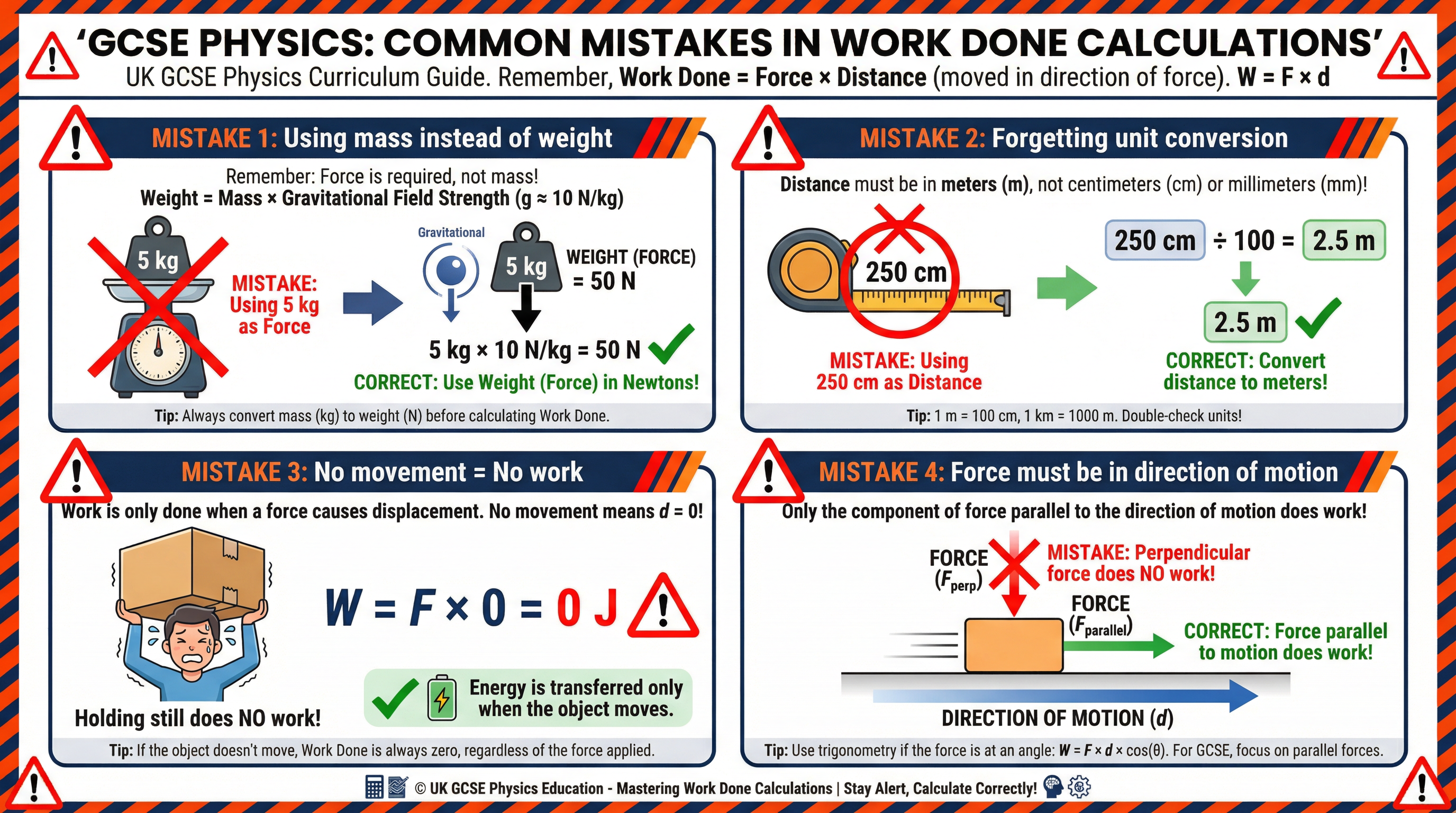
In physics, work done has a precise, technical meaning that differs from its everyday usage. Work is done on an object when a force causes that object to move through a distance in the direction of the force. This directional requirement is critical: if a force is applied perpendicular to the direction of motion, no work is done by that force.
Consider a person carrying a heavy shopping bag horizontally across a supermarket car park. The person exerts an upward force to support the bag against gravity, yet the bag moves horizontally. Because the supporting force is perpendicular to the direction of motion, the person does zero work on the bag in the physics sense — even though they feel exhausted. This is a classic OCR examination scenario designed to test whether candidates truly understand the directional condition.
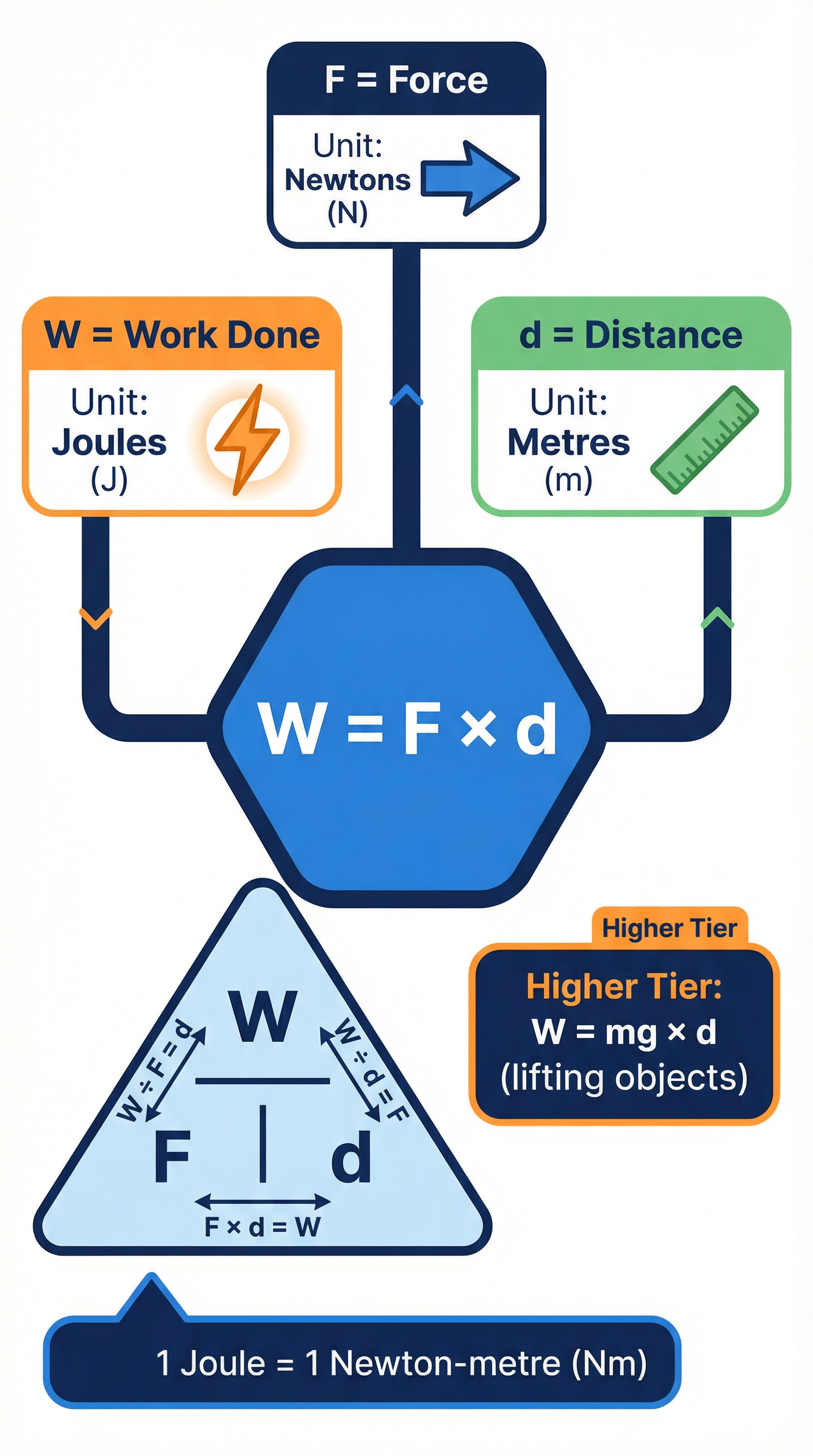
The defining equation is:
W = F × d
where W = work done (Joules, J), F = force applied (Newtons, N), d = distance moved in the direction of the force (metres, m)
A critical equivalence that examiners award a dedicated mark for is: 1 Joule = 1 Newton-metre (Nm). This is not merely a unit curiosity — it reveals the physical meaning of the Joule as the energy transferred when a one-Newton force moves an object one metre.
Concept 2: Work Done and Energy Transfer
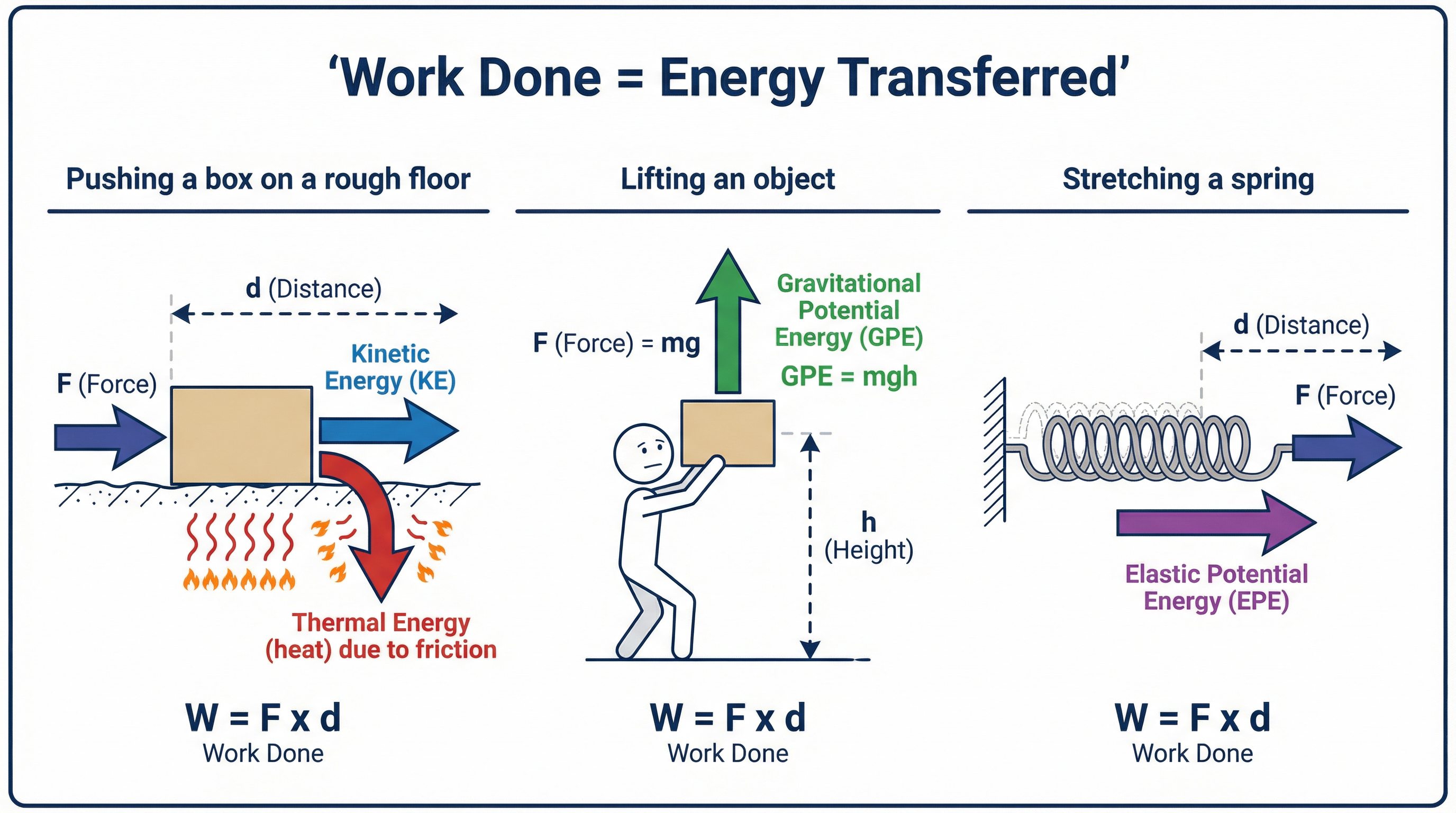
The most important conceptual insight in this topic is that work done and energy transferred are identical. They are two descriptions of the same physical event, measured in the same unit (Joules), and calculated using the same equation. OCR examiners deliberately vary their wording between questions — sometimes asking for "work done" and sometimes for "energy transferred" — to test whether candidates recognise this equivalence.
When work is done against friction (for example, pushing a box across a rough floor), the energy is not lost — it is transferred to thermal energy (heat) in the surfaces in contact and dissipated to the surroundings. Candidates who explicitly state that "energy is dissipated as thermal energy to the surroundings" when friction is involved will earn the credit that many others miss.
When work is done against gravity (lifting an object), the energy is stored as gravitational potential energy (GPE) in the object. The work done equals the GPE gained, which is why W = F × d and GPE = mgh yield identical results for a vertical lift (since F = weight = mg and d = height h).
Concept 3: The Mass vs. Weight Distinction (Higher Tier)
This is the single most common source of lost marks in Work Done questions at Higher tier. Mass (measured in kilograms, kg) is the amount of matter in an object. Weight (measured in Newtons, N) is the gravitational force acting on that mass. They are fundamentally different quantities.
The relationship between them is:
Weight = mass × gravitational field strength
W = m × g
where g = 10 N/kg on Earth (use this value unless told otherwise)
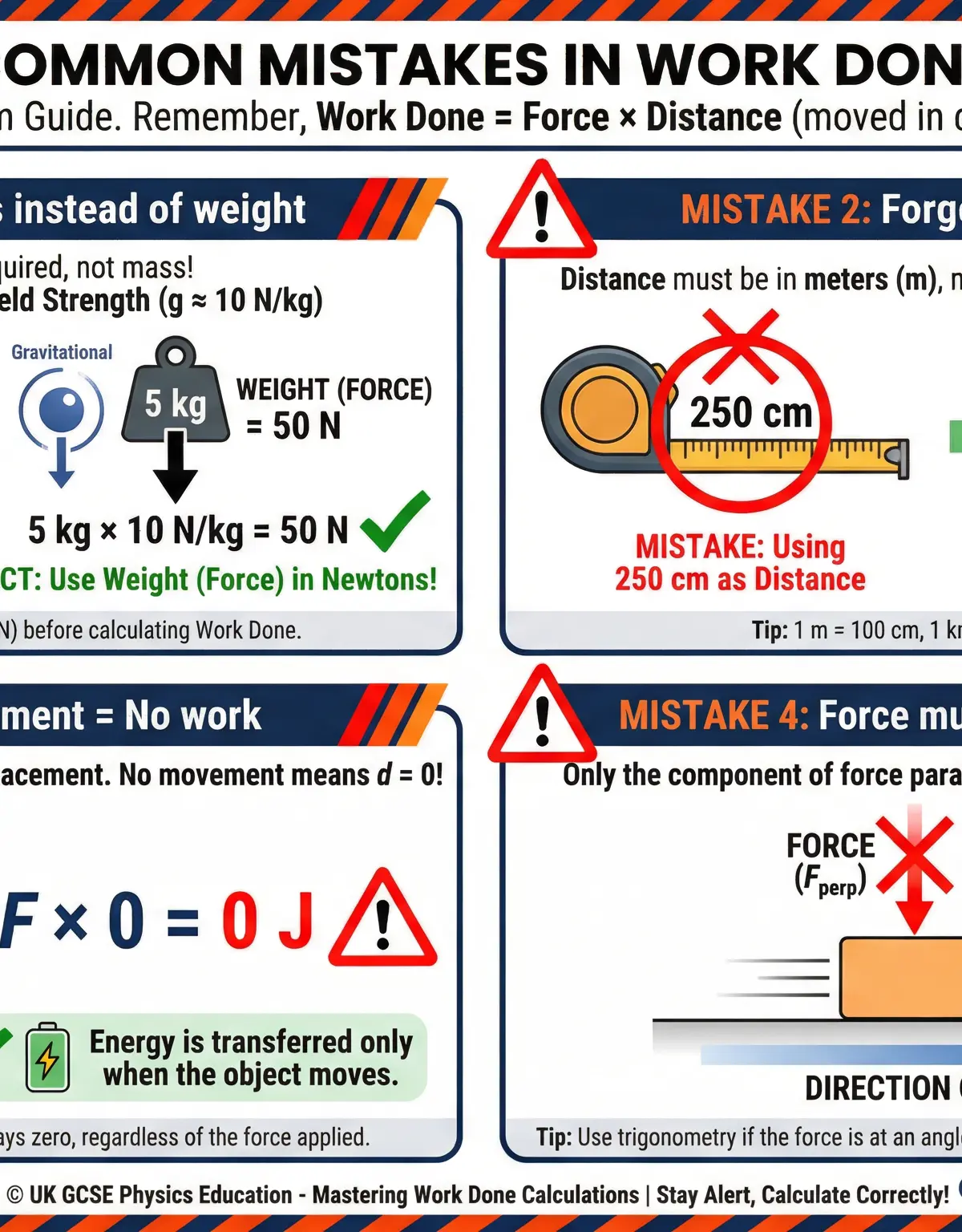
Whenever a question provides a mass in kilograms and asks about work done in lifting or moving against gravity, candidates must first calculate the weight in Newtons before substituting into W = F × d. Failing to do so — substituting the mass value directly as the force — is the most frequently penalised error in this topic.
Example: A box has a mass of 8 kg. The force needed to lift it = 8 × 10 = 80 N (not 8 N).
Concept 4: Unit Conversions
OCR examiners regularly embed unit conversion challenges within Work Done questions, particularly in higher-tariff calculations. The SI unit for distance is the metre (m), and all distances must be converted before substitution.
| Given Unit | Conversion to Metres |
|---|---|
| Centimetres (cm) | Divide by 100: 250 cm = 2.5 m |
| Millimetres (mm) | Divide by 1000: 500 mm = 0.5 m |
| Kilometres (km) | Multiply by 1000: 2 km = 2000 m |
Similarly, energy values may be given in kilojoules (kJ) or megajoules (MJ):
| Given Unit | Conversion to Joules |
|---|---|
| Kilojoules (kJ) | Multiply by 1000: 5 kJ = 5000 J |
| Megajoules (MJ) | Multiply by 1,000,000: 2 MJ = 2,000,000 J |
Concept 5: Power and Work Done (Higher Tier)
Power is the rate at which work is done — or equivalently, the rate of energy transfer. It connects directly to Work Done through the equation:
P = W / t
where P = power (Watts, W), W = work done (Joules, J), t = time (seconds, s)
Higher tier candidates are frequently asked multi-step questions that require calculating work done first, then using that value to find power, or vice versa. One Watt is defined as one Joule per second (1 W = 1 J/s). This equation is given on the OCR formula sheet, but candidates must be able to rearrange it: W = P × t and t = W / P.

Mathematical Relationships and Formulas
The following table summarises all formulas relevant to this topic, with their memorisation status for OCR GCSE:
| Formula | Meaning | Units | OCR Formula Sheet? |
|---|---|---|---|
| W = F × d | Work done = Force × distance | J = N × m | Must memorise |
| Weight = m × g | Weight = mass × gravitational field strength | N = kg × N/kg | Must memorise |
| GPE = m × g × h | Gravitational potential energy | J | Given on sheet |
| P = W / t | Power = Work done ÷ time | W = J/s | Given on sheet |
| KE = ½mv² | Kinetic energy | J | Given on sheet |
Key equivalence to memorise: 1 J = 1 N·m (one Joule equals one Newton-metre)
Practical Applications
Work Done is not an abstract concept — it describes energy transfer in countless real-world contexts that OCR examiners use as question settings:
Construction and Engineering: A crane lifts a steel beam of mass 500 kg to a height of 12 m. The work done against gravity equals the GPE gained: W = 500 × 10 × 12 = 60,000 J = 60 kJ.
Transport: A car engine applies a driving force of 3,000 N to move the car 400 m along a road. Work done = 3,000 × 400 = 1,200,000 J = 1.2 MJ. If friction forces are present, some of this energy is dissipated as thermal energy.
Sports Science: A weightlifter raises a 120 kg barbell 2.1 m above the ground. Weight = 120 × 10 = 1,200 N. Work done = 1,200 × 2.1 = 2,520 J. Once the barbell is held stationary overhead, no further work is done — a concept that surprises many students.
Braking: When a car brakes, the braking force does work against the motion of the car. This work is done against friction in the brake pads, transferring kinetic energy to thermal energy in the brakes and surroundings.
Graph and Data Skills
While Work Done questions are primarily calculation-based, candidates may encounter force-distance graphs in the context of elastic potential energy (Hooke's Law). The area under a force-distance graph equals the work done. For a linear (straight-line) graph through the origin (as with a spring obeying Hooke's Law), the area is a triangle: Work done = ½ × F × d. This is a Higher tier skill and connects Work Done to the topic of springs and elastic potential energy.
Visual Resources
3 diagrams and illustrations
Interactive Diagrams
3 interactive diagrams to visualise key concepts
Conceptual Flow Outline
Decision flowchart for solving any Work Done calculation question — follow each step to avoid the most common errors and secure every available mark
Conceptual Flow Outline
Energy transfer pathways through Work Done — showing how the type of motion determines which energy store receives the transferred energy
Conceptual Flow Outline
Synoptic concept map showing how Work Done connects to Power, Gravitational Potential Energy, and Kinetic Energy — essential for Higher tier multi-step questions
Worked Examples
5 worked examples — open one to explore the question and available guidance.
Practice Questions
Test your understanding — click to reveal model answers
A person pushes a shopping trolley with a force of 40 N across a car park. The trolley moves 25 m. Calculate the work done by the person. [2 marks]
Hint: Use W = F × d. Both values are already in the correct units.
A crane lifts a steel beam of mass 200 kg to a height of 15 m. Calculate the work done by the crane. (g = 10 N/kg) [4 marks]
Hint: The beam has a mass, not a weight. You must calculate the weight (in Newtons) before you can use W = F × d.
A horse pulls a plough with a force of 1200 N along a field. The plough moves 350 m. The ground exerts a friction force of 400 N on the plough. (a) Calculate the work done by the horse. [2 marks] (b) Explain what happens to the energy transferred by the friction force. [2 marks]
Hint: For part (a), use the horse's force (1200 N) and the distance. For part (b), think about what friction does to energy — where does it go?
A motor does 45,000 J of work in 3 minutes. Calculate the power output of the motor. [Higher Tier — 4 marks]
Hint: Power = Work done ÷ time. Check the units of time — the question gives minutes, but the equation requires seconds.
A 60 kg athlete runs up a hill. The vertical height of the hill is 80 m and the distance along the slope is 200 m. The athlete applies an average force of 300 N along the slope. (a) Calculate the work done by the athlete running up the slope. [2 marks] (b) Calculate the gravitational potential energy gained by the athlete. (g = 10 N/kg) [3 marks] (c) Suggest why your answers to (a) and (b) are different. [2 marks] [Higher Tier]
Hint: For (a) use the force along the slope and the distance along the slope. For (b) use GPE = mgh with the vertical height. For (c) think about where the 'extra' energy goes.
Test your understanding of Work Done
Active recall beats re-reading. Take an instant quiz now to test what you’ve learned and lock it into long-term memory.
7 days Premium · Then free forever · No card, no charge