OCR · GCSE · Physics
Course version: J249 · Version from Sept 2018
Describe for situations where there are energy transfers in a system, that…
Full specification wording
Work done: describe for situations where there are energy transfers in a system, that there is no net change to the total energy of a closed system (qualitative only) (to include: the law of conservation of energy)
The law of conservation of energy states that energy cannot be created or destroyed, only transferred from one store to another.
Checked against the OCR J249 specification (opens in a new tab) on .
- Point 1 of 5
- 4 key terms
Study notes
From the checked teaching notes for this specification point.
The idea
The law of conservation of energy states that energy cannot be created or destroyed, only transferred from one store to another. In a closed system, no energy enters or leaves from outside, so although energy moves between stores, the total energy stays the same. For example, a falling ball transfers energy from its gravitational potential store to its kinetic store, and some to thermal energy by heating the surroundings through air resistance, but the total within the closed system does not change. A multiple-choice question may ask you to pick the statement that correctly describes this. Choose the option that says energy is transferred between stores with no net change to the total in a closed system.
What earns the marks
- States that energy cannot be created or destroyed, only transferred between stores.
- Recognises that in a closed system no energy enters or leaves from outside.
- Concludes that the total energy of a closed system shows no net change.
- Describes energy moving between stores, such as gravitational potential to kinetic, while the total stays constant.
- Applies the law of conservation of energy to a described situation qualitatively.
Common mistakes and how to put them right
Claims that energy is used up or destroyed during transfers.
Put it right by stating that energy is transferred, not destroyed.
Assumes the total energy changes because one store empties.
Put it right by noting that energy moves to another store so the total is unchanged.
Treats an open system as closed.
Put it right by checking whether energy enters or leaves from outside.
Gives a numerical calculation when the question asks for a qualitative description.
Put it right by describing the transfers in words.
Exam tips
- Look for the option that mentions both transfer between stores and no net change to the total.
- Check whether the system is described as closed before accepting a statement about constant total energy.
- Reject any option that says energy is created, destroyed or used up.
Try the lesson
The start of the Work done: describe for situations where there are energy transfers in a system, that there is no net change to the total energy of a closed system (qualitative only) (to include: the law of conservation of energy) lesson, made from checked teaching notes for this specification point.
Have a go first
A ball is dropped and falls towards the ground. Energy is transferred from its gravitational store to its kinetic store. What happens to the total energy of the ball and its surroundings during the fall?
Listen
The law of conservation of energy states that energy cannot be created or destroyed, only transferred from one store to another. In a closed system, no energy enters or leaves from outside, so although energy moves between stores, the total energy stays the same. For example, a falling ball transfers energy from its gravitational potential store to its kinetic store, and some to thermal energy by heating the surroundings through air resistance, but the total within the closed system does not change. A multiple-choice question may ask you to pick the statement that correctly describes this. Choose the option that says energy is transferred between stores with no net change to the total in a closed system. A strong answer earns marks for these points. States that energy cannot be created or destroyed, only transferred between stores. Recognises that in a closed system no energy enters or leaves from outside. Concludes that the total energy of a closed system shows no net change. Describes energy moving between stores, such as gravitational potential to kinetic, while the total stays constant. A common slip: Claims that energy is used up or destroyed during transfers. Instead, stating that energy is transferred, not destroyed. Exam tip: Look for the option that mentions both transfer between stores and no net change to the total.
See it
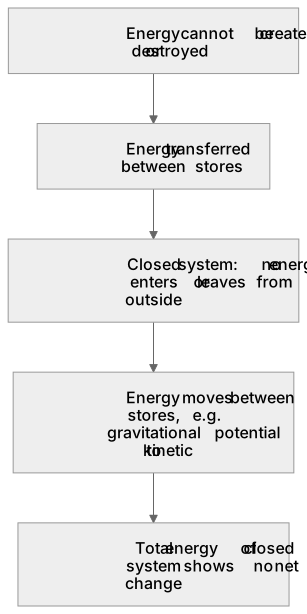
Put it in order
Put these steps in the order they happen.
- 1. Energy transferred between stores
- 2. Closed system: no energy enters or leaves from outside
- 3. Energy cannot be created or destroyed
- 4. Total energy of closed system shows no net change
- 5. Energy moves between stores, e.g. gravitational potential to kinetic
Key words
Say what each word means before you turn the card.
Conservation of energy
Try answering aloud or in your head before turning the card.
Closed systems
Try answering aloud or in your head before turning the card.
Energy transfers between stores
Try answering aloud or in your head before turning the card.
Qualitative description
Try answering aloud or in your head before turning the card.
See every definition
- Conservation of energy
- The law stating that energy cannot be created or destroyed, only transferred from one store to another.
- Closed systems
- A system in which no energy enters or leaves from outside, so the total energy stays the same.
- Energy transfers between stores
- Energy moving from one store to another, such as gravitational potential to kinetic, while the total stays constant.
- Qualitative description
- Describing the transfers in words rather than giving a numerical calculation.
Label the diagram
Some boxes have lost their names. Pick the right name for each number.
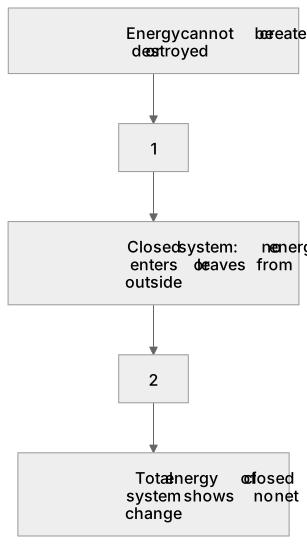
1Box 1
2Box 2
There is more to this lesson
The full lesson goes on to check your understanding and help you earn the marks. Create a free account to carry on, with your progress saved.
A week of Premium from your first lesson · Then the free plan continues · No card, no charge
Test your understanding of Work done: describe for situations where there are energy transfers in a system, that there is no net change to the total energy of a closed system (qualitative only) (to include: the law of conservation of energy)
Active recall beats re-reading. Take an instant quiz now to test what you’ve learned and lock it into long-term memory.
A week of Premium from your first lesson · Then the free plan continues · No card, no charge