OCR · GCSE · Physics
Course version: J249 · Version from Sept 2018
Make calculations of the energy changes associated with changes in a…
Full specification wording
Work done: make calculations of the energy changes associated with changes in a system, recalling or selecting the relevant equations for mechanical, electrical, and thermal processes; thereby express in quantitative form and on a common scale the overall redistribution of energy in the system (to include: work done by forces, current flow, through heating and the use of kW h to measure energy use in electrical appliances in the home)
This criterion asks you to pick the right energy equation for a process and then calculate.
Checked against the OCR J249 specification (opens in a new tab) on .
- Point 4 of 5
- 4 key terms
Study notes
From the checked teaching notes for this specification point.
The idea
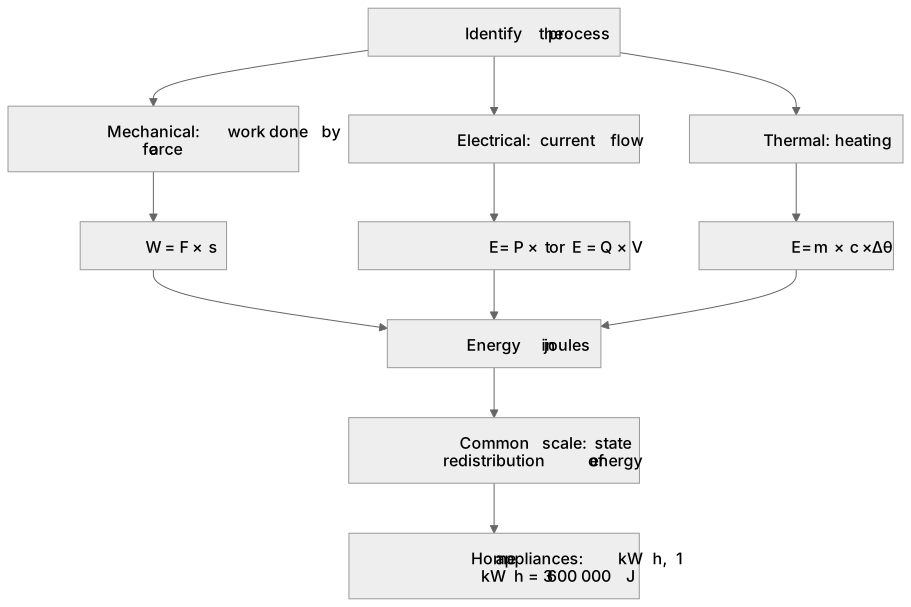
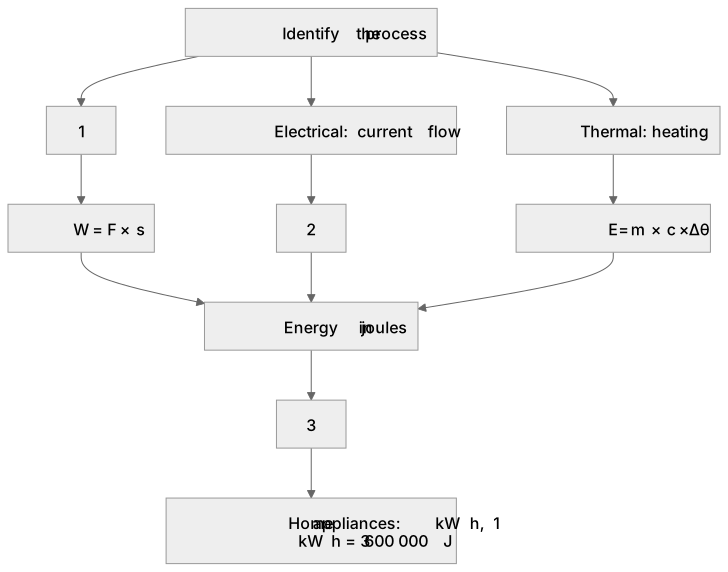
This criterion asks you to pick the right energy equation for a process and then calculate. For a mechanical process, work done by a force is W = F × s, where F is the force in newtons and s the distance moved along the force in metres, giving joules. For an electrical process, energy transferred by current flow is E = P × t or E = Q × V, with power in watts and time in seconds giving joules. For heating, use E = m × c × Δθ, with mass in kilograms, specific heat capacity in J/(kg °C) and temperature change in °C. Because all these give joules, you can put the results on one common scale and state how energy is redistributed. For home appliances, kilowatt-hours are used: 1 kW h = 1000 W × 3600 s = 3 600 000 J, so a 2 kW heater running 3 h uses 6 kW h, which is 6 × 3 600 000 = 21 600 000 J.
What earns the marks
- Selects the equation matching the named process, such as W = F × s for work done by a force, before substituting values.
- Converts time to seconds and power to watts when calculating electrical energy in joules.
- Uses E = m × c × Δθ with mass in kilograms and temperature change in °C for a heating process.
- Converts between kilowatt-hours and joules using 1 kW h = 3 600 000 J to place home appliance energy use on a common scale.
- States the overall redistribution of energy in the system in quantitative terms, for example how much moves by work, by current flow and by heating.
Common mistakes and how to put them right
Uses minutes or hours directly in E = P × t.
Put it right: Convert the time to seconds so the answer is in joules.
Forgets to convert kilowatts to watts before multiplying by time.
Put it right: Multiply the power in kW by 1000 first.
Mixes units so the answer is not in joules.
Put it right: Keep force in newtons, distance in metres, mass in kilograms and time in seconds.
Treats a kW h as a unit of power.
Put it right: Recognise it as a unit of energy equal to 3 600 000 J.
Exam tips
- Write down the equation and the quantity each symbol stands for before substituting numbers.
- Convert every value to SI units first, then convert the final answer to kW h only if the question asks for it.
- Check that your answer is in joules and is a sensible size for the appliance or process described.
Try the lesson
The start of the Work done: make calculations of the energy changes associated with changes in a system, recalling or selecting the relevant equations for mechanical, electrical, and thermal processes; thereby express in quantitative form and on a common scale the overall redistribution of energy in the system (to include: work done by forces, current flow, through heating and the use of kW h to measure energy use in electrical appliances in the home) lesson, made from checked teaching notes for this specification point.
Have a go first
A current of 2 A flows through a 12 V lamp for 5 s. How much energy is transferred by the lamp?
Listen
This criterion asks you to pick the right energy equation for a process and then calculate. For a mechanical process, work done by a force is W = F × s, where F is the force in newtons and s the distance moved along the force in metres, giving joules. For an electrical process, energy transferred by current flow is E = P × t or E = Q × V, with power in watts and time in seconds giving joules. For heating, use E = m × c × Δθ, with mass in kilograms, specific heat capacity in J/(kg °C) and temperature change in °C. Because all these give joules, you can put the results on one common scale and state how energy is redistributed. For home appliances, kilowatt-hours are used: 1 kW h = 1000 W × 3600 s = 3 600 000 J, so a 2 kW heater running 3 h uses 6 kW h, which is 6 × 3 600 000 = 21 600 000 J. A strong answer earns marks for these points. Selects the equation matching the named process, such as W = F × s for work done by a force, before substituting values. Converts time to seconds and power to watts when calculating electrical energy in joules. Uses E = m × c × Δθ with mass in kilograms and temperature change in °C for a heating process. Converts between kilowatt-hours and joules using 1 kW h = 3 600 000 J to place home appliance energy use on a common scale. Exam tip: Write down the equation and the quantity each symbol stands for before substituting numbers.
See it
Key words
Say what each word means before you turn the card.
work done by a force
Try answering aloud or in your head before turning the card.
energy transferred by current flow
Try answering aloud or in your head before turning the card.
heating
Try answering aloud or in your head before turning the card.
kilowatt-hours
Try answering aloud or in your head before turning the card.
See every definition
- work done by a force
- Calculated as W = F × s, where F is the force in newtons and s the distance moved along the force in metres, giving joules.
- energy transferred by current flow
- Calculated as E = P × t or E = Q × V, with power in watts and time in seconds giving joules.
- heating
- Calculated as E = m × c × Δθ, with mass in kilograms, specific heat capacity in J/(kg °C) and temperature change in °C.
- kilowatt-hours
- Used for home appliances, where 1 kW h = 1000 W × 3600 s = 3 600 000 J.
Label the diagram
Some boxes have lost their names. Pick the right name for each number.
1Box 1
2Box 2
3Box 3
There is more to this lesson
The full lesson goes on to check your understanding and help you earn the marks. Create a free account to carry on, with your progress saved.
A week of Premium from your first lesson · Then the free plan continues · No card, no charge
Test your understanding of Work done: make calculations of the energy changes associated with changes in a system, recalling or selecting the relevant equations for mechanical, electrical, and thermal processes; thereby express in quantitative form and on a common scale the overall redistribution of energy in the system (to include: work done by forces, current flow, through heating and the use of kW h to measure energy use in electrical appliances in the home)
Active recall beats re-reading. Take an instant quiz now to test what you’ve learned and lock it into long-term memory.
A week of Premium from your first lesson · Then the free plan continues · No card, no charge