AQA · A-Level · Psychology
Course version: 7182-2025 · Exams from 2027
Risk factors in the development of addiction, including genetic…
Full specification wording
Addiction: Risk factors in the development of addiction, including genetic vulnerability, personality and social influences.
The development of addiction is rarely caused by a single trigger; rather, it emerges from interacting risk factors.
Checked against the AQA 7182-2025 specification (opens in a new tab) on .
- Point 2 of 6
- 4 key terms
Study notes
From the checked teaching notes for this specification point.
The idea
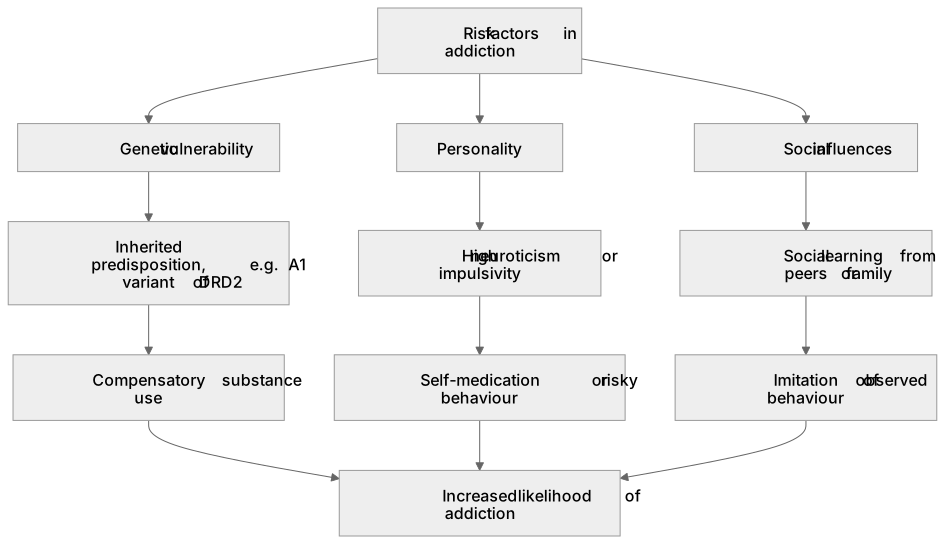
The development of addiction is rarely caused by a single trigger; rather, it emerges from interacting risk factors. Genetic vulnerability suggests individuals inherit a predisposition, such as possessing the A1 variant of the DRD2 gene, which reduces dopamine receptor density and drives compensatory substance use. Personality traits also elevate risk; for instance, high levels of neuroticism or impulsivity can lead individuals to self-medicate or engage in risky behaviours. Furthermore, social influences play a critical role through mechanisms like social learning. If an adolescent observes peers or family members receiving social rewards for smoking, they may imitate this behaviour, increasing their likelihood of developing an addiction.
What earns the marks
- Explain genetic vulnerability using specific mechanisms, such as inherited variations in dopamine receptor genes (e.g., DRD2).
- Describe how personality traits, particularly impulsivity and neuroticism, correlate with higher rates of substance misuse.
- Outline social influences, distinguishing between peer pressure (normative social influence) and family influences (observational learning).
- Evaluate the interaction of these risk factors using the diathesis-stress model, noting that genetics alone do not guarantee addiction.
Common mistakes and how to put them right
Claiming there is a single 'addiction gene'.
Put it right: Explain that genetic vulnerability involves multiple genes (polygenic) interacting with environmental triggers.
Confusing peer pressure with family influences.
Put it right: Clearly separate peer conformity from parental modelling and perceived parental approval.
Assuming personality traits cause addiction directly.
Put it right: State that personality traits are correlational risk factors, not deterministic causes.
Exam tips
- Use the diathesis-stress model as a synoptic evaluation point to explain how genetic vulnerability interacts with social influences.
- When discussing personality, explicitly name traits like impulsivity or antisocial personality disorder rather than just saying 'a bad personality'.
- Support your explanation of social influences with psychological concepts like vicarious reinforcement or normative social influence.
Try the lesson
The start of the Addiction: Risk factors in the development of addiction, including genetic vulnerability, personality and social influences. lesson, made from checked teaching notes for this specification point.
Have a go first
Which personality trait is most consistently identified by researchers as a significant risk factor for the development of addiction?
Listen
The development of addiction is rarely caused by a single trigger; rather, it emerges from interacting risk factors. Genetic vulnerability suggests individuals inherit a predisposition, such as possessing the A1 variant of the DRD2 gene, which reduces dopamine receptor density and drives compensatory substance use. Personality traits also elevate risk; for instance, high levels of neuroticism or impulsivity can lead individuals to self-medicate or engage in risky behaviours. Furthermore, social influences play a critical role through mechanisms like social learning. If an adolescent observes peers or family members receiving social rewards for smoking, they may imitate this behaviour, increasing their likelihood of developing an addiction. A strong answer earns marks for these points. Explain genetic vulnerability using specific mechanisms, such as inherited variations in dopamine receptor genes (e.g., DRD2). Describe how personality traits, particularly impulsivity and neuroticism, correlate with higher rates of substance misuse. Outline social influences, distinguishing between peer pressure (normative social influence) and family influences (observational learning). Evaluate the interaction of these risk factors using the diathesis-stress model, noting that genetics alone do not guarantee addiction. A common slip: Claiming there is a single 'addiction gene'. Instead, Explain that genetic vulnerability involves multiple genes (polygenic) interacting with environmental triggers. Exam tip: Use the diathesis-stress model as a synoptic evaluation point to explain how genetic vulnerability interacts with social influences.
See it
Key words
Say what each word means before you turn the card.
Genetic vulnerability
Try answering aloud or in your head before turning the card.
Personality traits
Try answering aloud or in your head before turning the card.
Social influences
Try answering aloud or in your head before turning the card.
Diathesis-stress model
Try answering aloud or in your head before turning the card.
See every definition
- Genetic vulnerability
- Inheriting a predisposition to addiction, such as possessing the A1 variant of the DRD2 gene, which reduces dopamine receptor density and drives compensatory substance use.
- Personality traits
- Characteristics such as high levels of neuroticism or impulsivity that can lead individuals to self-medicate or engage in risky behaviours.
- Social influences
- Mechanisms such as social learning, where observing peers or family members receiving social rewards for smoking may lead an adolescent to imitate this behaviour.
- Diathesis-stress model
- A model used to explain how genetic vulnerability interacts with social influences, noting that genetics alone do not guarantee addiction.
Label the diagram
Some boxes have lost their names. Pick the right name for each number.
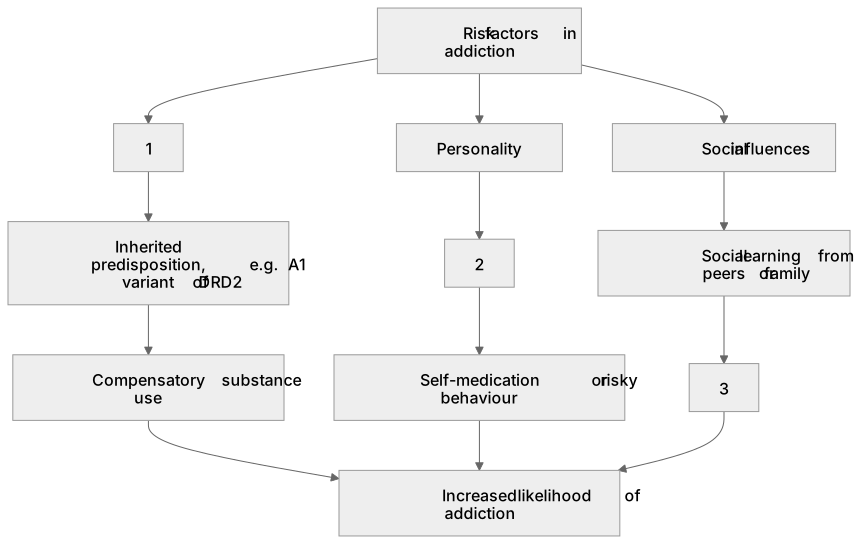
1Box 1
2Box 2
3Box 3
There is more to this lesson
The full lesson goes on to check your understanding and help you earn the marks. Create a free account to carry on, with your progress saved.
A week of Premium from your first lesson · Then the free plan continues · No card, no charge
Test your understanding of Addiction: Risk factors in the development of addiction, including genetic vulnerability, personality and social influences.
Active recall beats re-reading. Take an instant quiz now to test what you’ve learned and lock it into long-term memory.
A week of Premium from your first lesson · Then the free plan continues · No card, no charge