AQA · A-Level · Psychology
Course version: 7182-2025 · Exams from 2027
Media influences on aggression, including the effects of computer games.…
Full specification wording
Aggression: Media influences on aggression, including the effects of computer games. The role of desensitisation, disinhibition and cognitive priming.
Does watching or playing violence make people aggressive?
Checked against the AQA 7182-2025 specification (opens in a new tab) on .
- Point 5 of 5
- 4 key terms
Study notes
From the checked teaching notes for this specification point.
The idea
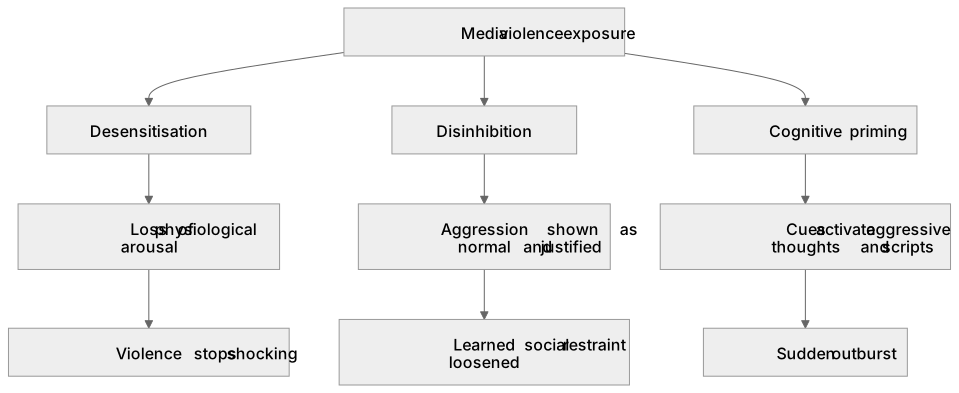
Does watching or playing violence make people aggressive? Experiments say a little: Bartholow and Anderson had students play a violent or a non-violent game and then blast an opponent with noise, and the violent-game group chose louder, longer bursts; Anderson's meta-analysis found a small but consistent effect. Three mechanisms are named. Desensitisation is the loss of physiological arousal, measured as heart rate, after repeated exposure, so violence stops shocking. Disinhibition is media showing aggression as normal and justified, which loosens learned social restraint. Cognitive priming occurs when violent media provides cues that activate existing aggressive thoughts and scripts in memory, explaining a sudden outburst.
What earns the marks
- Desensitisation: repeated exposure lowers physiological arousal to violence and reduces sympathy for victims, as in Weisz and Earls's mock trial.
- Disinhibition: media presents aggression as normative, justified and free of consequence, weakening the social norms that usually restrain it.
- Cognitive priming: violent media provides cues that activate existing aggressive thoughts and scripts in memory, which is why the effect can be immediate and short-lived.
Common mistakes and how to put them right
Treating desensitisation, disinhibition and priming as three names for one idea.
Put it right: The first is reduced arousal, the second is changed norms, the third is memory activation.
Reading a correlation between hours of violent gaming and aggression as proof that gaming caused it.
Claiming media violence causes real-world atrocities such as shootings, which no study shows and which examiners read as uncritical.
Ignoring the timescale: desensitisation builds over long exposure while priming is immediate and cue-driven, so an outburst straight after play is priming.
Exam tips
- Match the mechanism to the scenario: an immediate reaction after playing suggests priming or disinhibition, while a person unmoved by real violence suggests desensitisation.
- Name the method as you cite the study, for example in a meta-analysis of published experiments, because the methodological comment is where the evaluation marks are.
- Build the evaluation around what each method can and cannot establish rather than listing generic criticisms about ecological validity.
Try the lesson
The start of the Aggression: Media influences on aggression, including the effects of computer games. The role of desensitisation, disinhibition and cognitive priming. lesson, made from checked teaching notes for this specification point.
Have a go first
Which of the following best describes the process of desensitisation in the context of media influences on aggression?
Listen
Does watching or playing violence make people aggressive? Experiments say a little: Bartholow and Anderson had students play a violent or a non-violent game and then blast an opponent with noise, and the violent-game group chose louder, longer bursts; Anderson's meta-analysis found a small but consistent effect. Three mechanisms are named. Desensitisation is the loss of physiological arousal, measured as heart rate, after repeated exposure, so violence stops shocking. Disinhibition is media showing aggression as normal and justified, which loosens learned social restraint. Cognitive priming occurs when violent media provides cues that activate existing aggressive thoughts and scripts in memory, explaining a sudden outburst. A strong answer earns marks for these points. What each type of evidence can show: experiments such as Bartholow and Anderson's noise blasts establish causation but measure proxies, correlations such as DeLisi's juvenile offenders cannot establish it, and longitudinal cohort studies track real outcomes over years. Desensitisation: repeated exposure lowers physiological arousal to violence and reduces sympathy for victims, as in Weisz and Earls's mock trial. Disinhibition: media presents aggression as normative, justified and free of consequence, weakening the social norms that usually restrain it. Cognitive priming: violent media provides cues that activate existing aggressive thoughts and scripts in memory, which is why the effect can be immediate and short-lived. Exam tip: Match the mechanism to the scenario: an immediate reaction after playing suggests priming or disinhibition, while a person unmoved by real violence suggests desensitisation.
See it
Key words
Say what each word means before you turn the card.
Desensitisation
Try answering aloud or in your head before turning the card.
Disinhibition
Try answering aloud or in your head before turning the card.
Cognitive priming
Try answering aloud or in your head before turning the card.
Meta-analysis
Try answering aloud or in your head before turning the card.
See every definition
- Desensitisation
- The loss of physiological arousal, measured as heart rate, after repeated exposure, so violence stops shocking.
- Disinhibition
- Media showing aggression as normal and justified, which loosens learned social restraint.
- Cognitive priming
- When violent media provides cues that activate existing aggressive thoughts and scripts in memory, explaining a sudden outburst.
- Meta-analysis
- A method in which Anderson found a small but consistent effect across published experiments.
Label the diagram
Some boxes have lost their names. Pick the right name for each number.
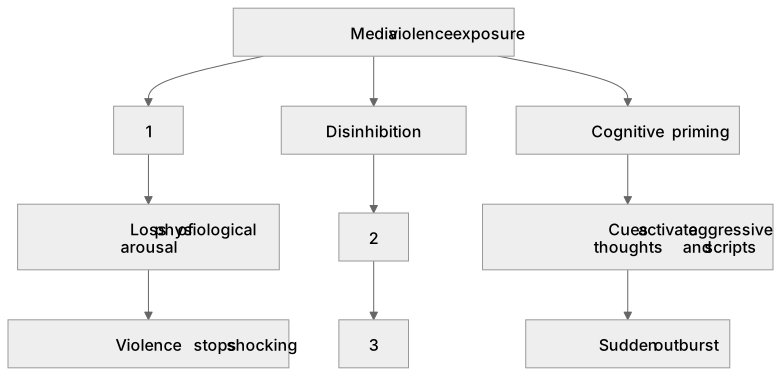
1Box 1
2Box 2
3Box 3
There is more to this lesson
The full lesson goes on to check your understanding and help you earn the marks. Create a free account to carry on, with your progress saved.
A week of Premium from your first lesson · Then the free plan continues · No card, no charge
Test your understanding of Aggression: Media influences on aggression, including the effects of computer games. The role of desensitisation, disinhibition and cognitive priming.
Active recall beats re-reading. Take an instant quiz now to test what you’ve learned and lock it into long-term memory.
A week of Premium from your first lesson · Then the free plan continues · No card, no charge