AQA · A-Level · Psychology
Course version: 7182-2025 · Exams from 2027
Solve simple algebraic equations (to include: calculating the degrees of…
Full specification wording
Algebra: Solve simple algebraic equations (to include: calculating the degrees of freedom for a Chi Square test)
Degrees of freedom decide which line of the Chi Square table you read; the wrong line gives the wrong critical value and decision.
Checked against the AQA 7182-2025 specification (opens in a new tab) on .
- Point 3 of 3
- 4 key terms
Study notes
From the checked teaching notes for this specification point.
The idea
Degrees of freedom decide which line of the Chi Square table you read; the wrong line gives the wrong critical value and decision. The rule is the number of rows minus one, multiplied by the number of columns minus one, written as (rows - 1)(columns - 1). Count only the cells holding observed frequencies, so a 2 by 2 contingency table has 1 degree of freedom and a 2 by 3 table has 2. Read the critical value at the chosen significance level. The AQA Chi Square table does not require choosing between one and two tails. Compare in the correct direction: Chi Square is significant when the calculated value is equal to or greater than the critical value. The same habit of rearranging a short equation turns a total and a number of participants into a mean.
What earns the marks
- Quoting the rule as (rows - 1)(columns - 1) and showing the numbers put into it, so that a 2 by 3 table gives 1 multiplied by 2, which is 2 degrees of freedom.
- Counting rows and columns from the observed frequencies only, and leaving out the row of totals and the column of totals that a printed table often carries.
- Using the degrees of freedom together with the level of significance to read the critical value from the Chi Square table, noting that this specific table does not use one or two tails.
- Stating the comparison in the right direction, since the calculated Chi Square value must be equal to or greater than the critical value for the result to be significant.
- Rearranging other short equations correctly under exam pressure, such as making the mean the subject by dividing the total of the scores by the number of scores.
Common mistakes and how to put them right
Using the number of participants, or the grand total of the frequencies, as the degrees of freedom instead of the size of the table.
Put it right: A study of 60 people set out in a 2 by 2 table still has 1 degree of freedom.
Counting the totals row and the totals column as data, so a 2 by 2 table is read as 3 by 3 and the critical value is taken from the wrong line of the table.
Comparing in the wrong direction and calling a small calculated value significant because Mann Whitney U and Wilcoxon T work that way.
Put it right: Chi Square needs the calculated value to be equal to or greater than the critical value.
Looking for one-tailed or two-tailed columns in the Chi Square critical values table, which are not present in the AQA specification table.
Exam tips
- Degrees of freedom appear as a calculate question attached to a contingency table, so count the table first and write the substituted rule rather than the bare answer.
- Longer questions ask you to explain whether the result is significant, which needs the degrees of freedom, the level of significance, the calculated value, the critical value and the decision about the null hypothesis.
- Where a table of critical values is printed, point to the exact figure you used, because the marks are for the comparison rather than for the arithmetic.
Try the lesson
The start of the Algebra: Solve simple algebraic equations (to include: calculating the degrees of freedom for a Chi Square test) lesson, made from checked teaching notes for this specification point.
Have a go first
A researcher conducts a Chi-Square test of association using a contingency table with 3 rows and 2 columns. The formula for degrees of freedom is df = (r - 1)(c - 1). What is the degrees of freedom for this test?
Listen
Degrees of freedom decide which line of the Chi Square table you read; the wrong line gives the wrong critical value and decision. The rule is the number of rows minus one, multiplied by the number of columns minus one, written as (rows - 1)(columns - 1). Count only the cells holding observed frequencies, so a 2 by 2 contingency table has 1 degree of freedom and a 2 by 3 table has 2. Read the critical value at the chosen significance level. The AQA Chi Square table does not require choosing between one and two tails. Compare in the correct direction: Chi Square is significant when the calculated value is equal to or greater than the critical value. The same habit of rearranging a short equation turns a total and a number of participants into a mean. A strong answer earns marks for these points. Quoting the rule as (rows - 1)(columns - 1) and showing the numbers put into it, so that a 2 by 3 table gives 1 multiplied by 2, which is 2 degrees of freedom. Counting rows and columns from the observed frequencies only, and leaving out the row of totals and the column of totals that a printed table often carries. Using the degrees of freedom together with the level of significance to read the critical value from the Chi Square table, noting that this specific table does not use one or two tails. Stating the comparison in the right direction, since the calculated Chi Square value must be equal to or greater than the critical value for the result to be significant. Exam tip: Degrees of freedom appear as a calculate question attached to a contingency table, so count the table first and write the substituted rule rather than the bare answer.
See it
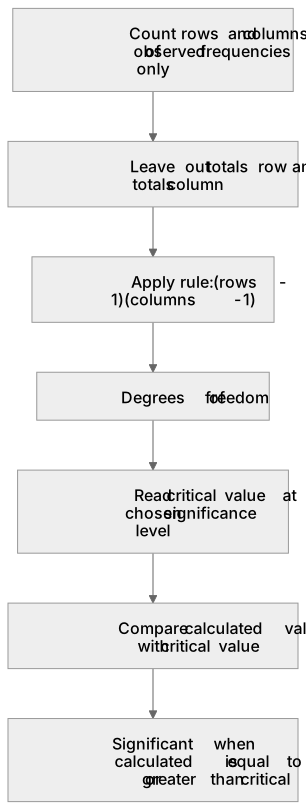
Put it in order
Put these steps in the order they happen.
- 1. Significant when calculated is equal to or greater than critical
- 2. Compare calculated value with critical value
- 3. Apply rule: (rows - 1)(columns - 1)
- 4. Read critical value at chosen significance level
- 5. Count rows and columns of observed frequencies only
- 6. Leave out totals row and totals column
- 7. Degrees of freedom
Key words
Say what each word means before you turn the card.
degrees of freedom
Try answering aloud or in your head before turning the card.
contingency tables
Try answering aloud or in your head before turning the card.
critical value tables
Try answering aloud or in your head before turning the card.
chi square decision rule
Try answering aloud or in your head before turning the card.
See every definition
- degrees of freedom
- The number of rows minus one, multiplied by the number of columns minus one, written as (rows - 1)(columns - 1).
- contingency tables
- Tables where only the cells holding observed frequencies are counted, so a 2 by 2 table has 1 degree of freedom and a 2 by 3 table has 2.
- critical value tables
- The line read is decided by the degrees of freedom together with the level of significance, and the AQA Chi Square table does not require choosing between one and two tails.
- chi square decision rule
- Chi Square is significant when the calculated value is equal to or greater than the critical value.
Label the diagram
Some boxes have lost their names. Pick the right name for each number.
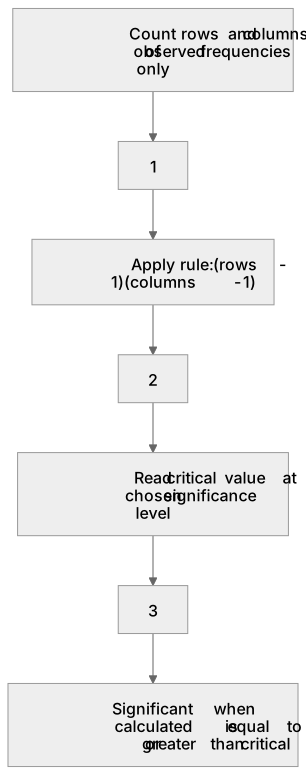
1Box 1
2Box 2
3Box 3
There is more to this lesson
The full lesson goes on to check your understanding and help you earn the marks. Create a free account to carry on, with your progress saved.
A week of Premium from your first lesson · Then the free plan continues · No card, no charge
Test your understanding of Algebra: Solve simple algebraic equations (to include: calculating the degrees of freedom for a Chi Square test)
Active recall beats re-reading. Take an instant quiz now to test what you’ve learned and lock it into long-term memory.
A week of Premium from your first lesson · Then the free plan continues · No card, no charge