AQA · A-Level · Psychology
Course version: 7182-2025 · Exams from 2027
Understand and use the symbols: =, <, <<, >>, >, ∝, ~ (to include:…
Full specification wording
Algebra: Understand and use the symbols: =, <, <<, >>, >, ∝, ~ (to include: expressing the outcome of an inferential test in the conventional form by stating the level of significance at the 0.05 level or 0.01 level by using symbols appropriately)
In a Psychology paper these signs are the shorthand a result is reported in, so each one has to be read exactly.
Checked against the AQA 7182-2025 specification (opens in a new tab) on .
- Point 1 of 3
- 4 key terms
Study notes
From the checked teaching notes for this specification point.
The idea
In a Psychology paper these signs are the shorthand a result is reported in, so each one has to be read exactly. Each sign carries one meaning: = states exact equality, < states less than and > states greater than, while the doubled signs << and >> state much less than and much greater than. The sign ∝ marks a proportional relationship between two measures, and ~ marks an approximate or order of magnitude figure, as in a sample of ~ 30 people. The conventional way to report an inferential result is to set the probability against the accepted level, writing p < 0.05 for a significant result and p > 0.05 for one that is not. At the 0.05 level a psychologist accepts a five percent probability that the pattern arose by chance; the stricter 0.01 level cuts that to one percent and is chosen where a false claim would be costly, such as in drug trials.
What earns the marks
- Justifying a move to the 0.01 level where a Type 1 error would be serious, for instance in drug research, and noting that the stricter level raises the risk of a Type 2 error instead.
- Using the remaining signs accurately, so ∝ claims that one measure rises in direct proportion with another and ~ claims only an approximate or rounded size.
Common mistakes and how to put them right
Reversing the sign and writing p > 0.05 for a significant result.
Put it right: The probability of a chance finding has to be small, so the significant outcome is always the one where p falls below the stated level.
Treating 0.05 as though it meant five, and writing the level as p < 5.
Put it right: The probability runs from zero to one, so five percent is written as 0.05 and one percent as 0.01.
Claiming that p < 0.05 proves the hypothesis, or that it shows a ninety five percent chance the theory is true.
Put it right: It states only the probability that the results occurred by chance, and it proves nothing.
Quoting a level of significance with no mention of the number of tails and no N or degrees of freedom, which leaves the marker unable to check that the right critical value was read.
Exam tips
- When explaining p < 0.05, include probability, the five-percent threshold and the decision about the null hypothesis, all tied to the variables in the study.
- When asked to state whether a result is significant, write one sentence in the conventional form: calculated value, critical value, tails, N or degrees of freedom, level, decision, then p < 0.05 or p > 0.05.
- Which way the comparison runs depends on the test. Chi Square, Spearman’s rho and both the related and unrelated t tests are significant when the calculated value is equal to or greater than the critical value; Mann Whitney U, Wilcoxon T and the sign test are significant when the calculated value is equal to or less than the critical value.
Try the lesson
The start of the Algebra: Understand and use the symbols: =, <, <<, >>, >, ∝, ~ (to include: expressing the outcome of an inferential test in the conventional form by stating the level of significance at the 0.05 level or 0.01 level by using symbols appropriately) lesson, made from checked teaching notes for this specification point.
Have a go first
A psychologist conducts an inferential statistical test and finds that the results are significant at the 5% level. Which of the following is the correct conventional way to express this outcome using mathematical symbols?
Listen
In a Psychology paper these signs are the shorthand a result is reported in, so each one has to be read exactly. Each sign carries one meaning: = states exact equality, states greater than, while the doubled signs > state much less than and much greater than. The sign ∝ marks a proportional relationship between two measures, and ~ marks an approximate or order of magnitude figure, as in a sample of ~ 30 people. The conventional way to report an inferential result is to set the probability against the accepted level, writing p 0.05 for one that is not. At the 0.05 level a psychologist accepts a five percent probability that the pattern arose by chance; the stricter 0.01 level cuts that to one percent and is chosen where a false claim would be costly, such as in drug trials. A strong answer earns marks for these points. Reading the sign in the direction the result needs: p 0.05 says it is greater than five percent, so it is not. Naming the level in full, as the 0.05 level or the five percent level, and then saying which hypothesis is rejected and which is retained, because a significant result rejects the null hypothesis and supports the alternative hypothesis. Writing the outcome in the conventional form, quoting the calculated value, the critical value, the number of participants or the degrees of freedom, whether the test was one tailed or two tailed, the level used, and closing with p < 0.05. Justifying a move to the 0.01 level where a Type 1 error would be serious, for instance in drug research, and noting that the stricter level raises the risk of a Type 2 error instead. Exam tip: When explaining p < 0.05, include probability, the five-percent threshold and the decision about the null hypothesis, all tied to the variables in the study.
See it
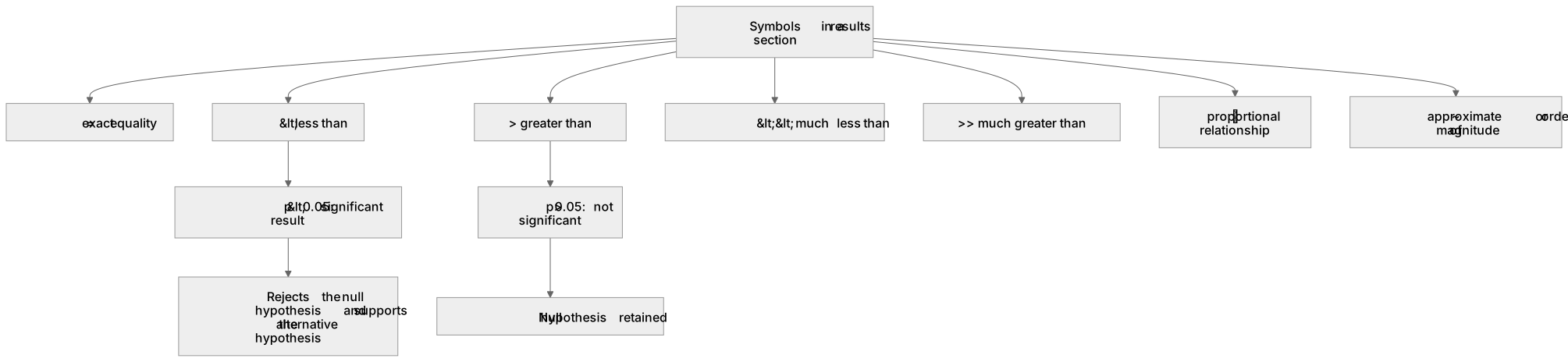
Key words
Say what each word means before you turn the card.
levels of significance
Try answering aloud or in your head before turning the card.
conventional reporting form
Try answering aloud or in your head before turning the card.
null hypothesis decisions
Try answering aloud or in your head before turning the card.
type 1 and type 2 errors
Try answering aloud or in your head before turning the card.
See every definition
- levels of significance
- The 0.05 level accepts a five percent probability that the pattern arose by chance, while the stricter 0.01 level cuts that to one percent.
- conventional reporting form
- Setting the probability against the accepted level, writing p < 0.05 for a significant result and p > 0.05 for one that is not.
- null hypothesis decisions
- A significant result rejects the null hypothesis and supports the alternative hypothesis, while a non-significant result does not.
- type 1 and type 2 errors
- A stricter level is chosen where a Type 1 error would be serious, and that stricter level raises the risk of a Type 2 error instead.
Label the diagram
Some boxes have lost their names. Pick the right name for each number.
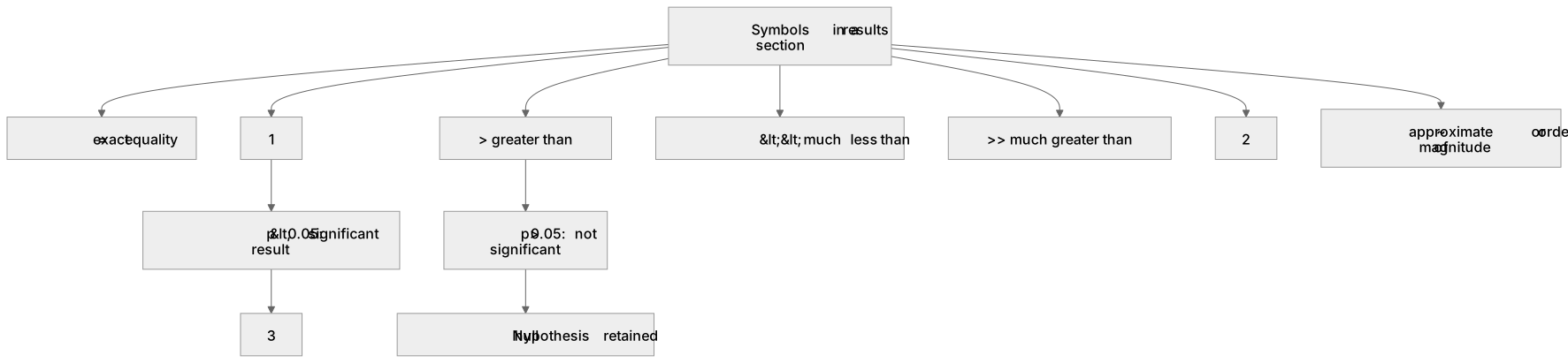
1Box 1
2Box 2
3Box 3
There is more to this lesson
The full lesson goes on to check your understanding and help you earn the marks. Create a free account to carry on, with your progress saved.
A week of Premium from your first lesson · Then the free plan continues · No card, no charge
Test your understanding of Algebra: Understand and use the symbols: =, <, <<, >>, >, ∝, ~ (to include: expressing the outcome of an inferential test in the conventional form by stating the level of significance at the 0.05 level or 0.01 level by using symbols appropriately)
Active recall beats re-reading. Take an instant quiz now to test what you’ve learned and lock it into long-term memory.
A week of Premium from your first lesson · Then the free plan continues · No card, no charge