AQA · A-Level · Psychology
Course version: 7182-2025 · Exams from 2027
The influence of early attachment on childhood and adult relationships,…
Full specification wording
Attachment: The influence of early attachment on childhood and adult relationships, including the role of an internal working model.
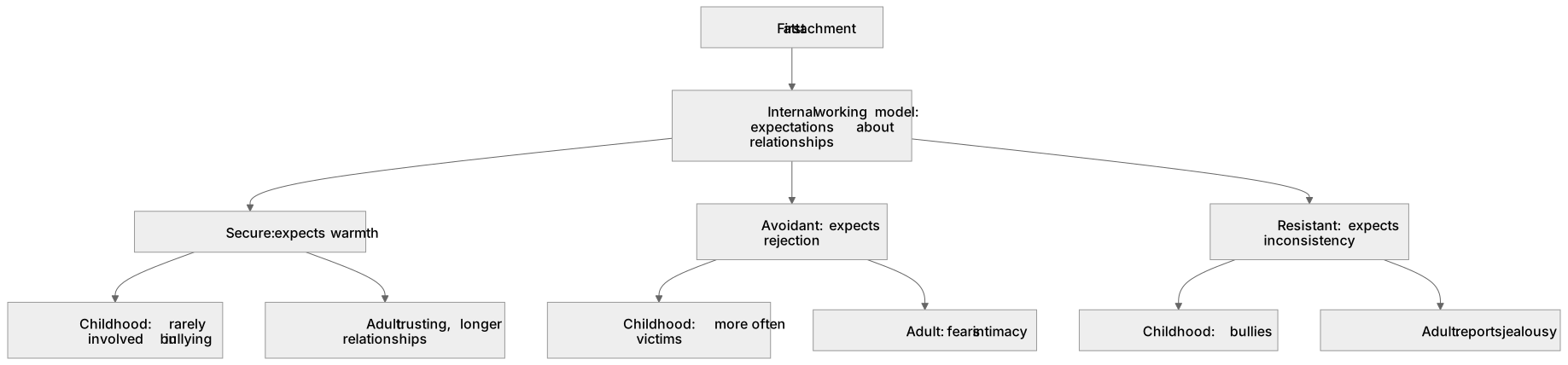
The internal working model is the mental template a first attachment leaves behind: a set of expectations about whether other people can be trusted and whether the child is worth caring for.
Checked against the AQA 7182-2025 specification (opens in a new tab) on .
- Point 5 of 5
- 3 key terms
Study notes
From the checked teaching notes for this specification point.
The idea
The internal working model is the mental template a first attachment leaves behind: a set of expectations about whether other people can be trusted and whether the child is worth caring for. A securely attached child expects warmth and behaves accordingly; an avoidant child expects rejection and keeps distance; a resistant child expects inconsistency and becomes clingy or controlling. Myron-Wilson and Smith (1998) found secure children were rarely involved in bullying, avoidant children were more often victims and resistant ones bullies. Hazan and Shaver's love quiz, answered by over six hundred readers, found 56% secure, 25% avoidant and 19% resistant, with secure adults reporting longer, more trusting relationships. Bailey et al found mothers usually passed their own attachment type to their babies.
What earns the marks
- Internal working model defined as a schema of expectations about relationships built from the first attachment.
- The continuity hypothesis stated: the model generalises to friendships, romantic relationships and the learner's own parenting.
- Effects on childhood relationships described type by type, with bullying evidence from Myron-Wilson and Smith (1998).
- Hazan and Shaver's love quiz: method, sample and the proportions of each adult type.
- Hazan and Shaver's outcomes: secure adults report trusting, longer relationships; avoidant adults fear intimacy; resistant adults report jealousy.
- Intergenerational transmission evidenced by Bailey et al's mothers and infants.
- Evaluation: correlational data cannot show cause, temperament is a plausible third factor, retrospective self-report threatens validity, and the claim is over-deterministic.
Common mistakes and how to put them right
Describing the internal working model as a memory of the parent rather than as expectations that guide behaviour.
Stating that an insecure baby will have failed adult relationships, when the association is a tendency and many people change.
Quoting the love quiz without noting that it was a self-selecting volunteer sample of newspaper readers reporting on the past.
Leaving out the temperament explanation, which is the standard alternative account of the same correlations.
Exam tips
- Every study here is correlational, so 'no cause and effect' plus a named third variable is an evaluation point you can always reach for.
- Say how the model works, not only that it exists: expectation shapes behaviour, behaviour shapes the partner's response.
- In an applied question, name the childhood type in the stem and predict a specific adult behaviour from it.
- Balance the deterministic reading by citing evidence that later experience can revise the model.
Try the lesson
The start of the Attachment: The influence of early attachment on childhood and adult relationships, including the role of an internal working model. lesson, made from checked teaching notes for this specification point.
Have a go first
According to Bowlby, what is the primary function of the internal working model in relation to later relationships?
Listen
The internal working model is the mental template a first attachment leaves behind: a set of expectations about whether other people can be trusted and whether the child is worth caring for. A securely attached child expects warmth and behaves accordingly; an avoidant child expects rejection and keeps distance; a resistant child expects inconsistency and becomes clingy or controlling. Myron-Wilson and Smith (1998) found secure children were rarely involved in bullying, avoidant children were more often victims and resistant ones bullies. Hazan and Shaver's love quiz, answered by over six hundred readers, found 56% secure, 25% avoidant and 19% resistant, with secure adults reporting longer, more trusting relationships. Bailey et al found mothers usually passed their own attachment type to their babies. A strong answer earns marks for these points. Internal working model defined as a schema of expectations about relationships built from the first attachment. The continuity hypothesis stated: the model generalises to friendships, romantic relationships and the learner's own parenting. Effects on childhood relationships described type by type, with bullying evidence from Myron-Wilson and Smith (1998). Hazan and Shaver's love quiz: method, sample and the proportions of each adult type. Exam tip: Every study here is correlational, so 'no cause and effect' plus a named third variable is an evaluation point you can always reach for.
See it
Key words
Say what each word means before you turn the card.
Internal working model
Try answering aloud or in your head before turning the card.
Continuity hypothesis
Try answering aloud or in your head before turning the card.
Temperament
Try answering aloud or in your head before turning the card.
See every definition
- Internal working model
- The mental template a first attachment leaves behind: expectations about whether other people can be trusted and whether the child is worth caring for.
- Continuity hypothesis
- The model generalises to friendships, romantic relationships and the learner's own parenting.
- Temperament
- A plausible third factor offered as the standard alternative account of the same correlations.
Label the diagram
Some boxes have lost their names. Pick the right name for each number.
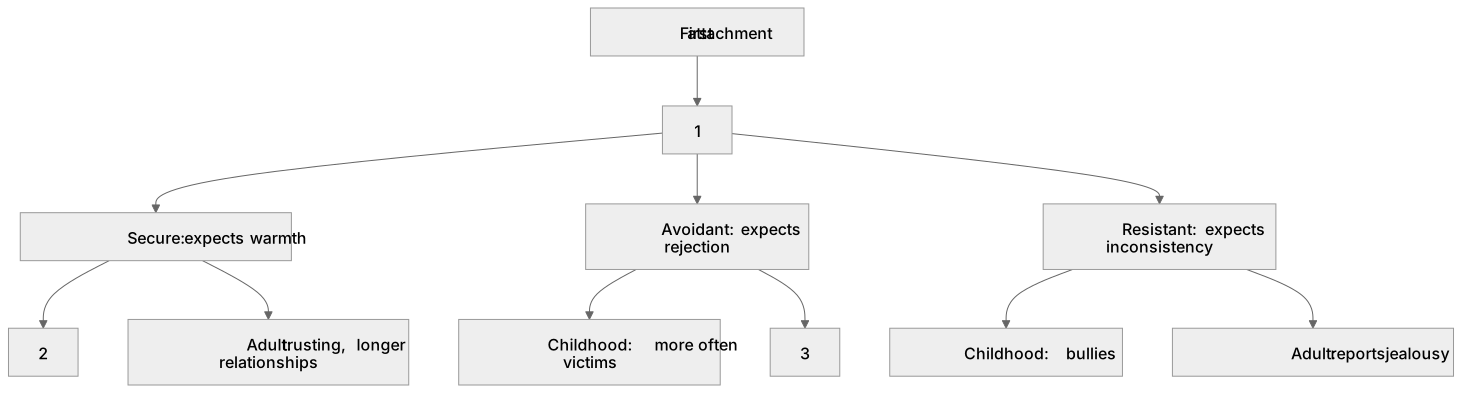
1Box 1
2Box 2
3Box 3
There is more to this lesson
The full lesson goes on to check your understanding and help you earn the marks. Create a free account to carry on, with your progress saved.
A week of Premium from your first lesson · Then the free plan continues · No card, no charge
Test your understanding of Attachment: The influence of early attachment on childhood and adult relationships, including the role of an internal working model.
Active recall beats re-reading. Take an instant quiz now to test what you’ve learned and lock it into long-term memory.
A week of Premium from your first lesson · Then the free plan continues · No card, no charge