AQA · A-Level · Psychology
Course version: 7182-2025 · Exams from 2027
Definitions in the field of mental health; deviation from ideal mental…
Full specification wording
Clinical Psychology and Mental Health: Definitions in the field of mental health; deviation from ideal mental health, deviation from social/cultural norms, failure to function adequately and statistical infrequency.
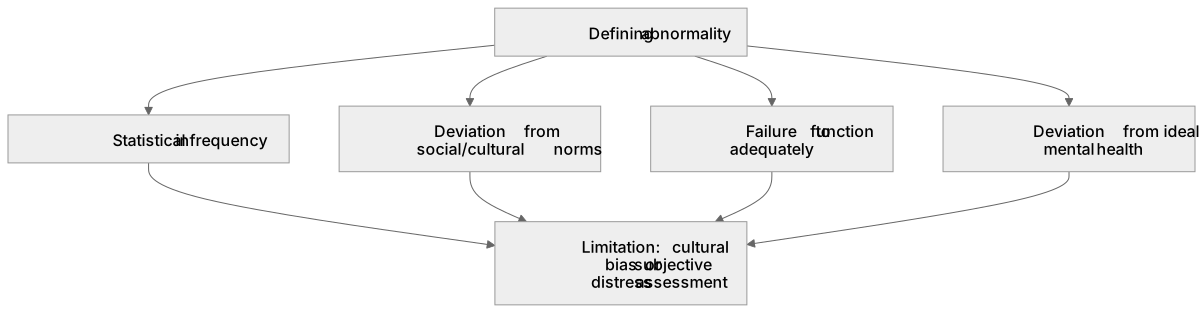
In Psychopathology, defining abnormality involves four main approaches.
Checked against the AQA 7182-2025 specification (opens in a new tab) on .
- Point 1 of 5
- 3 key terms
Study notes
From the checked teaching notes for this specification point.
The idea
In Psychopathology, defining abnormality involves four main approaches. Statistical infrequency defines abnormality as mathematically rare behaviours, like an IQ < 70. Deviation from social norms views abnormality as violating unwritten societal rules, e.g., antisocial personality disorder. Failure to function adequately is when one cannot cope with everyday life, showing distress (e.g., severe depression preventing work). Jahoda’s deviation from ideal mental health identifies abnormality by the absence of positive traits, like self-actualisation. Each definition has limitations, such as cultural bias or subjective distress assessment.
What earns the marks
- Define statistical infrequency as identifying behaviours outside the normal distribution curve.
- Explain deviation from social norms as behaviour violating implicit rules of a culture.
- Describe failure to function adequately using criteria like observer discomfort and unpredictability.
- Outline Jahoda's criteria for ideal mental health, including autonomy and resistance to stress.
- Evaluate definitions of abnormality by discussing cultural relativism and varying norms.
Common mistakes and how to put them right
Treating statistical infrequency as always negative.
Put it right: Rare traits like high IQ are desirable.
Confusing failure to function adequately with deviation from social norms.
Put it right: Failure to function focuses on individual coping, social norms on societal expectations.
Assuming Jahoda's criteria are universally applicable.
Put it right: Traits like self-actualisation are culturally specific.
Exam tips
- Use concrete examples, like intellectual disability disorder for statistical infrequency, to illustrate definitions of abnormality in psychopathology.
- Always include a limitation for each definition, such as human rights abuses with social norms.
Try the lesson
The start of the Clinical Psychology and Mental Health: Definitions in the field of mental health; deviation from ideal mental health, deviation from social/cultural norms, failure to function adequately and statistical infrequency. lesson, made from checked teaching notes for this specification point.
Have a go first
Which definition of abnormality identifies behaviour as abnormal if it violates the unwritten rules and expectations of a specific society?
Listen
In Psychopathology, defining abnormality involves four main approaches. Statistical infrequency defines abnormality as mathematically rare behaviours, like an IQ < 70. Deviation from social norms views abnormality as violating unwritten societal rules, e.g., antisocial personality disorder. Failure to function adequately is when one cannot cope with everyday life, showing distress (e.g., severe depression preventing work). Jahoda’s deviation from ideal mental health identifies abnormality by the absence of positive traits, like self-actualisation. Each definition has limitations, such as cultural bias or subjective distress assessment. A strong answer earns marks for these points. Define statistical infrequency as identifying behaviours outside the normal distribution curve. Explain deviation from social norms as behaviour violating implicit rules of a culture. Describe failure to function adequately using criteria like observer discomfort and unpredictability. Outline Jahoda's criteria for ideal mental health, including autonomy and resistance to stress. A common slip: Treating statistical infrequency as always negative. Instead, rare traits like high IQ are desirable. Exam tip: Use concrete examples, like intellectual disability disorder for statistical infrequency, to illustrate definitions of abnormality in psychopathology.
See it
Key words
Say what each word means before you turn the card.
Statistical infrequency
Try answering aloud or in your head before turning the card.
Deviation from social norms
Try answering aloud or in your head before turning the card.
Failure to function adequately
Try answering aloud or in your head before turning the card.
See every definition
- Statistical infrequency
- Identifying behaviours outside the normal distribution curve as abnormal.
- Deviation from social norms
- Behaviour violating implicit rules of a culture.
- Failure to function adequately
- When one cannot cope with everyday life, showing distress, using criteria like observer discomfort and unpredictability.
Label the diagram
Some boxes have lost their names. Pick the right name for each number.
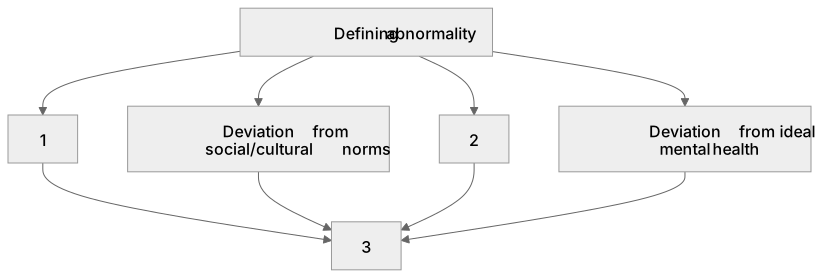
1Box 1
2Box 2
3Box 3
There is more to this lesson
The full lesson goes on to check your understanding and help you earn the marks. Create a free account to carry on, with your progress saved.
A week of Premium from your first lesson · Then the free plan continues · No card, no charge
Test your understanding of Clinical Psychology and Mental Health: Definitions in the field of mental health; deviation from ideal mental health, deviation from social/cultural norms, failure to function adequately and statistical infrequency.
Active recall beats re-reading. Take an instant quiz now to test what you’ve learned and lock it into long-term memory.
A week of Premium from your first lesson · Then the free plan continues · No card, no charge