AQA · A-Level · Psychology
Course version: 7182-2025 · Exams from 2027
Students should demonstrate knowledge and understanding of inferential…
Full specification wording
Inferential testing: Students should demonstrate knowledge and understanding of inferential testing and be familiar with the use of inferential tests.
Descriptive statistics tell you what happened in your sample; inferential statistics tell you whether it is safe to say the same about the population the sample came from.
Checked against the AQA 7182-2025 specification (opens in a new tab) on .
- Point 1 of 4
- 4 key terms
Study notes
From the checked teaching notes for this specification point.
The idea
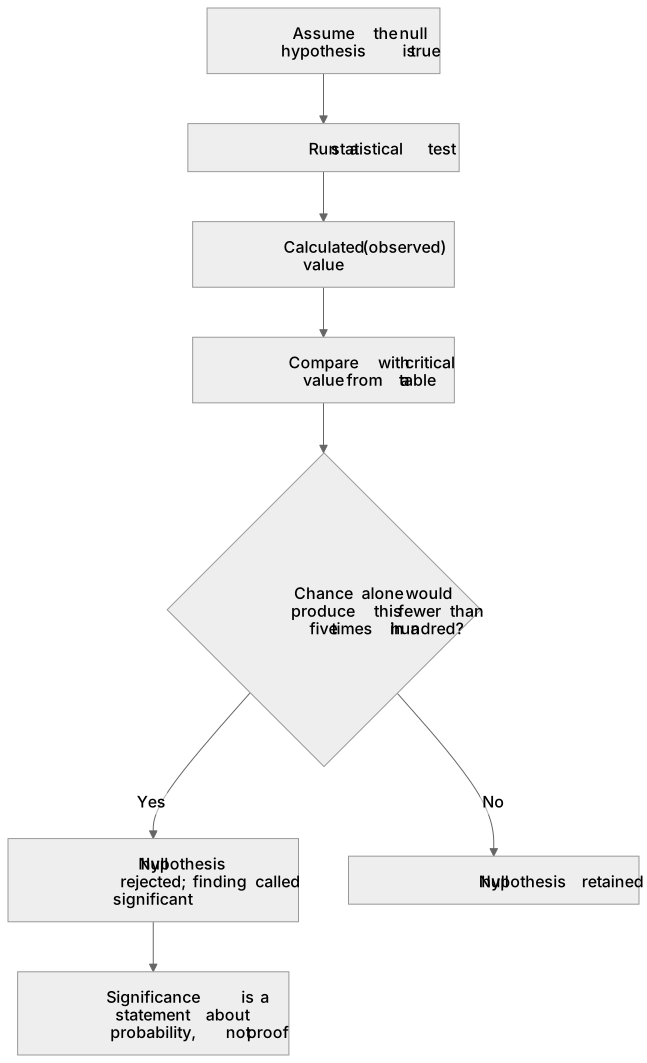
Descriptive statistics tell you what happened in your sample; inferential statistics tell you whether it is safe to say the same about the population the sample came from. The logic never changes. Assume the null hypothesis is true, that there is no difference or no correlation and any pattern is chance. Run a test that turns the whole data set into one number, the calculated or observed value, and compare it with a critical value read from a table. If chance alone would produce a result like this fewer than five times in a hundred, the null hypothesis is rejected and the finding is called significant. None of that is proof: significance is a statement about probability, so a real effect can be missed and a trivial one can reach significance because the sample was enormous.
What earns the marks
- Descriptive statistics (mean, range, graphs) summarise the sample; inferential statistics use probability to decide what can be claimed about the wider population.
- The null hypothesis is what is actually tested: it states there is no difference or no correlation and that any pattern in the data is due to chance.
- A statistical test converts the data into a calculated (observed) value, which is then compared with a critical value taken from a table of significance.
- The accepted level of significance in psychology is p less than or equal to 0.05, that is a 5% or smaller possibility that the result arose by chance.
- If the result reaches significance the null hypothesis is rejected and the alternative hypothesis retained; if it does not, the null hypothesis is retained.
- Evaluation: a significant result is probabilistic, never certain, and statistical significance is not the same as psychological importance or a large effect.
Common mistakes and how to put them right
Writing that the test 'proves' the hypothesis.
Put it right: An inferential test gives a probability, so the null hypothesis is rejected rather than disproved and the effect is never established with certainty.
Offering descriptive evidence as if it were inferential: quoting that one mean is bigger than another, or that a bar is taller, and calling the difference significant without any test.
Saying only that 'the results were significant' with no level, no tail and no comparison of calculated with critical value, which leaves an examiner nothing to credit.
Stating the null hypothesis as the opposite prediction ('participants will do worse') instead of as no difference or no correlation.
Exam tips
- Asked what a significant result means, answer as a probability sentence: the possibility that these results are due to chance is equal to or less than 5%, so the null hypothesis is rejected.
- In a scenario question write the null hypothesis in that study's own variables and conditions, not in the abstract, because the AO2 marks are for applying the idea to the material given.
- Name the population you are generalising to. Inferential testing is about going beyond the sample, and saying so earns the knowledge mark that a bare definition misses.
Try the lesson
The start of the Inferential testing: Students should demonstrate knowledge and understanding of inferential testing and be familiar with the use of inferential tests. lesson, made from checked teaching notes for this specification point.
Have a go first
What is the main purpose of using an inferential statistical test in psychological research?
Listen
Descriptive statistics tell you what happened in your sample; inferential statistics tell you whether it is safe to say the same about the population the sample came from. The logic never changes. Assume the null hypothesis is true, that there is no difference or no correlation and any pattern is chance. Run a test that turns the whole data set into one number, the calculated or observed value, and compare it with a critical value read from a table. If chance alone would produce a result like this fewer than five times in a hundred, the null hypothesis is rejected and the finding is called significant. None of that is proof: significance is a statement about probability, so a real effect can be missed and a trivial one can reach significance because the sample was enormous. A strong answer earns marks for these points. Descriptive statistics (mean, range, graphs) summarise the sample; inferential statistics use probability to decide what can be claimed about the wider population. The null hypothesis is what is actually tested: it states there is no difference or no correlation and that any pattern in the data is due to chance. A statistical test converts the data into a calculated (observed) value, which is then compared with a critical value taken from a table of significance. The accepted level of significance in psychology is p less than or equal to 0.05, that is a 5% or smaller possibility that the result arose by chance. Exam tip: Asked what a significant result means, answer as a probability sentence: the possibility that these results are due to chance is equal to or less than 5%, so the null hypothesis is rejected.
See it
Key words
Say what each word means before you turn the card.
Null hypothesis and alternative hypothesis
Try answering aloud or in your head before turning the card.
Probability and chance
Try answering aloud or in your head before turning the card.
Sample and population
Try answering aloud or in your head before turning the card.
Calculated value versus critical value
Try answering aloud or in your head before turning the card.
See every definition
- Null hypothesis and alternative hypothesis
- The null hypothesis states there is no difference or no correlation and any pattern is due to chance; if the result reaches significance it is rejected and the alternative hypothesis retained.
- Probability and chance
- Inferential statistics use probability to decide what can be claimed about the wider population, and significance is a statement about probability rather than proof.
- Sample and population
- Descriptive statistics summarise the sample, while inferential statistics use probability to decide what can be claimed about the wider population the sample came from.
- Calculated value versus critical value
- A statistical test converts the data into a calculated (observed) value, which is then compared with a critical value taken from a table of significance.
There is more to this lesson
The full lesson goes on to check your understanding and help you earn the marks. Create a free account to carry on, with your progress saved.
A week of Premium from your first lesson · Then the free plan continues · No card, no charge
Test your understanding of Inferential testing: Students should demonstrate knowledge and understanding of inferential testing and be familiar with the use of inferential tests.
Active recall beats re-reading. Take an instant quiz now to test what you’ve learned and lock it into long-term memory.
A week of Premium from your first lesson · Then the free plan continues · No card, no charge