AQA · A-Level · Psychology
Course version: 7182-2025 · Exams from 2027
Aims: stating aims, the difference between aims and hypotheses.
Full specification wording
Scientific processes: Aims: stating aims, the difference between aims and hypotheses.
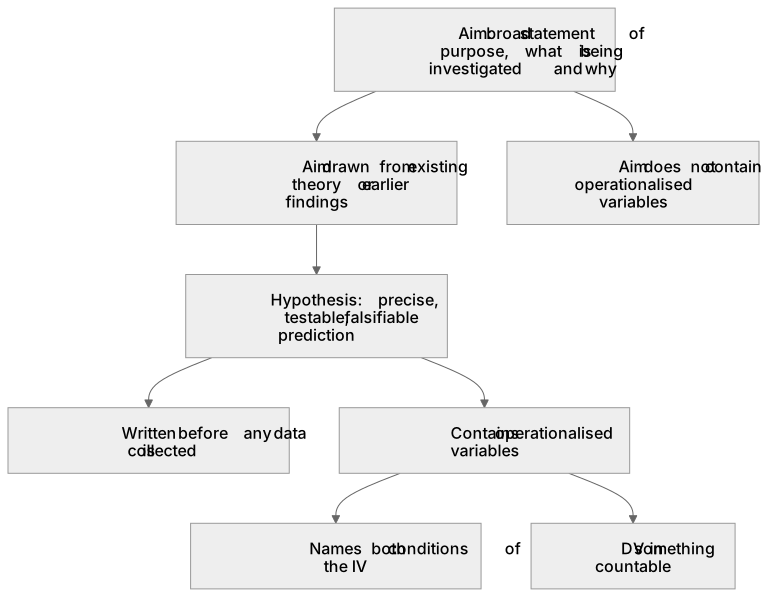
An aim is a broad statement of purpose: what the researcher intends to investigate and why, usually drawn from an existing theory or from earlier findings.
Checked against the AQA 7182-2025 specification (opens in a new tab) on .
- Point 1 of 17
- 4 key terms
Study notes
From the checked teaching notes for this specification point.
The idea
An aim is a broad statement of purpose: what the researcher intends to investigate and why, usually drawn from an existing theory or from earlier findings. A hypothesis is the precise, testable prediction that comes out of that purpose, written before any data is collected and phrased so that results could show it to be wrong. The purpose might be to investigate whether background noise disrupts memory; the prediction is that people who learn a list of 20 words in silence recall more of them than people who learn with music playing. Marks go missing when the purpose is written as a prediction, or when the prediction names variables without saying how they were manipulated and measured. Examiners want both conditions of the IV in the sentence and the DV in something countable.
What earns the marks
- Identifies an aim as a general statement of what is being investigated and why, developed from theory or previous research.
- Identifies a hypothesis as a precise, testable and falsifiable prediction written before data collection.
- States that a hypothesis contains operationalised variables and names both conditions, whereas an aim does not.
- Gives a worked contrast, for example investigating the effect of noise on recall versus predicting that recall of a word list is higher in silence.
- Notes that the aim comes first and the hypothesis is derived from it.
Common mistakes and how to put them right
Writing the aim as a prediction, for example 'noise will reduce recall', which is a hypothesis and scores nothing as an aim.
Writing the hypothesis with unoperationalised terms such as 'memory' or 'intelligence' instead of the score actually recorded.
Naming only one condition of the IV, so there is nothing for the predicted difference to be measured against.
Using 'to see if' phrasing and then giving no variables at all.
Exam tips
- Start an aim with 'to investigate' or 'to examine'; start a hypothesis with 'participants who...' so the two can never be confused on the page.
- If a scenario is given, lift its own materials and measures into your answer, because credit for operationalisation depends on using that scenario's DV.
- Check that a hypothesis contains both a clear prediction and operationalised variables that could actually be measured.
Try the lesson
The start of the Scientific processes: Aims: stating aims, the difference between aims and hypotheses. lesson, made from checked teaching notes for this specification point.
Have a go first
Which of the following best describes the difference between an aim and a hypothesis in psychological research?
Listen
An aim is a broad statement of purpose: what the researcher intends to investigate and why, usually drawn from an existing theory or from earlier findings. A hypothesis is the precise, testable prediction that comes out of that purpose, written before any data is collected and phrased so that results could show it to be wrong. The purpose might be to investigate whether background noise disrupts memory; the prediction is that people who learn a list of 20 words in silence recall more of them than people who learn with music playing. Marks go missing when the purpose is written as a prediction, or when the prediction names variables without saying how they were manipulated and measured. Examiners want both conditions of the IV in the sentence and the DV in something countable. A strong answer earns marks for these points. Identifies an aim as a general statement of what is being investigated and why, developed from theory or previous research. Identifies a hypothesis as a precise, testable and falsifiable prediction written before data collection. States that a hypothesis contains operationalised variables and names both conditions, whereas an aim does not. Gives a worked contrast, for example investigating the effect of noise on recall versus predicting that recall of a word list is higher in silence. Exam tip: Start an aim with 'to investigate' or 'to examine'; start a hypothesis with 'participants who... so the two can never be confused on the page.
See it
Key words
Say what each word means before you turn the card.
Aim
Try answering aloud or in your head before turning the card.
Hypothesis
Try answering aloud or in your head before turning the card.
Operationalised variables
Try answering aloud or in your head before turning the card.
Falsifiable
Try answering aloud or in your head before turning the card.
See every definition
- Aim
- A broad statement of purpose: what the researcher intends to investigate and why, usually drawn from an existing theory or from earlier findings.
- Hypothesis
- The precise, testable prediction that comes out of that purpose, written before any data is collected and phrased so that results could show it to be wrong.
- Operationalised variables
- Variables named in a hypothesis with both conditions of the IV in the sentence and the DV in something countable.
- Falsifiable
- Phrased so that results could show the prediction to be wrong.
Label the diagram
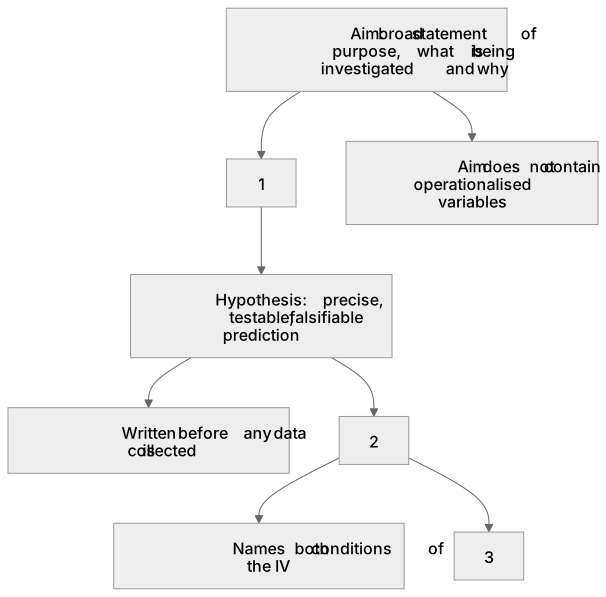
Some boxes have lost their names. Pick the right name for each number.
1Box 1
2Box 2
3Box 3
There is more to this lesson
The full lesson goes on to check your understanding and help you earn the marks. Create a free account to carry on, with your progress saved.
A week of Premium from your first lesson · Then the free plan continues · No card, no charge
Test your understanding of Scientific processes: Aims: stating aims, the difference between aims and hypotheses.
Active recall beats re-reading. Take an instant quiz now to test what you’ve learned and lock it into long-term memory.
A week of Premium from your first lesson · Then the free plan continues · No card, no charge