AQA · A-Level · Psychology
Stress
This guide provides a comprehensive breakdown of the AQA A-Level Psychology topic of Stress. It delves into the physiological responses (SAM and HPA), psychological factors like personality and workplace stress, and crucial evaluation of management techniques, ensuring candidates are prepared to maximise their marks."
- 7 min read
- 3 worked examples
- 5 practice questions
Study Notes
Overview
This guide covers the essential topic of Stress for the AQA A-Level Psychology examination. Understanding the body's response to stressors, both acute and chronic, is fundamental. We will explore the key physiological pathways—the Sympathomedullary (SAM) pathway and the Hypothalamic-Pituitary-Adrenal (HPA) axis—and their roles in the 'fight or flight' response and long-term health impacts, particularly immunosuppression. Examiners expect candidates to not only describe these pathways accurately but also to evaluate the research that underpins them, such as Selye's General Adaptation Syndrome (GAS) and its limitations. Furthermore, we will analyse different sources of stress, including major life events versus daily hassles, and the complexities of workplace stress. A significant portion of marks in this topic are awarded for understanding individual differences, such as the Hardy Personality and Type A/B/C behaviours, and for critically appraising various management strategies from drug therapy to psychological interventions like Stress Inoculation Training (SIT). This guide will equip you with the detailed knowledge (AO1) and critical evaluation skills (AO3) needed to excel.
The Physiology of Stress
The Sympathomedullary (SAM) Pathway: The Acute Response
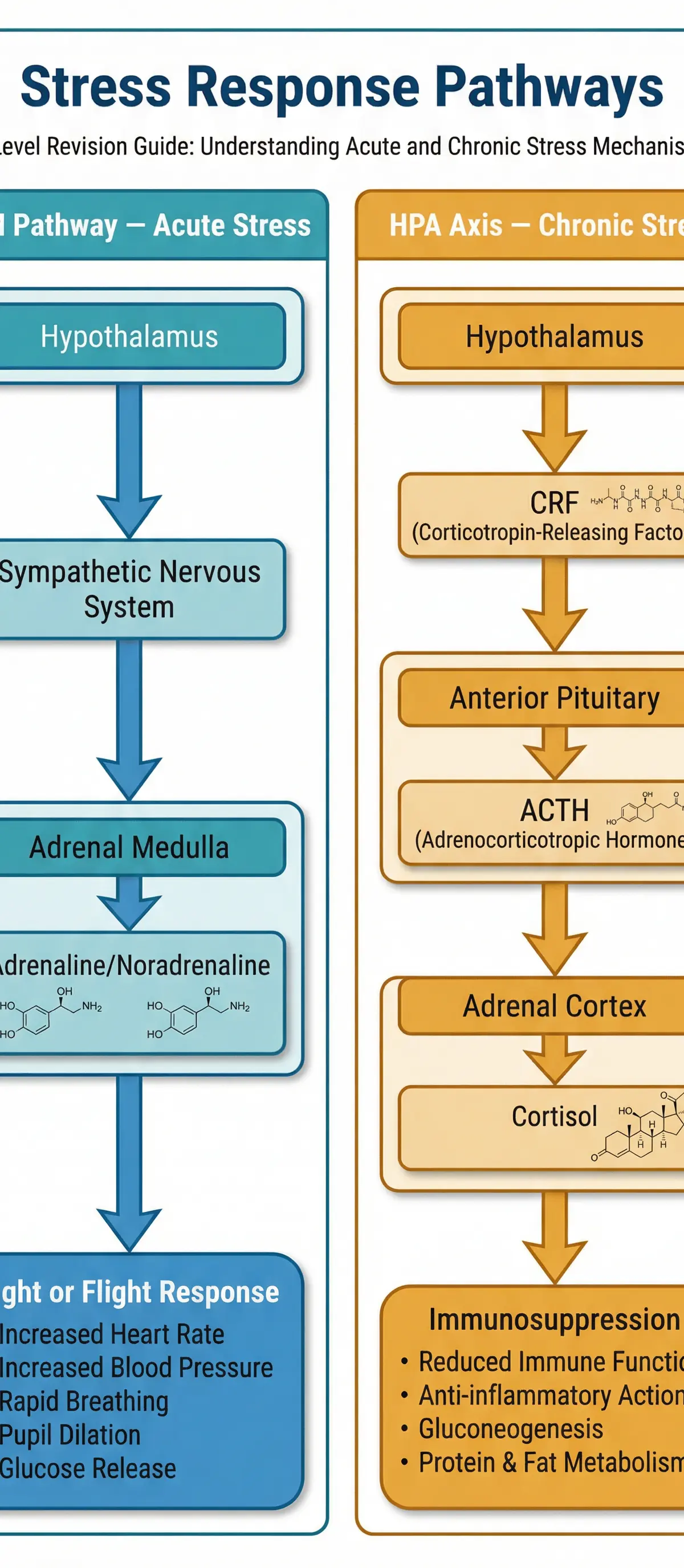
What happens: When an individual perceives a stressor as acute and immediate (e.g., a car swerving nearby), the hypothalamus is activated. It stimulates the sympathetic nervous system, which in turn signals the adrenal medulla.
Why it matters: The adrenal medulla releases the catecholamines adrenaline and noradrenaline into the bloodstream. This triggers the 'fight or flight' response, a cascade of physiological changes designed for immediate survival. Credit is given for identifying these changes, such as increased heart rate, blood pressure, and respiration, and the diversion of blood to muscles.
Specific Knowledge: Candidates must know the sequence: Stressor -> Hypothalamus -> Sympathetic Nervous System -> Adrenal Medulla -> Adrenaline/Noradrenaline -> Fight or Flight.
The Hypothalamic-Pituitary-Adrenal (HPA) System: The Chronic Response
What happens: For persistent, ongoing stressors (e.g., exam pressure), the HPA axis is activated. The hypothalamus releases Corticotropin-Releasing Factor (CRF). This is detected by the anterior pituitary gland, which then releases Adrenocorticotropic Hormone (ACTH).
Why it matters: ACTH travels through the bloodstream to the adrenal cortex, stimulating it to release glucocorticoids, most notably cortisol. Cortisol has several effects, but a key one for this topic is immunosuppression. It reduces the production and effectiveness of lymphocytes (like T-cells and B-cells) and Natural Killer (NK) cells, weakening the immune response.
Specific Knowledge: The sequence is: Stressor -> Hypothalamus (releases CRF) -> Pituitary Gland (releases ACTH) -> Adrenal Cortex (releases Cortisol) -> Physiological Effects (including immunosuppression). Linking this to research, such as Kiecolt-Glaser et al. (1984) on medical students, is crucial for AO3 marks.
Sources of Stress
Life Changes vs. Daily Hassles
Life Changes: Investigated by Holmes and Rahe (1967), who developed the Social Readjustment Rating Scale (SRRS). They proposed that major life events requiring significant adjustment (e.g., death of a spouse, marriage, job loss) act as major sources of stress. Each event is given a Life Change Unit (LCU) score, and a high cumulative score is correlated with increased risk of illness.
Daily Hassles: In contrast, Kanner et al. (1981) argued that the minor, frequent irritations of everyday life (e.g., traffic, arguments, losing things) are a more significant source of stress. They found that the cumulative effect of these 'hassles' was a better predictor of psychological and physical illness than major life events. This provides a strong evaluation point against the SRRS.
Workplace Stress
The 'Control' Model (Marmot et al., 1997): The Whitehall studies on civil servants found that low job control was the most significant factor leading to stress-related illness (specifically, coronary heart disease). Those in lower-grade positions with little autonomy over their work had higher stress levels, even if their workload was not the heaviest.
The 'Demand' Model: This model focuses on the balance between job demands and the control an employee has. High demand is not stressful if it is matched by high control. The most stressful combination is high demand coupled with low control.
Individual Differences in Stress
Personality Types
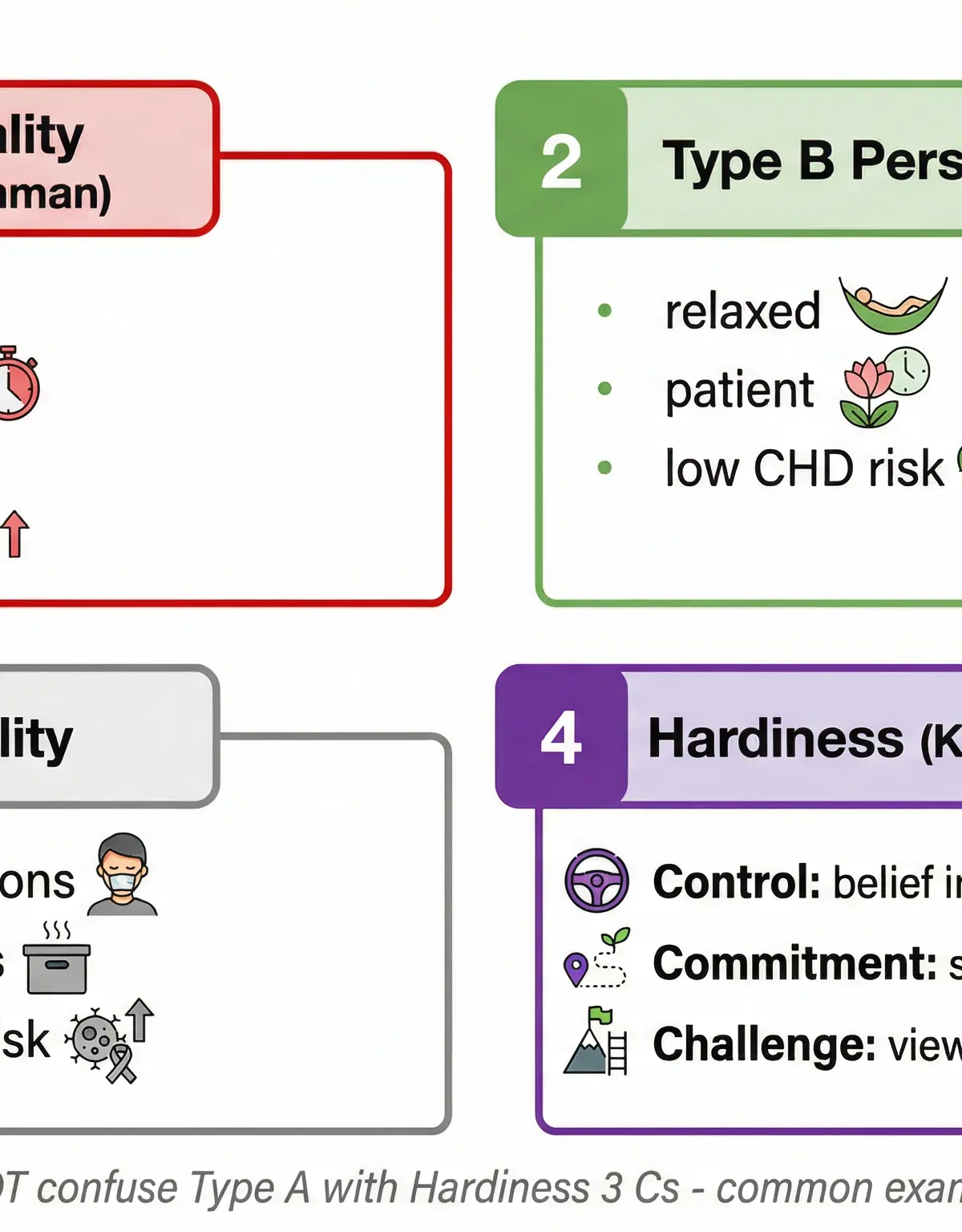
Type A: Defined by Friedman and Rosenman (1974), these individuals are competitive, ambitious, time-urgent, and hostile. Their research found a significant link between Type A personality and an increased risk of coronary heart disease (CHD).
Type B: The opposite of Type A; relaxed, patient, and easy-going.
Type C: Characterised by being compliant, patient, and conflict-avoidant, and who tend to suppress their emotions (especially anger). This personality type has been linked in some research to an increased risk of cancer.
The Hardy Personality
Kobasa and Maddi (1977) proposed that some individuals are more psychologically 'hardy' and thus more resistant to stress. Hardiness consists of the Three Cs:
- Control: Hardy individuals see themselves as being in control of their lives, rather than being controlled by external factors.
- Commitment: They have a strong sense of purpose and are actively engaged in their work and relationships.
- Challenge: They view change and potential stressors as opportunities for growth, not as threats.
Managing Stress
Drug Therapy
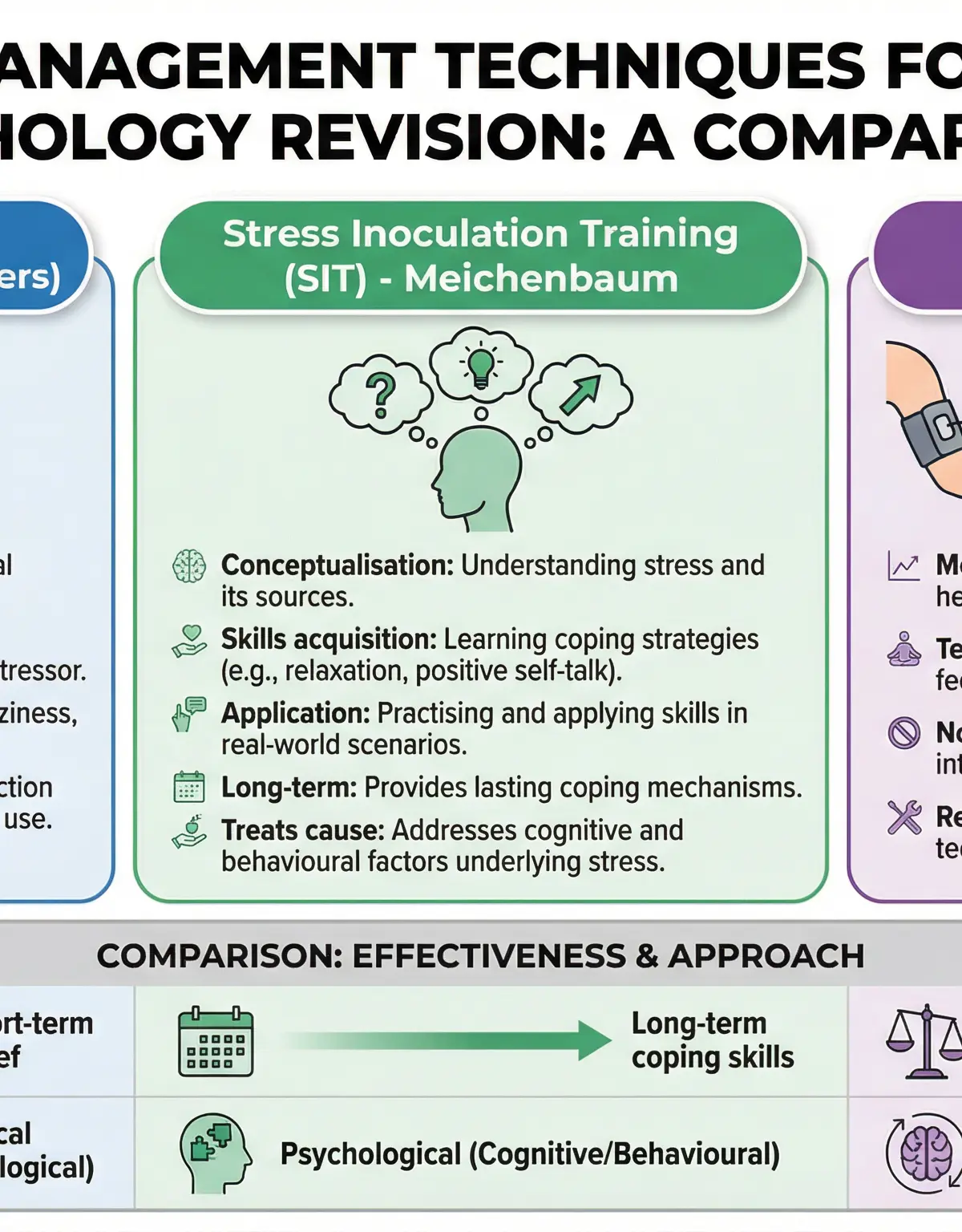
- Benzodiazepines (BZs): Such as Valium and Librium. They work by enhancing the action of the neurotransmitter GABA, which has a quieting effect on many neurons in the brain, reducing anxiety. They are fast-acting but carry risks of dependency and side effects like drowsiness.
- Beta-Blockers (BBs): They reduce the activity of adrenaline and noradrenaline, thus interfering with the physiological effects of the SAM pathway (e.g., they slow the heart rate and lower blood pressure). They treat the symptoms, not the psychological cause.
Psychological Therapies
- Stress Inoculation Training (SIT): A cognitive-behavioural therapy developed by Meichenbaum. It involves three phases: Conceptualisation (identifying stressors), Skills Acquisition (learning coping skills like relaxation and positive self-talk), and Application (practising these skills in real-world situations). It is long-lasting but requires significant time and effort.
- Biofeedback: A technique where the individual is connected to sensors that provide feedback on physiological responses (e.g., heart rate, muscle tension). By observing this feedback, the person learns to control these responses, often through relaxation techniques. It is non-invasive but requires specialist equipment.
"
Worked Examples
3 worked examples — open one to explore the question and available guidance.
Practice Questions
Try the question, then reveal an answer plan or example response
Outline the findings of one study that has investigated the effect of stress on the immune system. (4 marks)
Hint: Think about a study that measured a biological marker of immune function in a high-stress and low-stress condition.
Distinguish between the SAM pathway and the HPA axis. (4 marks)
Hint: Focus on four key differences: speed of onset, duration, key hormone, and adrenal gland part.
Evaluate the use of drug therapy to manage stress. (6 marks)
Hint: Consider both the strengths (e.g., effectiveness) and weaknesses (e.g., side effects, dependency).
Javier is a manager who feels constantly under pressure. He has a heavy workload and feels he has no control over his tasks. He is often irritable and has had several colds this year. His colleague, Anya, has a similar workload but seems to thrive. She sees pressure as a chance to prove herself and is very involved in her projects. Using your knowledge of psychology, explain their different responses to stress. (10 marks)
Hint: This is an AO2 application question. You need to identify concepts related to workplace stress and individual differences and explicitly link them to Javier and Anya.
Outline and evaluate Selye's General Adaptation Syndrome. (8 marks)
Hint: Describe the three stages (ARE) and then provide evaluation points, focusing on the research methods and generalisability.
Watch or listen (optional)
Test your understanding of Stress
Active recall beats re-reading. Take an instant quiz now to test what you’ve learned and lock it into long-term memory.
7 days Premium · Then the free plan continues · No card, no charge