AQA · GCSE · Psychology
Perception
Perception is the fascinating process by which our brain makes sense of the world, sitting right at the heart of the nature-nurture debate. This topic explores how we judge depth, why optical illusions trick our minds, and how our expectations literally change what we see.
- 6 min read
- 3 worked examples
- 3 practice questions
- 6 key terms
Study Notes
Overview
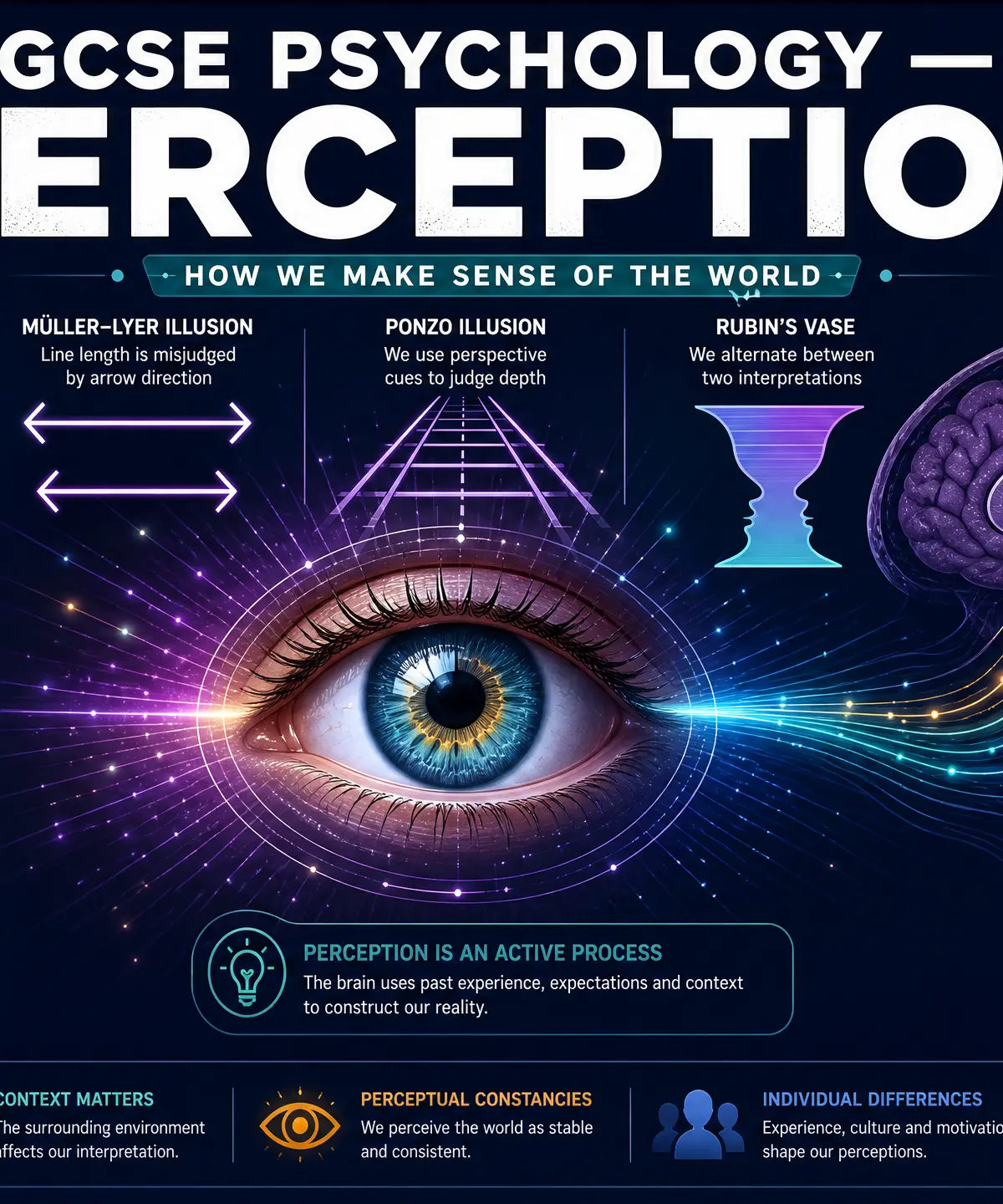
Welcome to the GCSE Psychology topic of Perception. While sensation is simply the raw physical data collected by our eyes and ears, perception is the complex, active process of interpreting that data to construct our reality. This topic is highly significant because it forces us to question whether we are born with the ability to perceive the world accurately (nature) or whether we learn it through experience (nurture).
Examiners expect you to be able to clearly distinguish between sensation and perception, identify specific monocular and binocular depth cues, and evaluate the two major theories of perception: Gibson's Direct Theory and Gregory's Constructivist Theory. Furthermore, you must be able to apply these concepts to explain why specific visual illusions occur, and understand how factors like motivation and expectation (perceptual set) influence our perception, backed by key studies.
Audio Lesson
Listen to the comprehensive revision podcast for this topic below:

Sensation vs Perception
Sensation: The physical process where our sensory organs (e.g., the retina in the eye) detect raw information from the environment (e.g., light waves).
Perception: The psychological process where the brain organises, interprets, and makes sense of the sensory information to create a meaningful experience.
Depth Cues
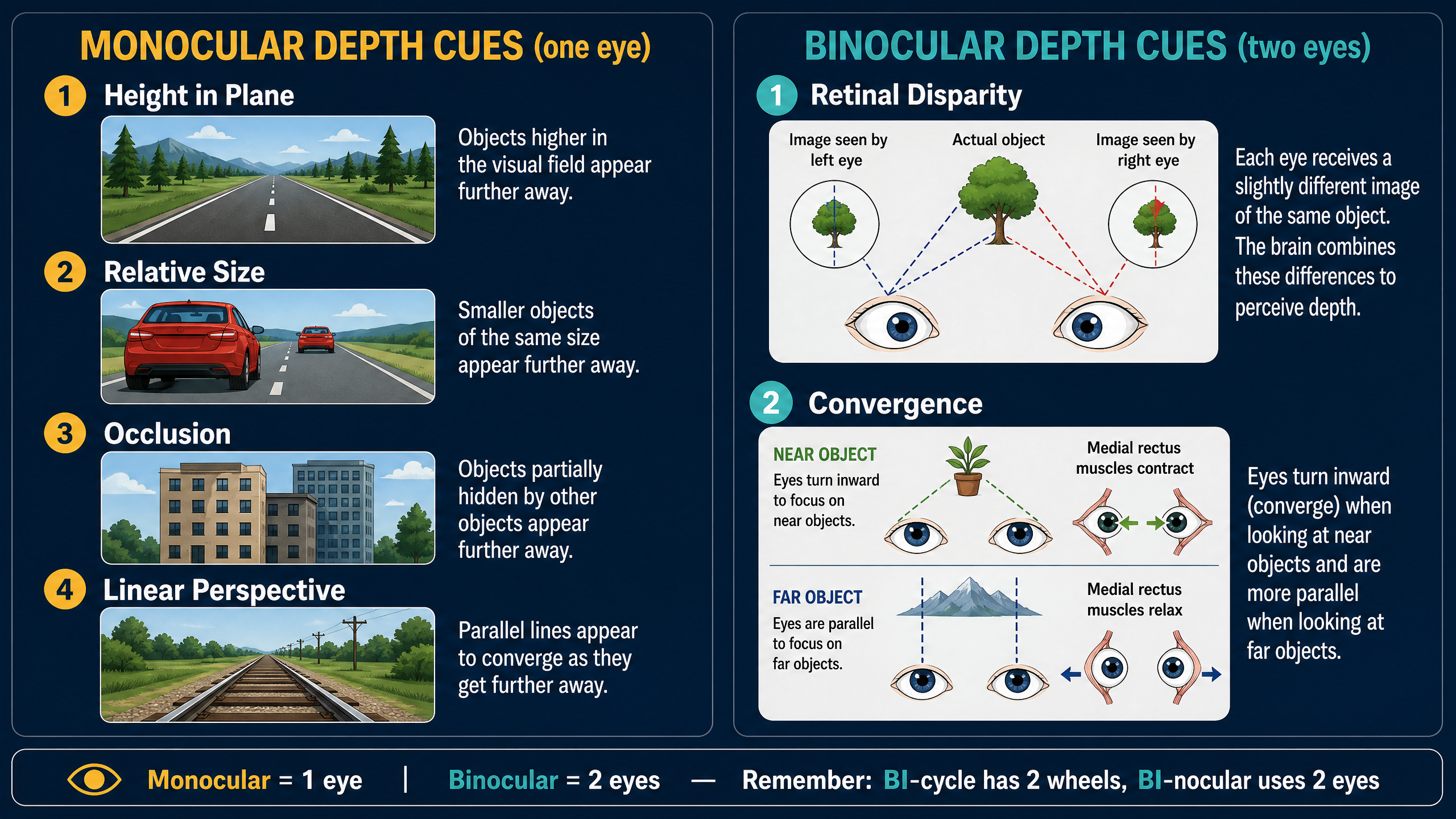
To navigate the 3D world, our brain relies on depth cues to judge distance.
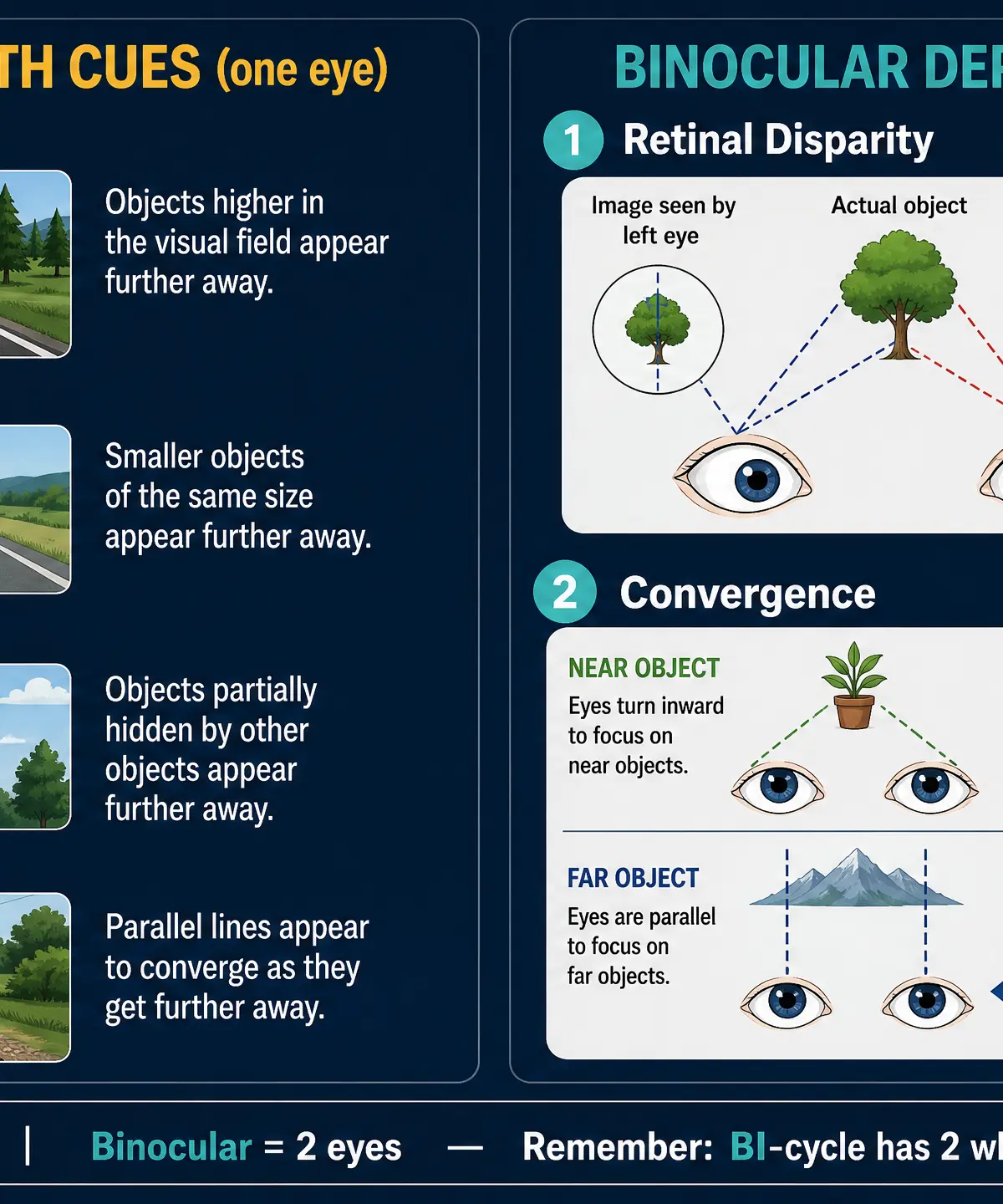
Monocular Depth Cues (Require One Eye)
- Height in Plane: Objects higher up in the visual field appear further away.
- Relative Size: If two objects are known to be similar in size, the one that casts a smaller image on the retina is perceived as further away.
- Occlusion: When one object obscures part of another, the hidden object is perceived as being further away.
- Linear Perspective: Parallel lines appear to converge as they recede into the distance.
Binocular Depth Cues (Require Two Eyes)
- Retinal Disparity: Because our eyes are about 6cm apart, they receive slightly different images. The brain compares these images; a larger difference (disparity) means the object is closer.
- Convergence: When looking at a close object, our eye muscles must work harder to turn the eyes inward. The brain detects this muscular effort as a cue for closeness.
Theories of Perception
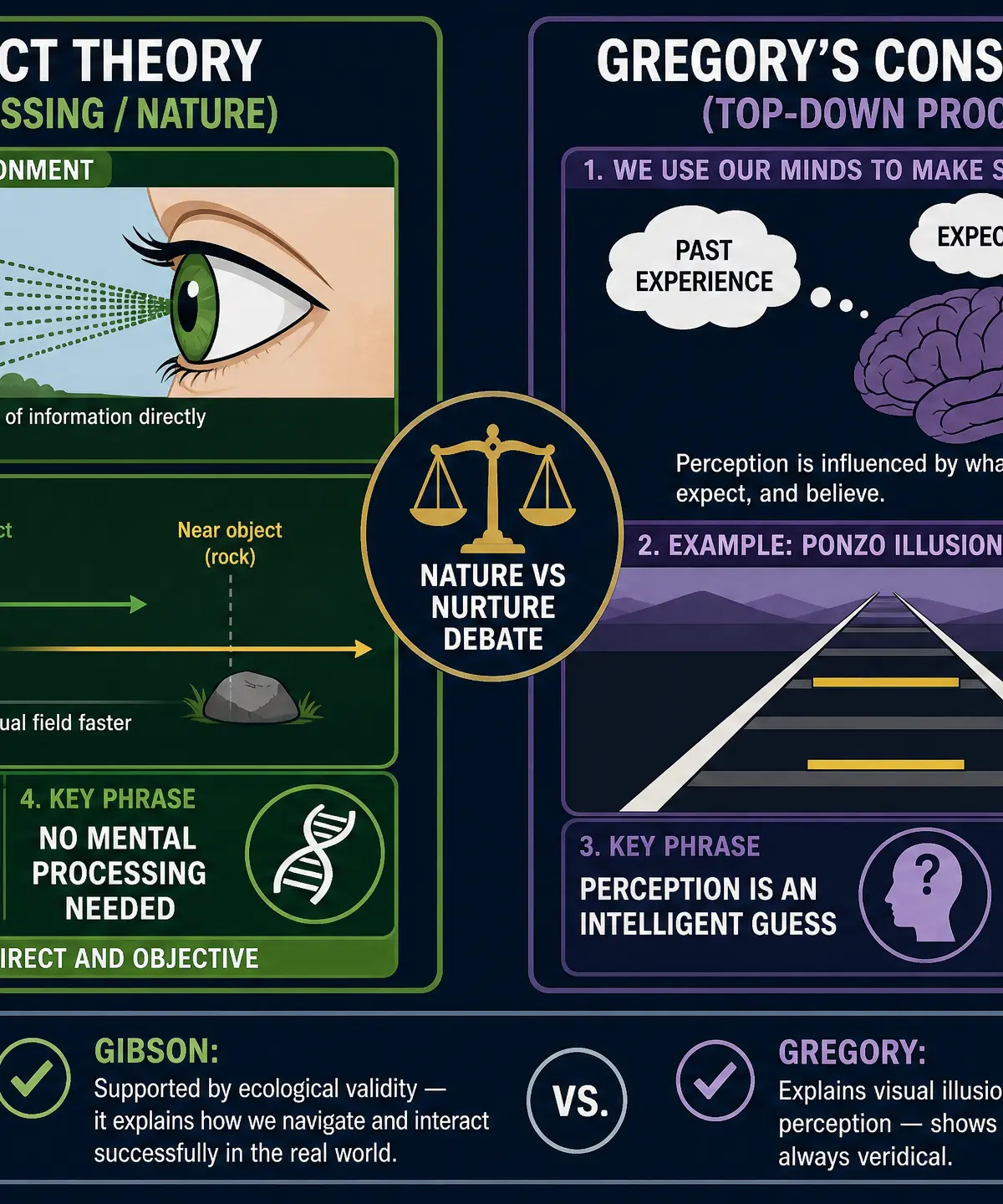
Gibson's Direct Theory (Nature)
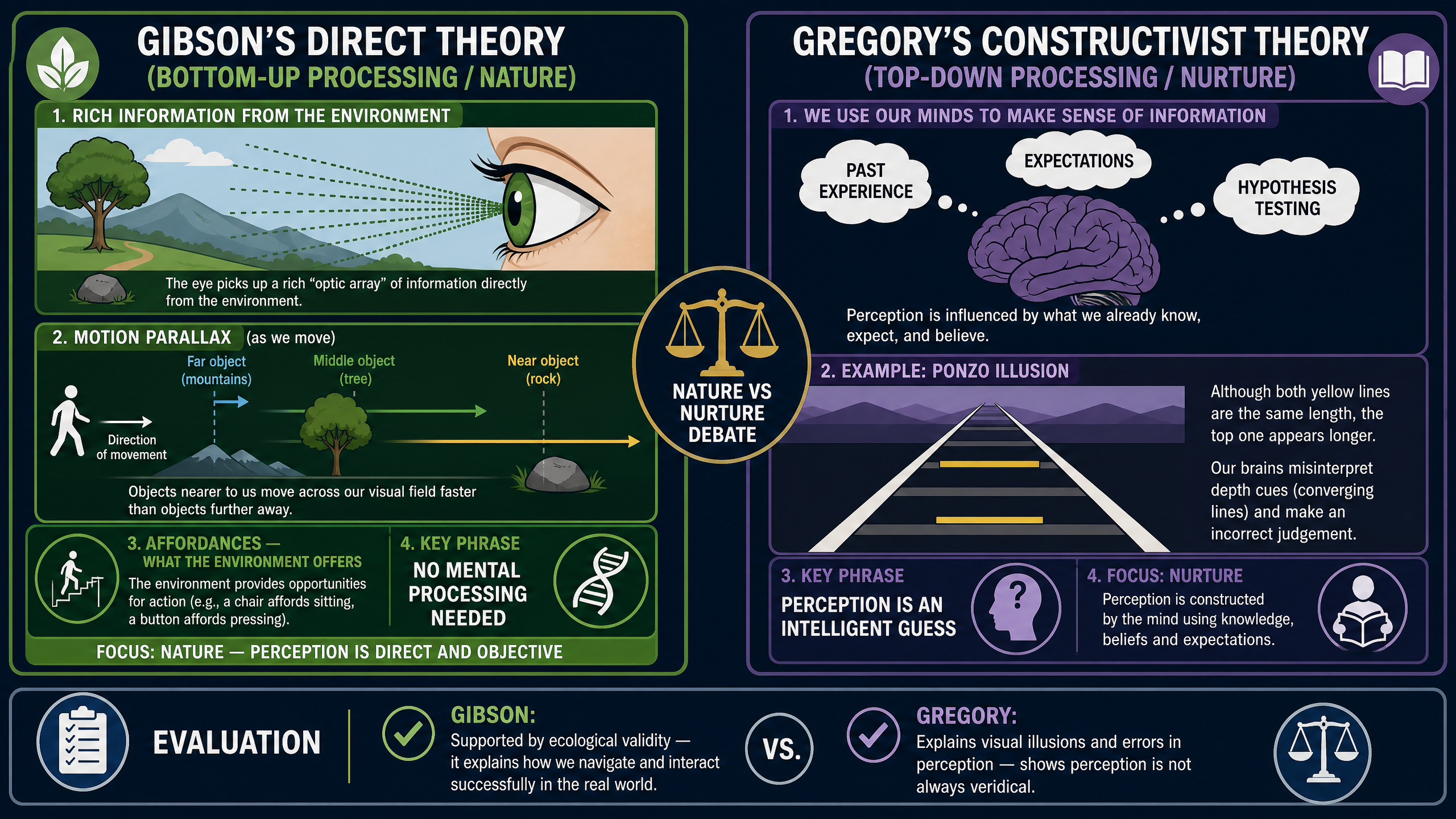
Gibson argued that perception is an innate, bottom-up process. We do not need to make inferences; the environment provides a rich 'optic array' that gives us all the information we need directly.
- Motion Parallax: A key concept. As we move, objects closer to us appear to move faster across our visual field than objects further away, providing direct distance information.
- Affordances: The environment offers direct clues about what objects are for (e.g., a chair affords sitting).
Gregory's Constructivist Theory (Nurture)
Gregory argued that perception is a top-down process involving inference and hypothesis testing. Because sensory information is often incomplete or ambiguous, our brain uses past experience and knowledge to construct our perception.
- Hypothesis Testing: The brain makes an educated guess about what is out there.
- Explaining Illusions: Gregory's theory successfully explains visual illusions as the brain making the wrong hypothesis based on misinterpreted cues.
Visual Illusions
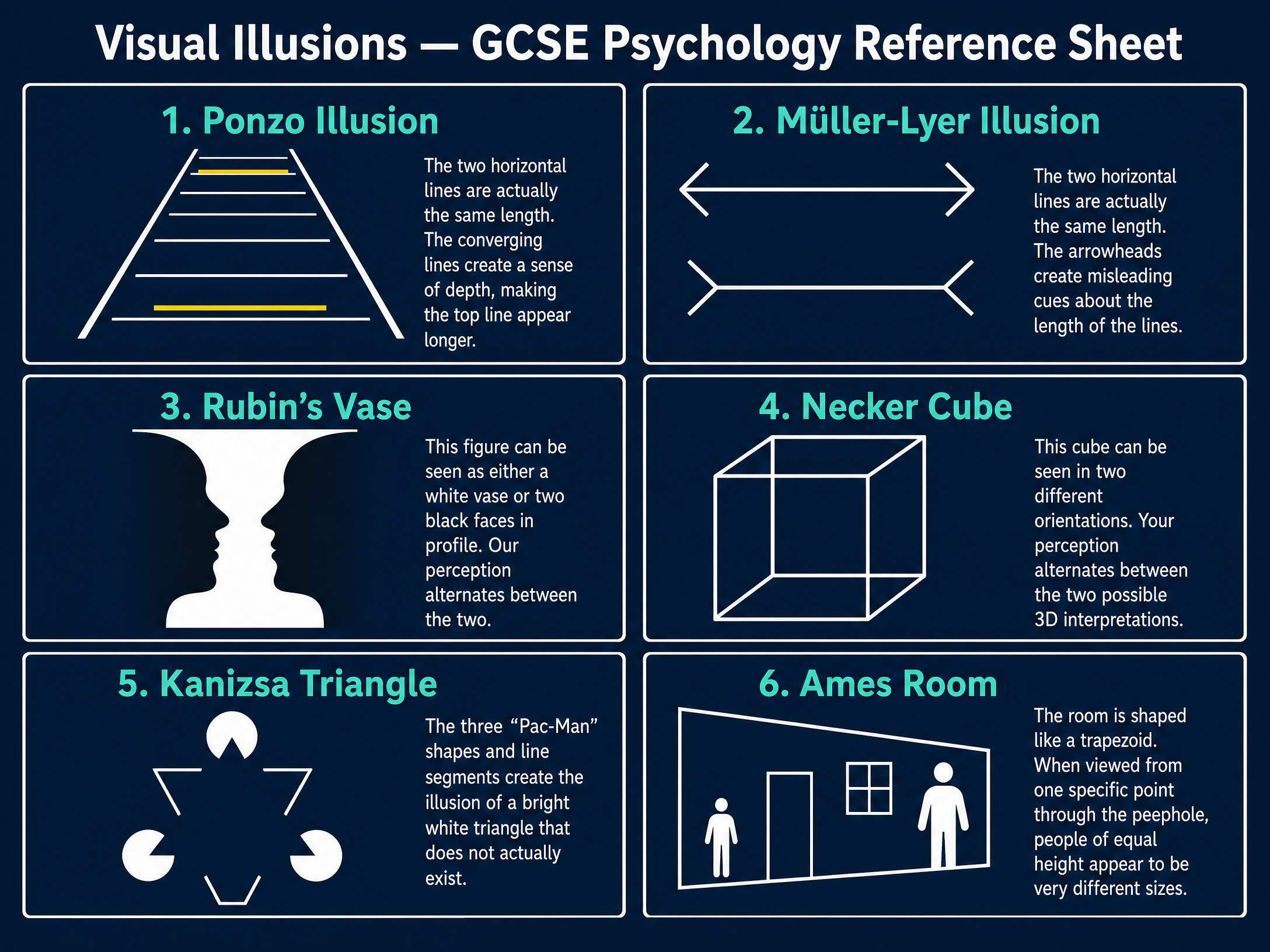
Visual illusions occur when our perception is tricked, revealing how the brain processes information.
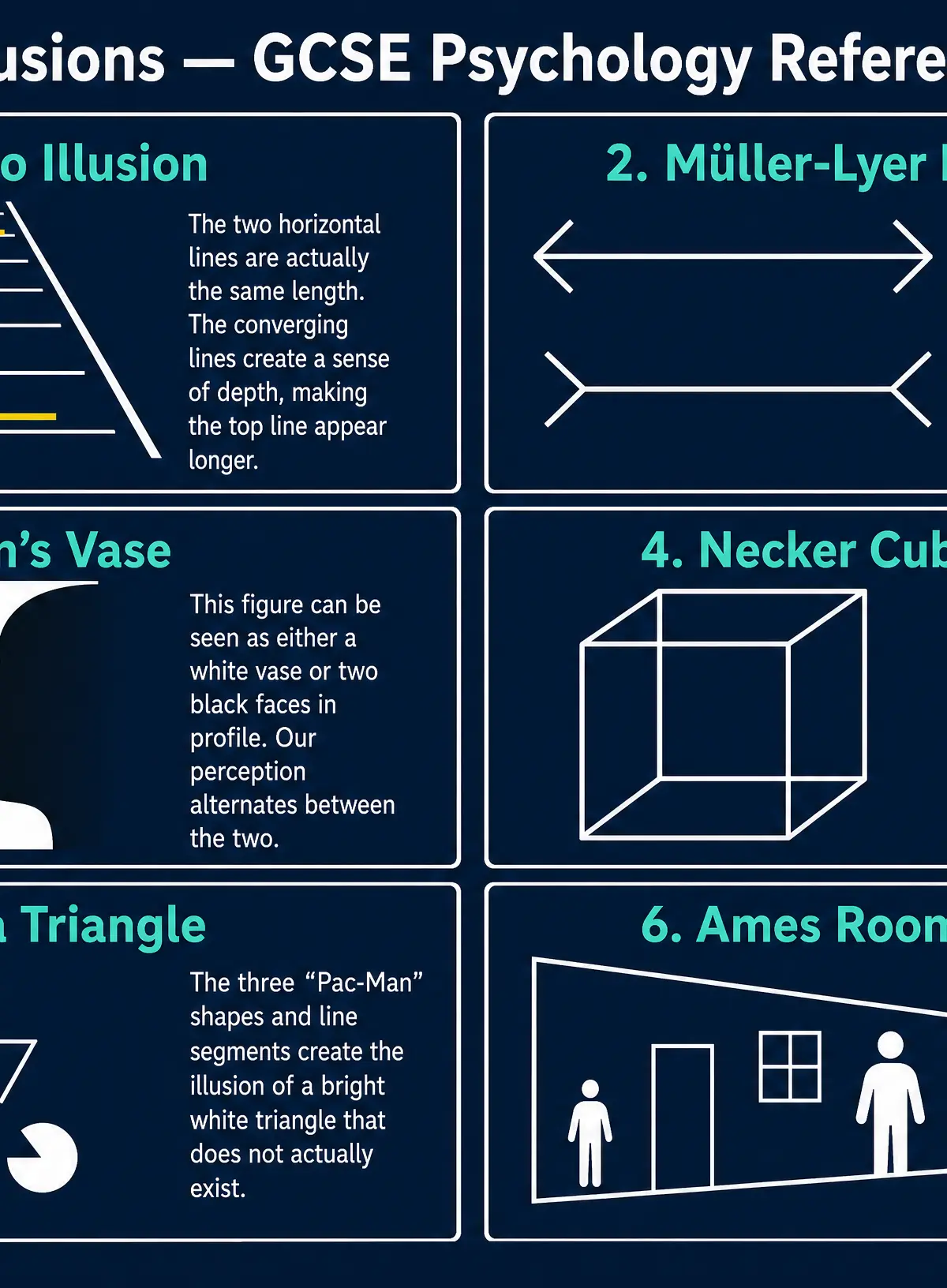
- Ponzo Illusion: (Misinterpreted depth cues). Converging lines create linear perspective, making the brain assume the top horizontal line is further away, and therefore larger.
- Müller-Lyer Illusion: (Misinterpreted depth cues). The outward-pointing arrowheads resemble the inside corner of a room (further away), while inward-pointing arrows resemble the outside corner of a building (closer).
- Rubin's Vase: (Ambiguity). The image has two equally valid interpretations (a vase or two faces). The brain cannot decide which is the 'figure' and which is the 'ground', so perception flips between them.
- Necker Cube: (Ambiguity). A 2D wireframe drawing that can be perceived as a 3D cube in two different orientations.
- Kanizsa Triangle: (Fiction). The brain perceives a bright white triangle that isn't physically drawn, filling in the gaps to create meaningful contours.
- Ames Room: (Misinterpreted depth cues / Size constancy). A distorted trapezoidal room that looks square from a specific peephole. Because the brain assumes the room is a normal shape, it perceives the people inside as changing size rather than distance.
Perceptual Set
Perceptual set is a readiness or tendency to notice some aspects of sensory data and ignore others, influenced by expectations, emotion, motivation, and culture.
Key Studies
- Motivation (Gilchrist & Nesberg, 1952): Participants deprived of food and water rated pictures of food and drink as brighter than a control group did. This shows that biological motivation affects what we perceive.
- Expectation (Bruner & Minturn, 1955): Participants were shown an ambiguous figure that could be read as a '13' or a 'B'. Those who had just seen numbers perceived it as '13', while those who had seen letters perceived it as 'B'. This demonstrates the power of context and expectation.
Visual Resources
3 diagrams and illustrations
Interactive Diagrams
1 interactive diagram to visualise key concepts
Conceptual Flow Outline
The pathway from Sensation to Perception
Worked Examples
3 worked examples — open one to explore the question and available guidance.
Practice Questions
Test your understanding — click to reveal model answers
Describe the Gilchrist and Nesberg (1952) study into how motivation affects perception. (4 marks)
Hint: Think about what the participants were deprived of, what they were shown, and what the results were.
A student is looking at a drawing of a wireframe cube. Sometimes the front face appears to point downwards to the left, but if they stare at it, the front face suddenly appears to point upwards to the right. Identify this illusion and explain why it occurs. (3 marks)
Hint: Name the specific cube illusion, and use the correct psychological term for an image with two valid interpretations.
Discuss Gregory's constructivist theory of perception. (9 marks)
Hint: Outline the key features of the theory (top-down, inference, nurture) and then evaluate it with strengths (explains illusions) and weaknesses (infant studies).