OCR · A-Level · Psychology
Observations
Mastering observational methods is crucial for OCR A-Level Psychology, as it forms a cornerstone of the research methods paper. This guide provides the precise language, design principles, and evaluation points needed to secure top marks in 'Design a Study' questions.
- 5 min read
- 3 worked examples
- 5 practice questions
- 6 key terms
Check what you remember
Read the wording for your board, then hide it and explain Operationalisation in your own words. Rough notes are fine. This is a self-check, with no mark or grade.
Reference: OCR
The process of defining a variable so that it can be precisely measured or tested. For observations, this means creating objective, measurable behavioural categories.
Study Notes
Overview
Observational research is a fundamental method in psychology, allowing researchers to capture behaviour as it naturally occurs. For OCR A-Level candidates, a precise understanding of observational design is not just recommended; it is essential for achieving high marks in Component 1. Examiners expect candidates to be able to distinguish between different types of observation (e.g., participant vs. non-participant, overt vs. covert, naturalistic vs. controlled), justify design choices in the context of a novel stimulus, and demonstrate mastery of data recording techniques like time and event sampling. This guide will break down these core concepts, providing the specific terminology and analytical frameworks required to impress examiners and confidently tackle any observation-based question.
Key Concepts in Observational Design
The Three Dimensions of Observation
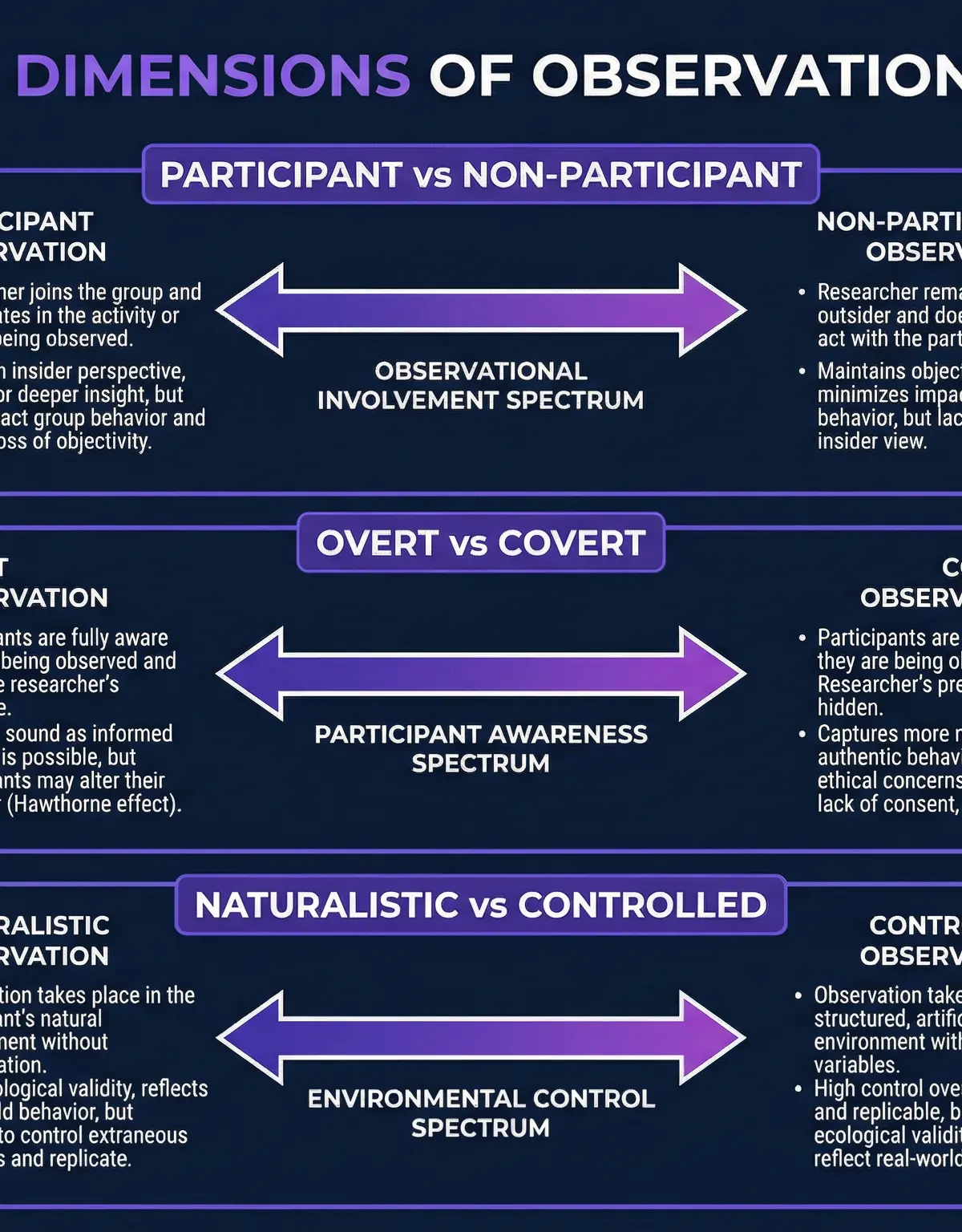
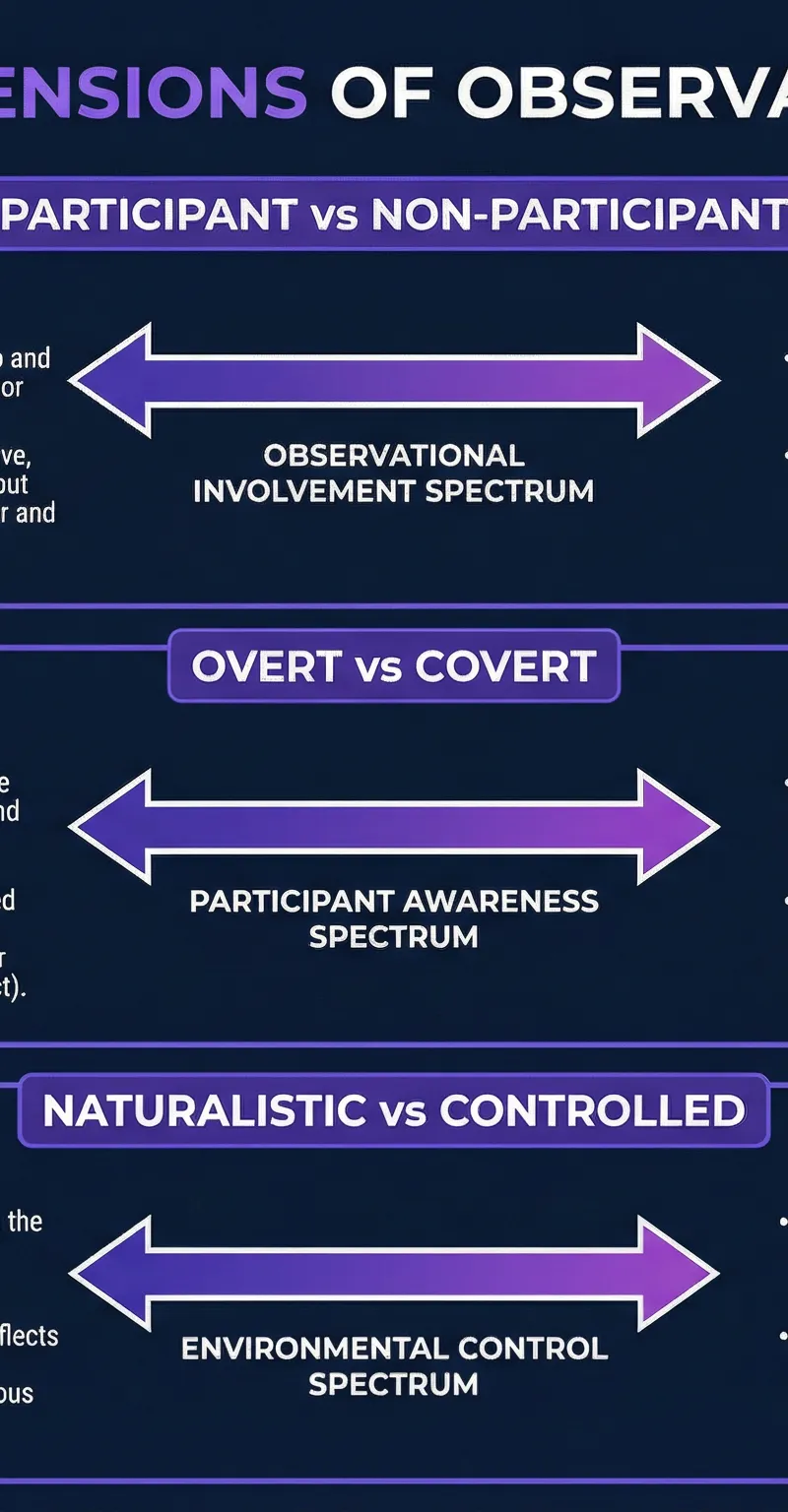
Observational studies can be classified along three independent dimensions. A common mistake candidates make is conflating these dimensions (e.g., assuming a covert study must be non-participant). It is vital to treat them as separate design choices.
-
Participant vs. Non-Participant Observation: This dimension concerns the role of the observer. In a participant observation, the researcher becomes part of the group they are studying. This allows for deep, rich, qualitative data but risks the researcher losing objectivity (a phenomenon known as 'going native') or influencing the group's behaviour. In a non-participant observation, the researcher remains separate from the group, which enhances objectivity but may limit the depth of understanding.
-
Overt vs. Covert Observation: This dimension relates to the awareness of the participants. In an overt (disclosed) observation, participants know they are being studied. This is ethically sound as it allows for informed consent, but it can lead to the observer effect (or Hawthorne effect), where participants alter their behaviour simply because they are being watched. In a covert (undisclosed) observation, participants are unaware they are being studied. This yields more natural, valid behaviour but raises significant ethical issues regarding deception and lack of consent.
-
Naturalistic vs. Controlled Observation: This dimension refers to the setting. A naturalistic observation is conducted in a real-world environment where the researcher does not manipulate any variables. This maximises ecological validity but sacrifices control over extraneous variables. A controlled observation takes place in a structured environment, such as a laboratory (e.g., Ainsworth's 'Strange Situation'), allowing the researcher to control variables and improve replicability, but at the cost of ecological validity.
Sampling Procedures in Observations
It is impractical for an observer to record everything. Therefore, researchers use systematic sampling methods to collect data.
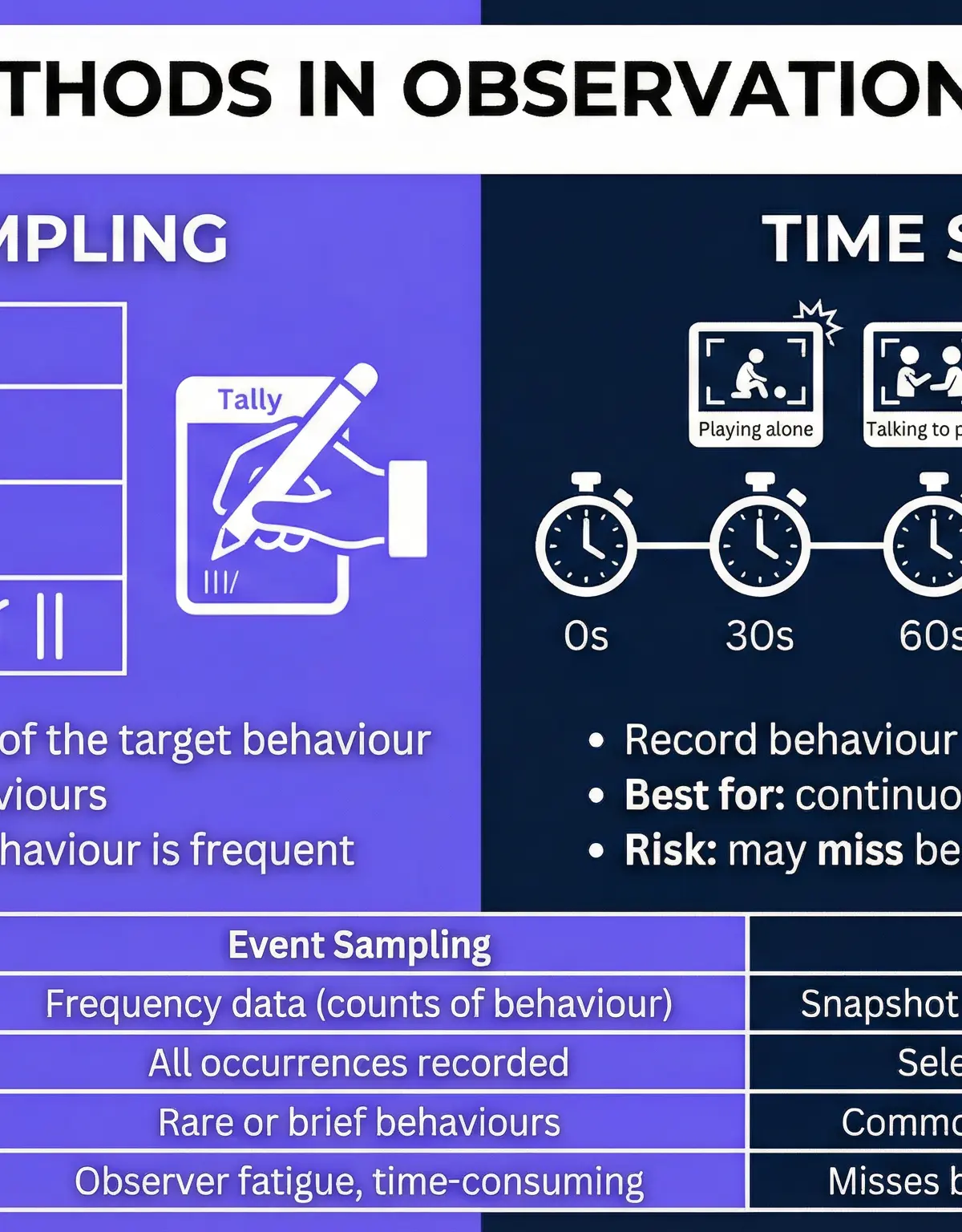
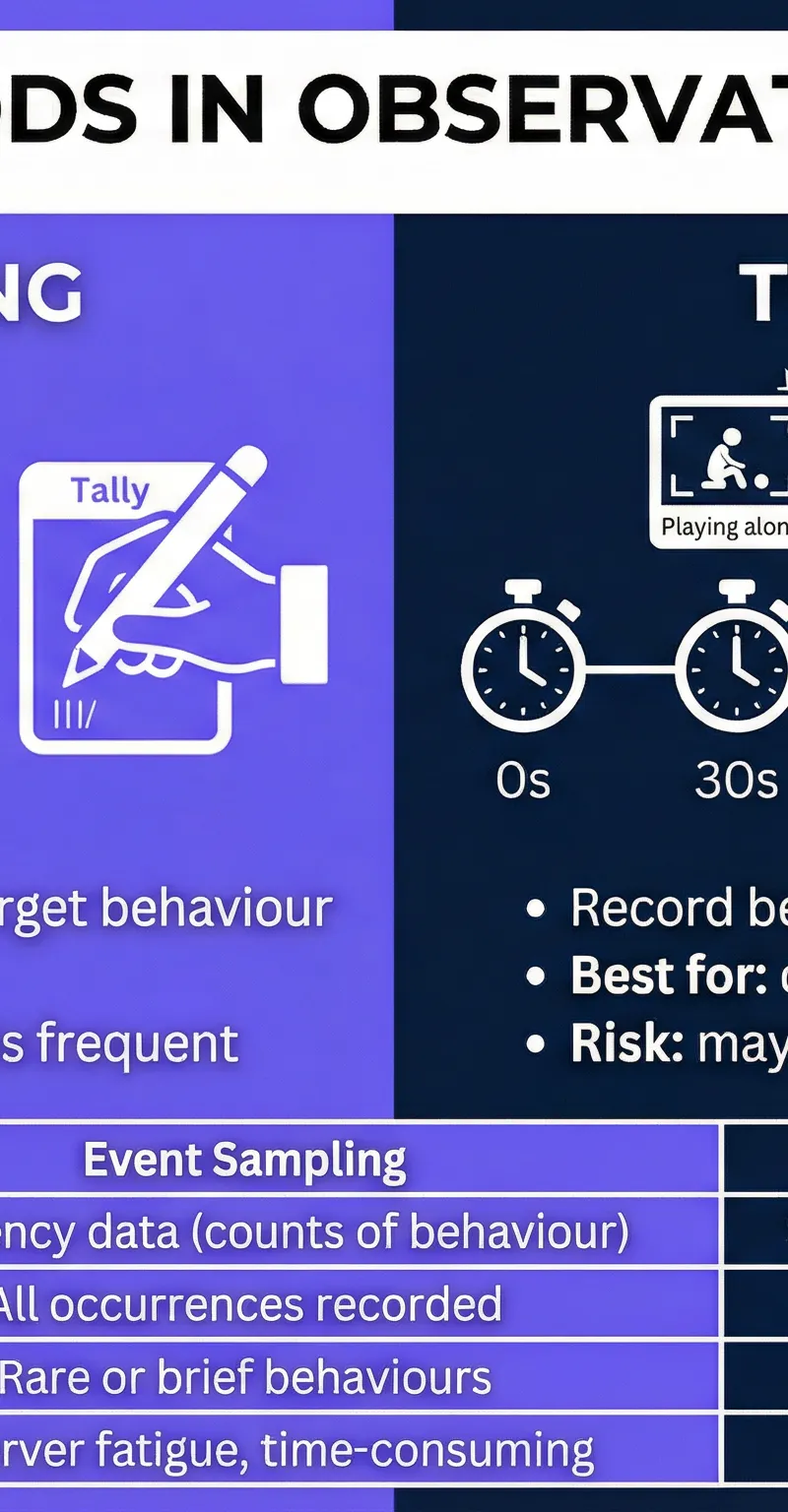
- Event Sampling: The observer records a tally every time a specific, pre-defined target behaviour occurs throughout the entire observation period. This method is excellent for capturing behaviours that are infrequent or brief, as they are less likely to be missed. However, if the target behaviour is very frequent, this method can be tiring for the observer and difficult to manage.
- Time Sampling: The observer records behaviour at prescribed time intervals (e.g., every 30 seconds). This method is effective for behaviours that are continuous or occur frequently, as it provides a 'snapshot' of activity at that moment. The primary limitation is that behaviours occurring between intervals are missed, potentially providing an unrepresentative picture of the overall observation.
Recording Observational Data
To ensure data is recorded systematically and reliably, researchers must use a structured coding frame with fully operationalised behavioural categories.
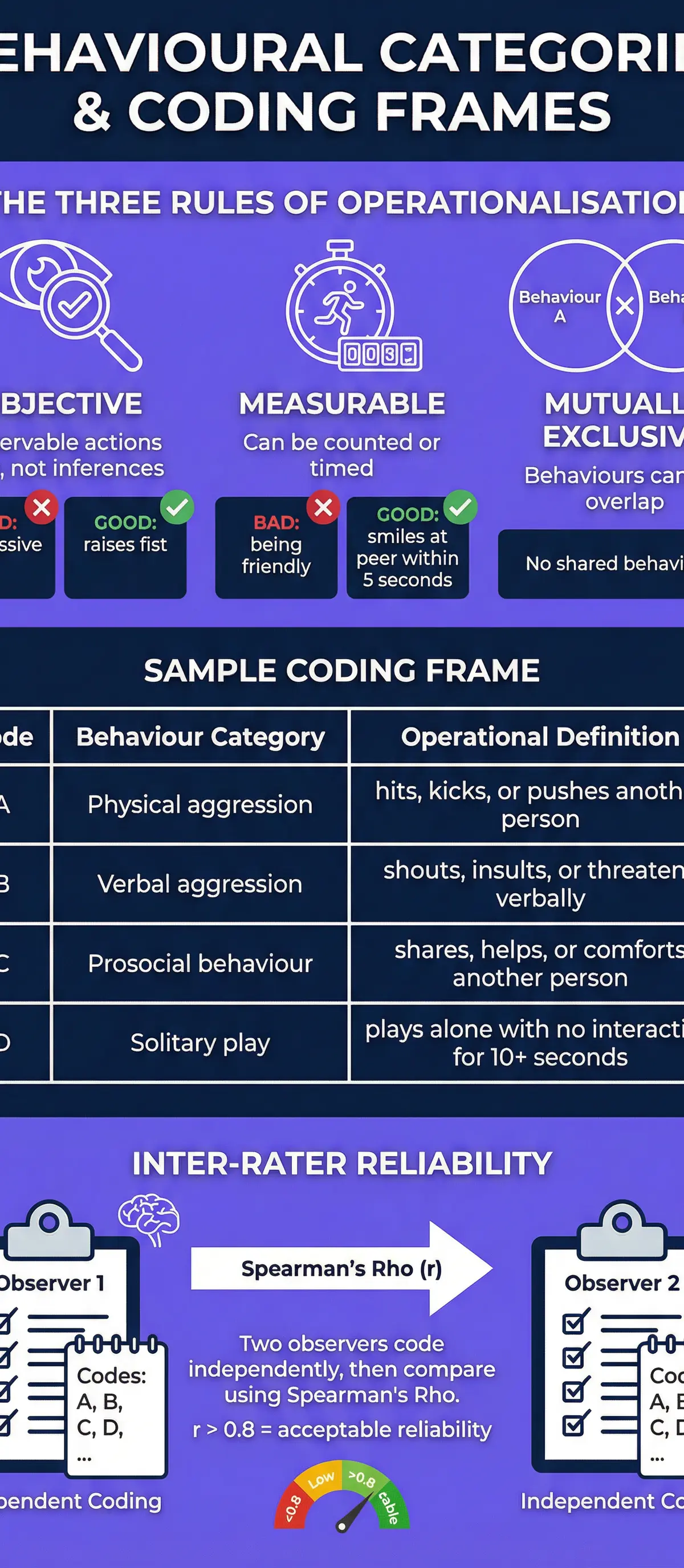
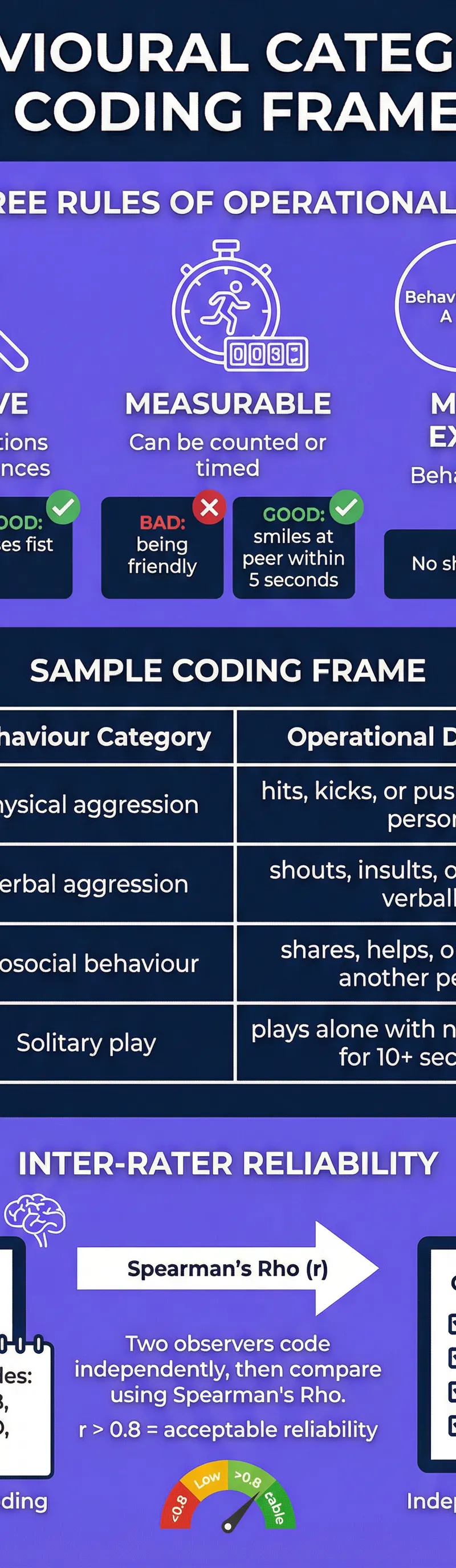
- Behavioural Categories: Before the observation begins, the researcher must break down the target behaviour into a set of discrete, observable categories. For these categories to be effective, they must be:
- Objective: They must be observable actions, not subjective states (e.g., 'pushes another child' instead of 'is aggressive').
- Measurable: They must be able to be counted or timed.
- Mutually Exclusive: The categories should not overlap; a single action should not fit into more than one category.
- Inter-Rater Reliability: To check the reliability of the coding system, two independent observers watch the same behaviour and record data using the same categories. Their results are then correlated using a statistical test (typically Spearman's Rho). A correlation coefficient of +0.8 or higher is generally accepted as indicating good inter-rater reliability.
Worked Examples
3 worked examples — open one to explore the question and available guidance.
Practice Questions
Try the question, then reveal an answer plan or example response
A psychologist wants to observe how doctors communicate with elderly patients. Suggest a suitable behavioural coding frame the psychologist could use. (4 marks)
Hint: Remember OMM: Objective, Measurable, Mutually Exclusive. Think about specific, observable actions.
Explain the difference between event sampling and time sampling. (4 marks)
Hint: Define each term and then highlight the key distinction between them.
Distinguish between observer bias and observer effects. (3 marks)
Hint: One is about the researcher, the other is about the participant.
A researcher is conducting a covert participant observation of a group of environmental activists. Evaluate the ethical issues of this study. (6 marks)
Hint: Consider both the problems and potential justifications. Think about consent, deception, and the right to withdraw.
Explain how a psychologist could ensure their observational study has high inter-rater reliability. (3 marks)
Hint: Think about the process from start to finish: training, independent observation, and statistical testing.
Exam technique
How to turn what you know into marks
How to approach the question
For 'Design a Study' questions, use the 'Who, What, Where, How' framework. Who are the participants? What behaviour is being measured? Where will the study take place? How will data be recorded and reliability be checked?
How to structure your answer
- Design questions
- Structure your answer with subheadings: Type of Observation, Sampling Method, Behavioural Categories, Reliability, Ethics.
- Explain questions
- Point, Evidence/Example, Explanation, Link back to the question (PEEL).
- Evaluate questions
- Use a balanced structure. Present a strength, explain it, then present a weakness and explain it. Repeat for a second pair of points if time allows.
Timing
Approximately 1.25 minutes per mark. For a 12-mark question, spend 15 minutes.
Common pitfalls
- Confusing event and time sampling.
- Providing vague, non-operationalised behavioural categories like 'aggression'.
- Failing to justify design choices in the context of the stimulus.
- Giving generic ethical points instead of applying them to the specific scenario.
What the command words want
- Design
- Provide a practical, step-by-step plan that another psychologist could follow.
- Explain
- Provide a point and then elaborate on it, giving reasons why.
- Describe
- State the features of the method clearly.
- Evaluate
- Provide strengths and weaknesses, with elaboration and comparison.
Watch or listen (optional)
Test your understanding of Observations
Active recall beats re-reading. Take an instant quiz now to test what you’ve learned and lock it into long-term memory.
A week of Premium from your first lesson · Then the free plan continues · No card, no charge