Pearson Edexcel · GCSE · Psychology
Course version: 1PS0 · Version from Sept 2017
Understand biological explanations of criminality, including personality…
Full specification wording
Criminal psychology: 6.1.2 Understand biological explanations of criminality, including personality types (Eysenck, 1964), to include strengths and weaknesses of the theory: a. extraversion b. introversion c. neuroticism d. psychoticism
Biological explanations suggest criminality has innate roots.
Checked against the Pearson Edexcel 1PS0 specification (opens in a new tab) on .
- Point 2 of 4
- 3 key terms
Study notes
From the checked teaching notes for this specification point.
The idea
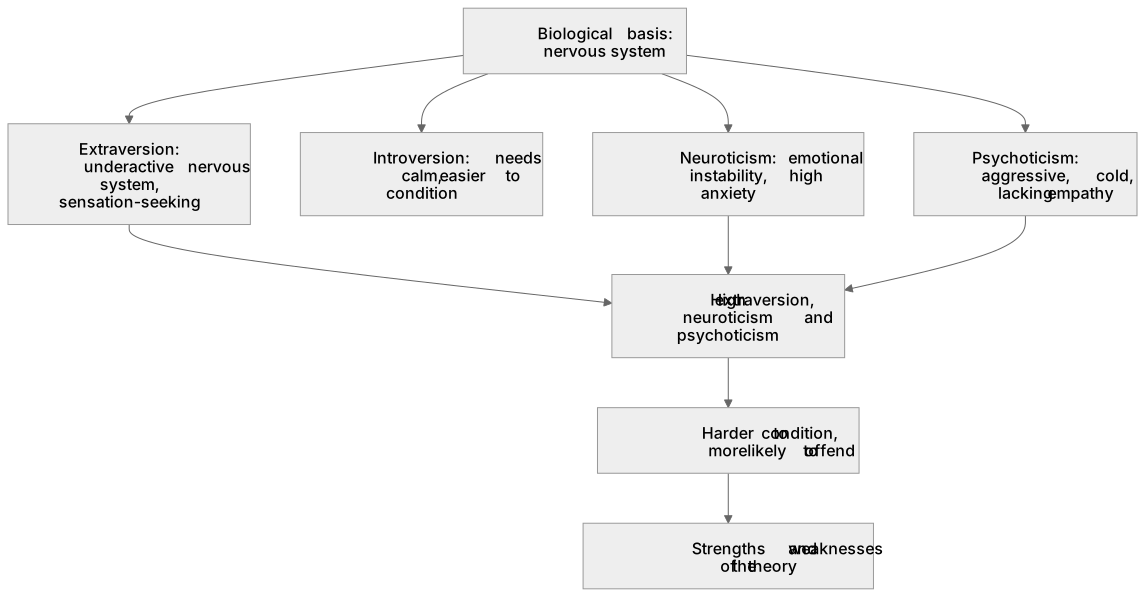
Biological explanations suggest criminality has innate roots. Eysenck (1964) proposed personality types are biologically determined by the nervous system and linked to crime. Extraversion involves being sensation-seeking, driven by an underactive nervous system requiring stimulation. Introversion is the opposite, needing calm. Neuroticism refers to emotional instability and high anxiety. Psychoticism involves being aggressive, cold, and lacking empathy. Eysenck argued individuals scoring high on extraversion, neuroticism, and psychoticism are harder to condition and more likely to offend. Strengths include combining biological and psychological factors, but weaknesses include relying on self-report questionnaires which may lack validity.
What earns the marks
- Describe extraversion as a biological need for environmental stimulation due to an underactive nervous system.
- Explain neuroticism as emotional instability stemming from a highly reactive autonomic nervous system.
- Define psychoticism as a trait characterised by aggression, impulsivity, and a lack of empathy, linked to testosterone levels.
- Explain that the combination of high extraversion, neuroticism, and psychoticism makes an individual difficult to socialise and condition against criminal acts.
- Evaluate Eysenck's theory by noting its strength in integrating biological and psychological concepts, and its weakness in relying on subjective self-report measures.
Common mistakes and how to put them right
Confusing psychoticism with psychosis or schizophrenia.
Put it right: Psychoticism is a personality trait relating to aggression and lack of empathy, not a clinical mental health disorder involving hallucinations.
Treating introversion as a cause of criminality.
Put it right: Introverts are easier to condition and less likely to seek illegal stimulation, making them less prone to criminality according to Eysenck.
Failing to link the personality traits to their biological basis.
Put it right: Explain that these traits are rooted in the functioning of the central and autonomic nervous systems.
Exam tips
- Use the acronym PEN (Psychoticism, Extraversion, Neuroticism) to remember the three traits Eysenck linked to criminal behaviour.
- When evaluating, mention that the Eysenck Personality Inventory (EPI) is a self-report tool, which can lead to socially desirable answers.
- Clearly distinguish between the biological cause (e.g., underactive nervous system) and the resulting psychological trait (e.g., extraversion).
Try the lesson
The start of the Criminal psychology: 6.1.2 Understand biological explanations of criminality, including personality types (Eysenck, 1964), to include strengths and weaknesses of the theory: a. extraversion b. introversion c. neuroticism d. psychoticism lesson, made from checked teaching notes for this specification point.
Have a go first
According to Eysenck's theory of the criminal personality, which trait is characterised by a lack of empathy, aggression, and being solitary?
Listen
Biological explanations suggest criminality has innate roots. Eysenck (1964) proposed personality types are biologically determined by the nervous system and linked to crime. Extraversion involves being sensation-seeking, driven by an underactive nervous system requiring stimulation. Introversion is the opposite, needing calm. Neuroticism refers to emotional instability and high anxiety. Psychoticism involves being aggressive, cold, and lacking empathy. Eysenck argued individuals scoring high on extraversion, neuroticism, and psychoticism are harder to condition and more likely to offend. Strengths include combining biological and psychological factors, but weaknesses include relying on self-report questionnaires which may lack validity. A strong answer earns marks for these points. Describe extraversion as a biological need for environmental stimulation due to an underactive nervous system. Explain neuroticism as emotional instability stemming from a highly reactive autonomic nervous system. Define psychoticism as a trait characterised by aggression, impulsivity, and a lack of empathy, linked to testosterone levels. Explain that the combination of high extraversion, neuroticism, and psychoticism makes an individual difficult to socialise and condition against criminal acts. A common slip: Confusing psychoticism with psychosis or schizophrenia. Instead, Psychoticism is a personality trait relating to aggression and lack of empathy, not a clinical mental health disorder involving hallucinations. Exam tip: Use the acronym PEN (Psychoticism, Extraversion, Neuroticism) to remember the three traits Eysenck linked to criminal behaviour.
See it
Key words
Say what each word means before you turn the card.
Extraversion
Try answering aloud or in your head before turning the card.
Introversion
Try answering aloud or in your head before turning the card.
Psychoticism
Try answering aloud or in your head before turning the card.
See every definition
- Extraversion
- Being sensation-seeking, driven by an underactive nervous system requiring stimulation.
- Introversion
- The opposite of extraversion, needing calm.
- Psychoticism
- Being aggressive, cold, and lacking empathy.
Label the diagram
Some boxes have lost their names. Pick the right name for each number.
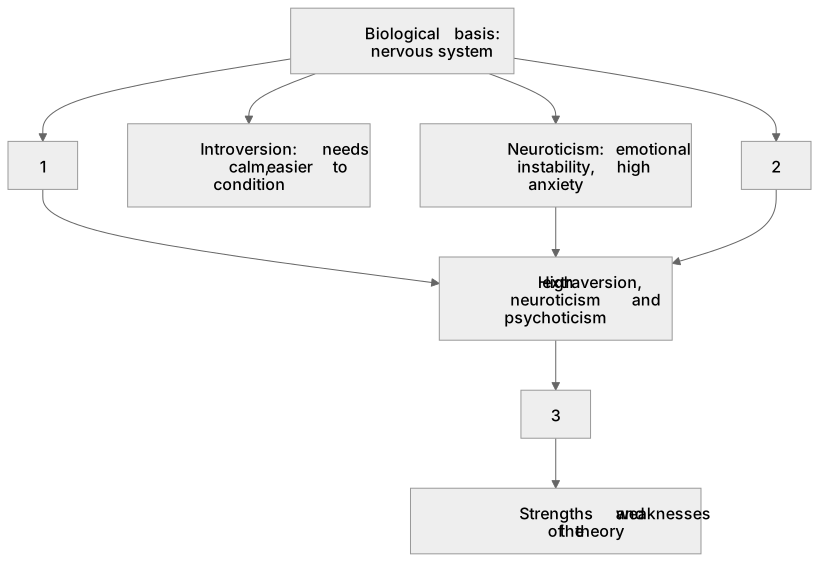
1Box 1
2Box 2
3Box 3
There is more to this lesson
The full lesson goes on to check your understanding and help you earn the marks. Create a free account to carry on, with your progress saved.
A week of Premium from your first lesson · Then the free plan continues · No card, no charge
Test your understanding of Criminal psychology: 6.1.2 Understand biological explanations of criminality, including personality types (Eysenck, 1964), to include strengths and weaknesses of the theory: a. extraversion b. introversion c. neuroticism d. psychoticism
Active recall beats re-reading. Take an instant quiz now to test what you’ve learned and lock it into long-term memory.
A week of Premium from your first lesson · Then the free plan continues · No card, no charge