Pearson Edexcel · GCSE · Psychology
Course version: 1PS0 · Version from Sept 2017
Arithmetic and numerical computation: a. recognise and use expressions in…
Full specification wording
Data analysis: 11.2.1 Arithmetic and numerical computation: a. recognise and use expressions in decimal and standard form b. estimate results c. use an appropriate number of significant figures
In psychology, handling data often requires arithmetic and numerical computation.
Checked against the Pearson Edexcel 1PS0 specification (opens in a new tab) on .
- Point 1 of 5
- 2 key terms
Study notes
From the checked teaching notes for this specification point.
The idea
In psychology, handling data often requires arithmetic and numerical computation. You must recognise and use expressions in decimal and standard form. Standard form (A × 10ⁿ, where 1 ≤ A < 10) is useful for very large or small numbers, such as writing 0.0034 as 3.4 × 10⁻³. Estimating results is a crucial skill to check if your final calculation is reasonable; for example, estimating 48 × 11 as 50 × 10 = 500. Finally, you must use an appropriate number of significant figures. When calculating, your final answer should typically match the lowest number of significant figures given in the raw data, ensuring you do not overstate the precision of your psychological measurements.
What earns the marks
- Convert numbers between standard decimal notation and standard form.
- Perform calculations using numbers provided in standard form and decimal form.
- Provide a reasonable estimate for a calculation by rounding numbers to one significant figure before computing.
- Round final answers to the appropriate number of significant figures based on the precision of the provided data.
Common mistakes and how to put them right
Writing standard form with a base number less than 1 or greater than 10 (for example, 45 × 10²).
Put it right: Ensure the base number is between 1 and 9.99 (for example, 4.5 × 10³).
Rounding to decimal places instead of significant figures when explicitly asked.
Put it right: Count significant figures from the first non-zero digit, regardless of the position of the decimal point.
Estimating by calculating the exact answer and then rounding it.
Put it right: Round the numbers first to make the mental calculation simpler and faster.
Exam tips
- Always check if a question specifies the number of significant figures or decimal places required for your answer.
- Use estimation to quickly verify if your calculator answer makes logical sense in the context of the data.
- When converting small decimals to standard form, remember that the exponent will be negative (for example, 0.05 is 5 × 10⁻²).
Try the lesson
The start of the Data analysis: 11.2.1 Arithmetic and numerical computation: a. recognise and use expressions in decimal and standard form b. estimate results c. use an appropriate number of significant figures lesson, made from checked teaching notes for this specification point.
Have a go first
A psychologist calculates that a participant's reaction time is 0.0034 seconds. How is this number written in standard form?
Listen
In psychology, handling data often requires arithmetic and numerical computation. You must recognise and use expressions in decimal and standard form. Standard form (A × 10ⁿ, where 1 ≤ A < 10) is useful for very large or small numbers, such as writing 0.0034 as 3.4 × 10⁻³. Estimating results is a crucial skill to check if your final calculation is reasonable; for example, estimating 48 × 11 as 50 × 10 = 500. Finally, you must use an appropriate number of significant figures. When calculating, your final answer should typically match the lowest number of significant figures given in the raw data, ensuring you do not overstate the precision of your psychological measurements. A strong answer earns marks for these points. Convert numbers between standard decimal notation and standard form. Perform calculations using numbers provided in standard form and decimal form. Provide a reasonable estimate for a calculation by rounding numbers to one significant figure before computing. Round final answers to the appropriate number of significant figures based on the precision of the provided data. A common slip: Writing standard form with a base number less than 1 or greater than 10 (for example, 45 × 10²). Instead, Ensure the base number is between 1 and 9.99 (for example, 4.5 × 10³). Exam tip: Always check if a question specifies the number of significant figures or decimal places required for your answer.
See it
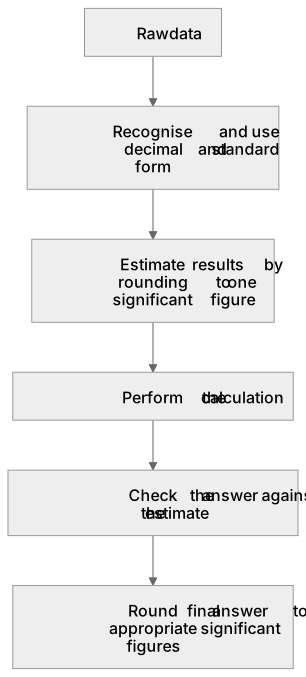
Put it in order
Put these steps in the order they happen.
- 1. Estimate results by rounding to one significant figure
- 2. Recognise and use decimal and standard form
- 3. Raw data
- 4. Round final answer to appropriate significant figures
- 5. Check the answer against the estimate
- 6. Perform the calculation
Key words
Say what each word means before you turn the card.
Standard form
Try answering aloud or in your head before turning the card.
Estimating results
Try answering aloud or in your head before turning the card.
See every definition
- Standard form
- A way of writing very large or small numbers as A × 10ⁿ, where 1 ≤ A < 10, such as writing 0.0034 as 3.4 × 10⁻³.
- Estimating results
- A crucial skill of rounding numbers before computing to check whether your final calculation is reasonable, for example estimating 48 × 11 as 50 × 10 = 500.
Label the diagram
Some boxes have lost their names. Pick the right name for each number.
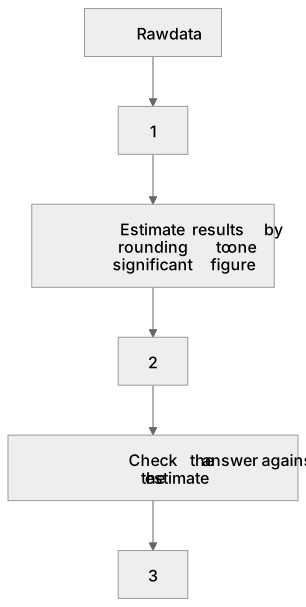
1Box 1
2Box 2
3Box 3
There is more to this lesson
The full lesson goes on to check your understanding and help you earn the marks. Create a free account to carry on, with your progress saved.
A week of Premium from your first lesson · Then the free plan continues · No card, no charge
Test your understanding of Data analysis: 11.2.1 Arithmetic and numerical computation: a. recognise and use expressions in decimal and standard form b. estimate results c. use an appropriate number of significant figures
Active recall beats re-reading. Take an instant quiz now to test what you’ve learned and lock it into long-term memory.
A week of Premium from your first lesson · Then the free plan continues · No card, no charge