Pearson Edexcel · GCSE · Psychology
Course version: 1PS0 · Version from Sept 2017
Understand the influence of extraneous variables and suggest possible ways…
Full specification wording
Designing psychological research: 11.1.2 Understand the influence of extraneous variables and suggest possible ways to control for them, including: a. use of standardised procedures b. counterbalancing c. randomisation d. single-blind techniques e. double-blind techniques
Extraneous variables are factors other than the independent variable that could affect the dependent variable.
Checked against the Pearson Edexcel 1PS0 specification (opens in a new tab) on .
- Point 2 of 17
- 4 key terms
Study notes
From the checked teaching notes for this specification point.
The idea
Extraneous variables are factors other than the independent variable that could affect the dependent variable. Researchers use specific methods to control them. Standardised procedures ensure participants experience identical environments and instructions, preventing situational variables from skewing data. Counterbalancing (half do condition A then B, half do B then A) controls order effects in repeated measures designs. Randomisation reduces bias by using chance to allocate participants. Single-blind techniques, where participants do not know their condition, reduce demand characteristics. Double-blind techniques, where neither participants nor the researcher know the conditions, prevent both demand characteristics and researcher bias.
What earns the marks
- Identify an extraneous variable in a given scenario that could affect the dependent variable.
- Explain how standardised procedures control situational variables by keeping the experience identical for all participants.
- Describe counterbalancing as a method to distribute order effects evenly across conditions in a repeated measures design.
- Explain how single-blind and double-blind techniques reduce demand characteristics and investigator effects respectively.
Common mistakes and how to put them right
Mistaking counterbalancing for a way to eliminate order effects.
Put it right: Counterbalancing balances order effects across conditions, it does not remove them.
Confusing single-blind and double-blind techniques.
Put it right: Single-blind hides the condition from the participant only, whereas double-blind hides it from both the participant and the researcher conducting the study.
Believing randomisation guarantees equal groups.
Put it right: Randomisation reduces systematic bias in allocation, but does not guarantee perfectly matched participant variables.
Exam tips
- When suggesting a control method for a scenario, explicitly link the method to the specific extraneous variable it addresses.
- Use the term 'demand characteristics' when explaining the purpose of a single-blind technique.
- Remember that counterbalancing is specifically used for repeated measures designs to address practice or fatigue effects.
Try the lesson
The start of the Designing psychological research: 11.1.2 Understand the influence of extraneous variables and suggest possible ways to control for them, including: a. use of standardised procedures b. counterbalancing c. randomisation d. single-blind techniques e. double-blind techniques lesson, made from checked teaching notes for this specification point.
Have a go first
A researcher wants to ensure that all participants receive exactly the same instructions and experience the same environment during an experiment. Which method of controlling extraneous variables is the researcher using?
Listen
Extraneous variables are factors other than the independent variable that could affect the dependent variable. Researchers use specific methods to control them. Standardised procedures ensure participants experience identical environments and instructions, preventing situational variables from skewing data. Counterbalancing (half do condition A then B, half do B then A) controls order effects in repeated measures designs. Randomisation reduces bias by using chance to allocate participants. Single-blind techniques, where participants do not know their condition, reduce demand characteristics. Double-blind techniques, where neither participants nor the researcher know the conditions, prevent both demand characteristics and researcher bias. A strong answer earns marks for these points. Identify an extraneous variable in a given scenario that could affect the dependent variable. Explain how standardised procedures control situational variables by keeping the experience identical for all participants. Describe counterbalancing as a method to distribute order effects evenly across conditions in a repeated measures design. Explain how single-blind and double-blind techniques reduce demand characteristics and investigator effects respectively. A common slip: Mistaking counterbalancing for a way to eliminate order effects. Instead, counterbalancing balances order effects across conditions, it does not remove them. Exam tip: When suggesting a control method for a scenario, explicitly link the method to the specific extraneous variable it addresses.
See it

Key words
Say what each word means before you turn the card.
Extraneous variables
Try answering aloud or in your head before turning the card.
Standardised procedures
Try answering aloud or in your head before turning the card.
Counterbalancing
Try answering aloud or in your head before turning the card.
Randomisation
Try answering aloud or in your head before turning the card.
See every definition
- Extraneous variables
- Factors other than the independent variable that could affect the dependent variable.
- Standardised procedures
- Methods that ensure participants experience identical environments and instructions, preventing situational variables from skewing data.
- Counterbalancing
- A method where half do condition A then B and half do B then A, controlling order effects in repeated measures designs.
- Randomisation
- A method that reduces bias by using chance to allocate participants.
Label the diagram
Some boxes have lost their names. Pick the right name for each number.
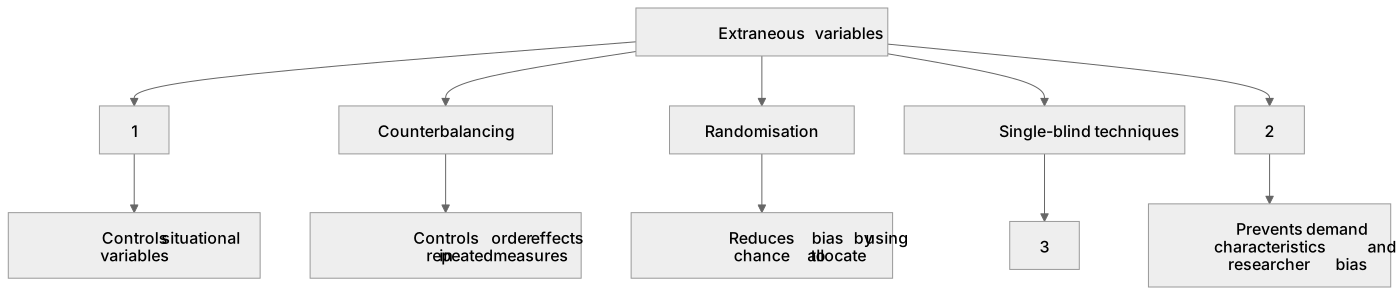
1Box 1
2Box 2
3Box 3
There is more to this lesson
The full lesson goes on to check your understanding and help you earn the marks. Create a free account to carry on, with your progress saved.
A week of Premium from your first lesson · Then the free plan continues · No card, no charge
Test your understanding of Designing psychological research: 11.1.2 Understand the influence of extraneous variables and suggest possible ways to control for them, including: a. use of standardised procedures b. counterbalancing c. randomisation d. single-blind techniques e. double-blind techniques
Active recall beats re-reading. Take an instant quiz now to test what you’ve learned and lock it into long-term memory.
A week of Premium from your first lesson · Then the free plan continues · No card, no charge