Pearson Edexcel · GCSE · Psychology
Course version: 1PS0 · Version from Sept 2017
Be able to write an alternative hypothesis
Full specification wording
Designing psychological research: 11.1.4 Be able to write an alternative hypothesis
An alternative hypothesis is a precise, testable statement predicting the outcome of a psychological study.
Checked against the Pearson Edexcel 1PS0 specification (opens in a new tab) on .
- Point 4 of 17
- 4 key terms
Study notes
From the checked teaching notes for this specification point.
The idea
An alternative hypothesis is a precise, testable statement predicting the outcome of a psychological study. Unlike a null hypothesis, which predicts no effect, the alternative hypothesis states that there will be a significant difference or relationship between variables. To write one effectively, you must clearly operationalise both the independent variable (IV) and the dependent variable (DV). For example, instead of saying caffeine affects memory, a strong alternative hypothesis would state: Participants who consume 50mg of caffeine will recall significantly more words from a list of 20 than participants who consume no caffeine. This clearly identifies the two conditions of the IV and how the DV is measured, making the prediction fully testable.
What earns the marks
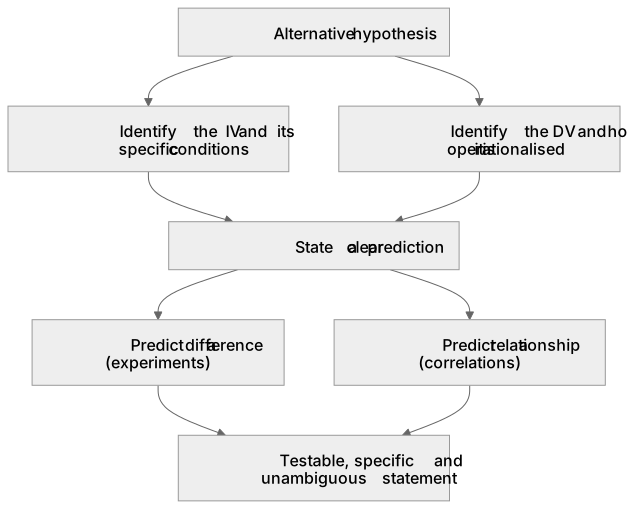
- Identifies the independent variable (IV) and its specific conditions.
- Identifies the dependent variable (DV) and exactly how it is operationalised.
- States a clear prediction of a difference (for experiments) or a relationship (for correlations).
- Ensures the statement is testable, specific and unambiguous.
Common mistakes and how to put them right
Writing a null hypothesis instead of an alternative hypothesis.
Put it right: Ensure the statement predicts an effect, difference, or relationship, rather than stating there will be no effect.
Failing to operationalise the variables.
Put it right: State exactly how the IV is manipulated and how the DV is measured, such as specifying time taken in seconds rather than just speed.
Writing an aim instead of a hypothesis.
Put it right: Write a predictive statement of the expected results, not a statement of what the study intends to investigate.
Exam tips
- Always include both conditions of the independent variable in your hypothesis to ensure clarity.
- Check that your dependent variable is measurable; if you cannot measure it, you cannot test the hypothesis.
- Read the scenario carefully to determine if you need to predict a difference for an experiment or a relationship for a correlation.
Try the lesson
The start of the Designing psychological research: 11.1.4 Be able to write an alternative hypothesis lesson, made from checked teaching notes for this specification point.
Have a go first
Which of the following best defines a directional alternative hypothesis?
Listen
An alternative hypothesis is a precise, testable statement predicting the outcome of a psychological study. Unlike a null hypothesis, which predicts no effect, the alternative hypothesis states that there will be a significant difference or relationship between variables. To write one effectively, you must clearly operationalise both the independent variable (IV) and the dependent variable (DV). For example, instead of saying caffeine affects memory, a strong alternative hypothesis would state: Participants who consume 50mg of caffeine will recall significantly more words from a list of 20 than participants who consume no caffeine. This clearly identifies the two conditions of the IV and how the DV is measured, making the prediction fully testable. A strong answer earns marks for these points. Identifies the independent variable (IV) and its specific conditions. Identifies the dependent variable (DV) and exactly how it is operationalised. States a clear prediction of a difference (for experiments) or a relationship (for correlations). Ensures the statement is testable, specific and unambiguous. A common slip: Writing a null hypothesis instead of an alternative hypothesis. Instead, Ensure the statement predicts an effect, difference, or relationship, rather than stating there will be no effect. Exam tip: Always include both conditions of the independent variable in your hypothesis to ensure clarity.
See it
Key words
Say what each word means before you turn the card.
Alternative hypothesis
Try answering aloud or in your head before turning the card.
Operationalise
Try answering aloud or in your head before turning the card.
Independent variable (IV)
Try answering aloud or in your head before turning the card.
Dependent variable (DV)
Try answering aloud or in your head before turning the card.
See every definition
- Alternative hypothesis
- A precise, testable statement predicting the outcome of a psychological study, stating that there will be a significant difference or relationship between variables.
- Operationalise
- State exactly how the independent variable is manipulated and how the dependent variable is measured, making the prediction fully testable.
- Independent variable (IV)
- The variable whose specific conditions are identified and manipulated in the study.
- Dependent variable (DV)
- The variable that is measured, and which must be operationalised so it can be tested.
Label the diagram
Some boxes have lost their names. Pick the right name for each number.
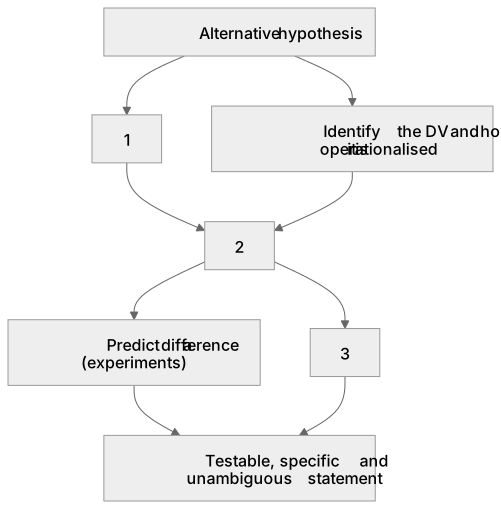
1Box 1
2Box 2
3Box 3
There is more to this lesson
The full lesson goes on to check your understanding and help you earn the marks. Create a free account to carry on, with your progress saved.
A week of Premium from your first lesson · Then the free plan continues · No card, no charge
Test your understanding of Designing psychological research: 11.1.4 Be able to write an alternative hypothesis
Active recall beats re-reading. Take an instant quiz now to test what you’ve learned and lock it into long-term memory.
A week of Premium from your first lesson · Then the free plan continues · No card, no charge