Pearson Edexcel · GCSE · Psychology
Course version: 1PS0 · Version from Sept 2017
Designing psychological research: 11.1.9 laboratory experiment
A laboratory experiment is conducted in a highly controlled, artificial environment where the researcher manipulates an independent variable to measure its effect on a dependent variable.
Checked against the Pearson Edexcel 1PS0 specification (opens in a new tab) on .
- Point 10 of 17
- 3 key terms
Study notes
From the checked teaching notes for this specification point.
The idea
A laboratory experiment is conducted in a highly controlled, artificial environment where the researcher manipulates an independent variable to measure its effect on a dependent variable. This strict control minimises extraneous variables, allowing researchers to establish a clear cause-and-effect relationship. For example, testing memory recall in a quiet room with timed word lists ensures background noise does not affect results. While laboratory experiments offer high internal validity and are easily replicable due to standardised procedures, they often lack ecological validity. Participants may also alter their behaviour due to demand characteristics, knowing they are being observed in an unnatural setting.
What earns the marks
- Identify that a laboratory experiment takes place in a controlled, artificial setting.
- Recognise that the independent variable is deliberately manipulated by the researcher.
- Explain that extraneous variables are strictly controlled to establish cause and effect.
- Evaluate the method by identifying high reliability and low ecological validity as key features.
Common mistakes and how to put them right
Believing laboratory experiments must take place in a science lab.
Put it right: A laboratory experiment can occur in any highly controlled, artificial environment, such as a quiet classroom used specifically for the study.
Confusing the independent and dependent variables.
Put it right: The independent variable is what the researcher changes, while the dependent variable is what is measured.
Assuming high ecological validity.
Put it right: Laboratory experiments typically have low ecological validity because the artificial setting does not reflect real-life situations.
Exam tips
- Always link the concept of strict control to the ability to establish cause and effect.
- Use the term 'standardised procedures' when explaining why laboratory experiments are highly replicable.
- When evaluating, contrast the high internal validity with the risk of demand characteristics.
Try the lesson
The start of the Designing psychological research: 11.1.9 laboratory experiment lesson, made from checked teaching notes for this specification point.
Have a go first
Which of the following is a key feature of a laboratory experiment in psychology?
Listen
A laboratory experiment is conducted in a highly controlled, artificial environment where the researcher manipulates an independent variable to measure its effect on a dependent variable. This strict control minimises extraneous variables, allowing researchers to establish a clear cause-and-effect relationship. For example, testing memory recall in a quiet room with timed word lists ensures background noise does not affect results. While laboratory experiments offer high internal validity and are easily replicable due to standardised procedures, they often lack ecological validity. Participants may also alter their behaviour due to demand characteristics, knowing they are being observed in an unnatural setting. A strong answer earns marks for these points. Identify that a laboratory experiment takes place in a controlled, artificial setting. Recognise that the independent variable is deliberately manipulated by the researcher. Explain that extraneous variables are strictly controlled to establish cause and effect. Evaluate the method by identifying high reliability and low ecological validity as key features. A common slip: Believing laboratory experiments must take place in a science lab. Instead, A laboratory experiment can occur in any highly controlled, artificial environment, such as a quiet classroom used specifically for the study. Exam tip: Always link the concept of strict control to the ability to establish cause and effect.
See it
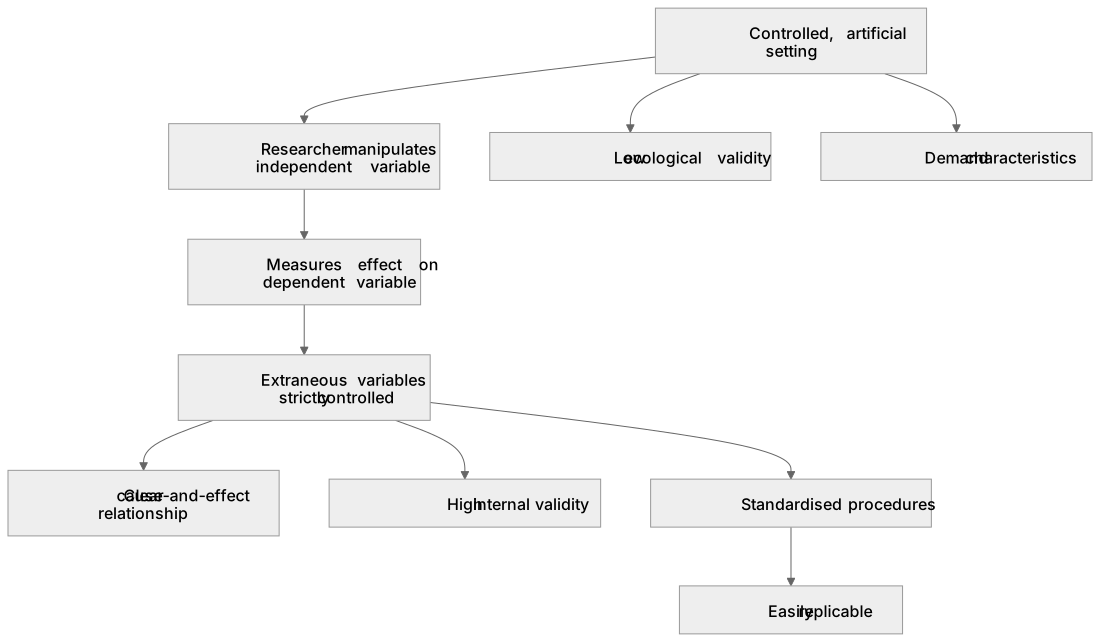
Key words
Say what each word means before you turn the card.
Laboratory experiment
Try answering aloud or in your head before turning the card.
Extraneous variables
Try answering aloud or in your head before turning the card.
Ecological validity
Try answering aloud or in your head before turning the card.
See every definition
- Laboratory experiment
- A study conducted in a highly controlled, artificial environment where the researcher manipulates an independent variable to measure its effect on a dependent variable.
- Extraneous variables
- Factors that are strictly controlled in a laboratory experiment so that a clear cause-and-effect relationship can be established.
- Ecological validity
- The extent to which findings reflect real-life situations, which laboratory experiments typically lack because of their artificial setting.
Label the diagram
Some boxes have lost their names. Pick the right name for each number.
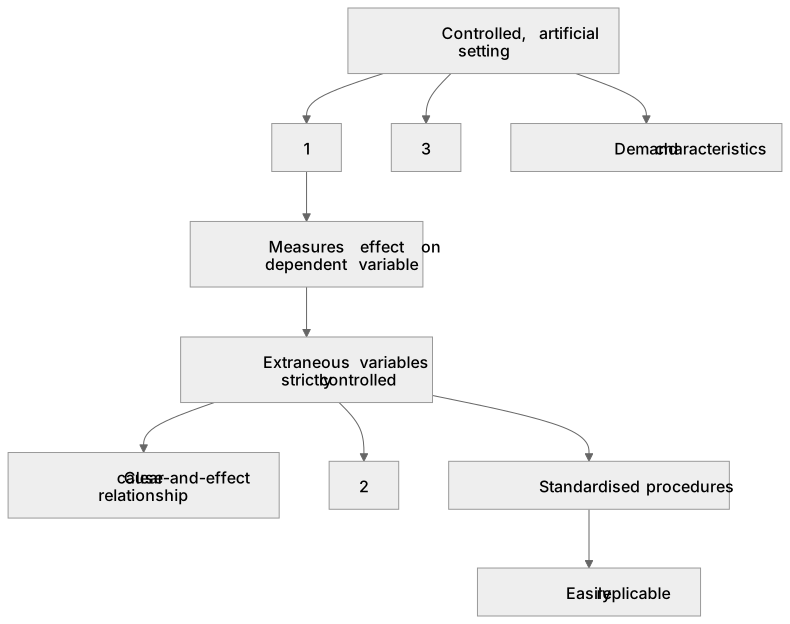
1Box 1
2Box 2
3Box 3
There is more to this lesson
The full lesson goes on to check your understanding and help you earn the marks. Create a free account to carry on, with your progress saved.
A week of Premium from your first lesson · Then the free plan continues · No card, no charge
Test your understanding of Designing psychological research: 11.1.9 laboratory experiment
Active recall beats re-reading. Take an instant quiz now to test what you’ve learned and lock it into long-term memory.
A week of Premium from your first lesson · Then the free plan continues · No card, no charge