Pearson Edexcel · GCSE · Psychology
Course version: 1PS0 · Version from Sept 2017
Understand how personality can be measured, including: a. personality…
Full specification wording
The self: 7.1.5 Understand how personality can be measured, including: a. personality scales b. personality types
Psychologists measure personality using various methods, primarily through personality scales and personality types.
Checked against the Pearson Edexcel 1PS0 specification (opens in a new tab) on .
- Point 5 of 6
Study notes
From the checked teaching notes for this specification point.
The idea
Psychologists measure personality using various methods, primarily through personality scales and personality types. Personality scales measure traits on a continuum. For example, an individual might score anywhere along a scale from highly introverted to highly extroverted, providing a nuanced profile of their traits. In contrast, personality types categorise individuals into distinct groups based on shared characteristics, such as Type A (competitive) or Type B (relaxed). While scales offer detailed, quantitative data about the degree to which a person possesses certain traits, type theories provide a broader, categorical approach that is easier to apply but may oversimplify complex human behaviour by forcing people into rigid boxes.
What earns the marks
- Define personality scales as tools that measure traits along a continuous dimension.
- Identify personality types as systems that classify individuals into distinct, categorical groups.
- Provide an example of a personality scale, such as measuring extroversion against introversion.
- Evaluate the limitations of personality types, such as oversimplifying complex individual differences.
Common mistakes and how to put them right
Confusing scales with types.
Put it right: Scales measure the degree of a trait on a continuum, whereas types place people into distinct categories.
Assuming personality types are highly accurate for everyone.
Put it right: Acknowledge that type theories often oversimplify behaviour and ignore situational factors.
Believing personality scales are entirely objective.
Put it right: Recognise that self-report scales can be affected by social desirability bias.
Exam tips
- Be prepared to compare the advantages and disadvantages of using scales versus types to measure personality.
- Use specific examples, like Type A and Type B personality or introversion and extroversion scales, to illustrate your points.
- Remember to mention self-report methods and their potential biases when discussing how these measures are administered.
Try the lesson
The start of the The self: 7.1.5 Understand how personality can be measured, including: a. personality scales b. personality types lesson, made from checked teaching notes for this specification point.
Have a go first
Which of the following best describes how a personality scale measures personality?
Listen
Psychologists measure personality using various methods, primarily through personality scales and personality types. Personality scales measure traits on a continuum. For example, an individual might score anywhere along a scale from highly introverted to highly extroverted, providing a nuanced profile of their traits. In contrast, personality types categorise individuals into distinct groups based on shared characteristics, such as Type A (competitive) or Type B (relaxed). While scales offer detailed, quantitative data about the degree to which a person possesses certain traits, type theories provide a broader, categorical approach that is easier to apply but may oversimplify complex human behaviour by forcing people into rigid boxes. A strong answer earns marks for these points. Define personality scales as tools that measure traits along a continuous dimension. Identify personality types as systems that classify individuals into distinct, categorical groups. Provide an example of a personality scale, such as measuring extroversion against introversion. Evaluate the limitations of personality types, such as oversimplifying complex individual differences. A common slip: Confusing scales with types. Instead, scales measure the degree of a trait on a continuum, whereas types place people into distinct categories. Exam tip: Be prepared to compare the advantages and disadvantages of using scales versus types to measure personality.
See it
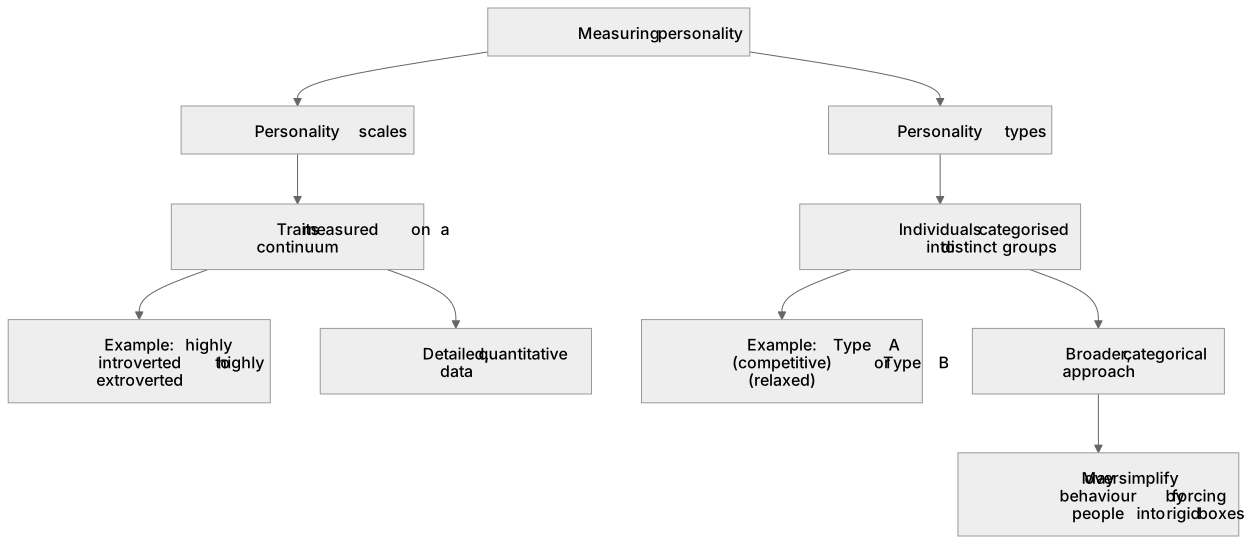
Label the diagram
Some boxes have lost their names. Pick the right name for each number.
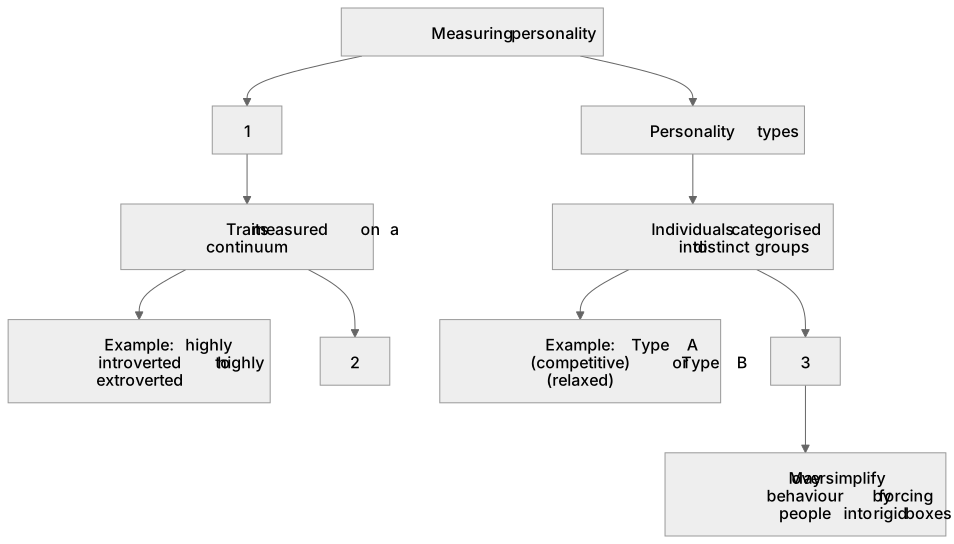
1Box 1
2Box 2
3Box 3
There is more to this lesson
The full lesson goes on to check your understanding and help you earn the marks. Create a free account to carry on, with your progress saved.
A week of Premium from your first lesson · Then the free plan continues · No card, no charge
Test your understanding of The self: 7.1.5 Understand how personality can be measured, including: a. personality scales b. personality types
Active recall beats re-reading. Take an instant quiz now to test what you’ve learned and lock it into long-term memory.
A week of Premium from your first lesson · Then the free plan continues · No card, no charge