Pearson Edexcel · GCSE · Psychology
Course version: 1PS0 · Version from Sept 2017
Development - 1.2 Studies: 1.2.2 Gunderson et al. (2013) Parent Praise to…
Full specification wording
Topic 1: Development - 1.2 Studies: 1.2.2 Gunderson et al. (2013) Parent Praise to 1-to 3-Year-Olds Predicts Children's Motivational Frameworks 5 Years Later
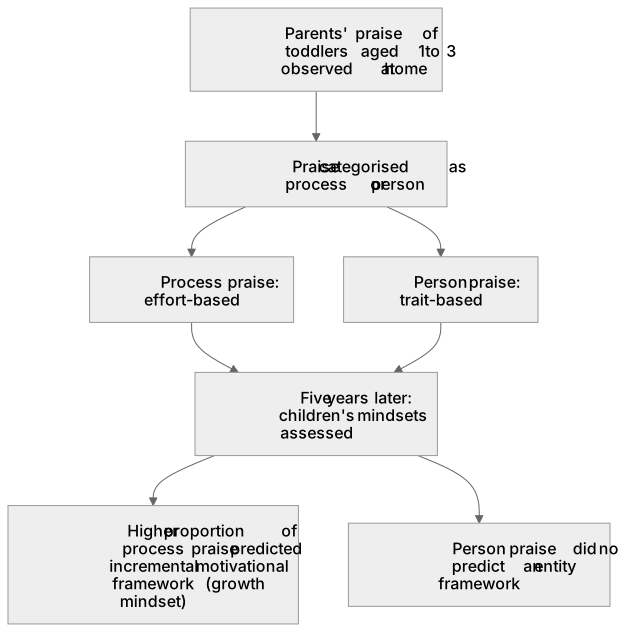
Gunderson et al. (2013) investigated whether parents' praise of toddlers (aged 1 to 3) predicts children's motivational frameworks five years later.
Checked against the Pearson Edexcel 1PS0 specification (opens in a new tab) on .
- Point 2 of 2
- 4 key terms
Study notes
From the checked teaching notes for this specification point.
The idea
Gunderson et al. (2013) investigated whether parents' praise of toddlers (aged 1 to 3) predicts children's motivational frameworks five years later. Researchers observed parent-child interactions at home, categorising praise as process (effort-based) or person (trait-based). Five years later, children's mindsets were assessed. Results showed that a higher proportion of process praise significantly predicted children developing an incremental motivational framework (growth mindset) at ages 7-8. However, person praise did not predict an entity framework. A strength is the high ecological validity of naturalistic home observations, but a weakness is that parents knew they were being observed, potentially leading to social desirability bias.
What earns the marks
- Identify the aim of Gunderson et al. (2013) as investigating the effect of early parental praise on later motivational frameworks.
- Distinguish between process praise (praising effort or strategy) and person praise (praising inherent traits).
- Recall the methodology, which involved naturalistic observation of parent-child interactions at home when children were 1 to 3 years old, followed by an assessment five years later.
- State the key finding that process praise predicts an incremental motivational framework (growth mindset), whereas person praise does not reliably predict an entity framework.
- Evaluate the study by identifying a strength (e.g., high ecological validity) and a weakness (e.g., potential social desirability bias from parents knowing they were observed).
Common mistakes and how to put them right
Confusing process and person praise.
Put it right: Process praise focuses on effort and strategy, whereas person praise focuses on fixed traits like intelligence.
Believing the study was conducted in a laboratory.
Put it right: The initial data collection involved naturalistic observations in the participants' homes.
Assuming person praise strongly predicted a fixed mindset.
Put it right: The study found that person praise did not significantly predict an entity motivational framework.
Exam tips
- Ensure you can define both process and person praise and provide a concrete example of each.
- Remember the longitudinal nature of the study, noting the five-year gap between the initial observations and the later mindset assessment.
- Be prepared to evaluate the study's methodology, contrasting the high ecological validity of the home setting with the weakness of potential social desirability bias.
Try the lesson
The start of the Topic 1: Development - 1.2 Studies: 1.2.2 Gunderson et al. (2013) Parent Praise to 1-to 3-Year-Olds Predicts Children's Motivational Frameworks 5 Years Later lesson, made from checked teaching notes for this specification point.
Have a go first
In Gunderson et al.'s (2013) study, which term is used to describe praise that focuses on a child's effort and behaviour?
Listen
Gunderson et al. (2013) investigated whether parents' praise of toddlers (aged 1 to 3) predicts children's motivational frameworks five years later. Researchers observed parent-child interactions at home, categorising praise as process (effort-based) or person (trait-based). Five years later, children's mindsets were assessed. Results showed that a higher proportion of process praise significantly predicted children developing an incremental motivational framework (growth mindset) at ages 7-8. However, person praise did not predict an entity framework. A strength is the high ecological validity of naturalistic home observations, but a weakness is that parents knew they were being observed, potentially leading to social desirability bias. A strong answer earns marks for these points. Identify the aim of Gunderson et al. (2013) as investigating the effect of early parental praise on later motivational frameworks. Distinguish between process praise (praising effort or strategy) and person praise (praising inherent traits). Recall the methodology, which involved naturalistic observation of parent-child interactions at home when children were 1 to 3 years old, followed by an assessment five years later. State the key finding that process praise predicts an incremental motivational framework (growth mindset), whereas person praise does not reliably predict an entity framework. A common slip: Confusing process and person praise. Instead, process praise focuses on effort and strategy, whereas person praise focuses on fixed traits like intelligence. Exam tip: Ensure you can define both process and person praise and provide a concrete example of each.
See it
Key words
Say what each word means before you turn the card.
Motivational frameworks
Try answering aloud or in your head before turning the card.
Longitudinal research
Try answering aloud or in your head before turning the card.
Naturalistic observation
Try answering aloud or in your head before turning the card.
Process praise
Try answering aloud or in your head before turning the card.
See every definition
- Motivational frameworks
- The mindsets assessed five years later, where a higher proportion of process praise predicted an incremental motivational framework (growth mindset).
- Longitudinal research
- A design in which parent-child interactions were observed when children were 1 to 3 years old and children's mindsets were assessed five years later.
- Naturalistic observation
- Observing parent-child interactions at home, which gives high ecological validity but risks social desirability bias because parents knew they were being observed.
- Process praise
- Praise that is effort-based, and a higher proportion of it significantly predicted children developing an incremental motivational framework.
Label the diagram
Some boxes have lost their names. Pick the right name for each number.
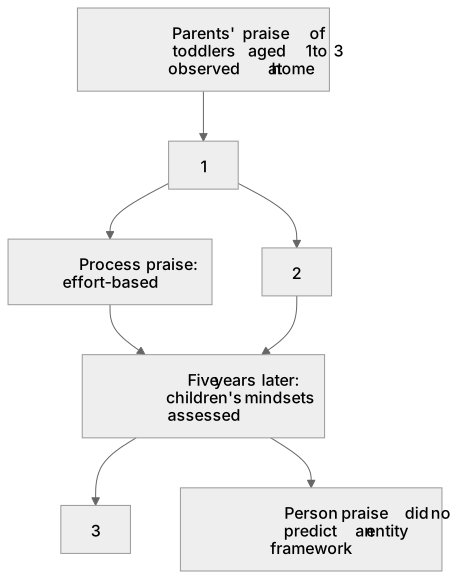
1Box 1
2Box 2
3Box 3
There is more to this lesson
The full lesson goes on to check your understanding and help you earn the marks. Create a free account to carry on, with your progress saved.
A week of Premium from your first lesson · Then the free plan continues · No card, no charge
Test your understanding of Topic 1: Development - 1.2 Studies: 1.2.2 Gunderson et al. (2013) Parent Praise to 1-to 3-Year-Olds Predicts Children's Motivational Frameworks 5 Years Later
Active recall beats re-reading. Take an instant quiz now to test what you’ve learned and lock it into long-term memory.
A week of Premium from your first lesson · Then the free plan continues · No card, no charge