Pearson Edexcel · GCSE · Psychology
Course version: 1PS0 · Version from Sept 2017
The self - 7.2 Studies: 7.2.1 Vohs and Schooler (2008) The Value of…
Full specification wording
Topic 7: The self - 7.2 Studies: 7.2.1 Vohs and Schooler (2008) The Value of Believing in Free Will: Encouraging a Belief in Determinism Increases Cheating
Vohs and Schooler (2008) investigated whether reading deterministic statements (suggesting behaviour is outside our control) increases cheating compared to reading statements supporting free will.
Checked against the Pearson Edexcel 1PS0 specification (opens in a new tab) on .
- Point 1 of 2
- 3 key terms
Study notes
From the checked teaching notes for this specification point.
The idea
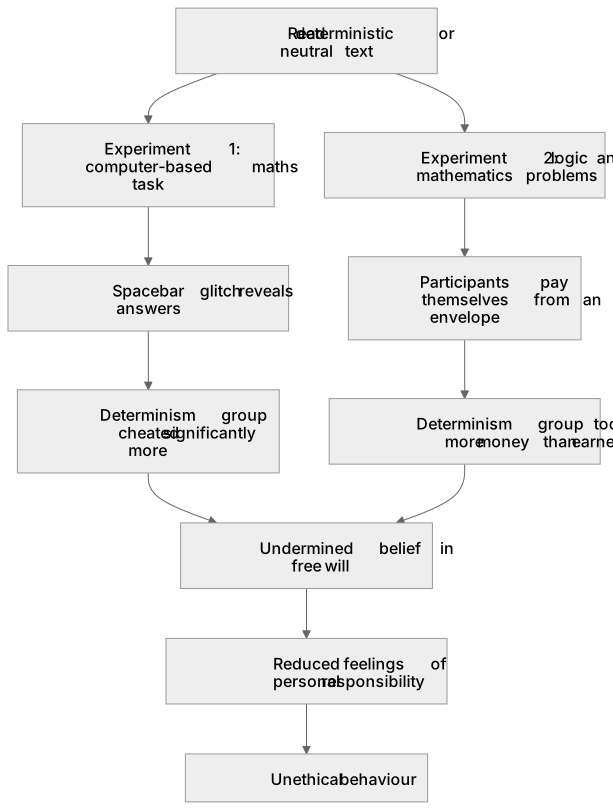
Vohs and Schooler (2008) investigated whether reading deterministic statements (suggesting behaviour is outside our control) increases cheating compared to reading statements supporting free will. In Experiment 1, participants read either a deterministic or neutral text, then completed a computer-based maths task where a 'glitch' allowed them to see the answers. Those in the determinism condition cheated significantly more. Experiment 2 used logic and mathematics problems where participants paid themselves for correct answers from an envelope; again, the determinism group took more money than they earned. The study concludes that undermining belief in free will can lead to unethical behaviour, as individuals feel less responsible for their actions.
What earns the marks
- Identify the aim of the study: to investigate whether a belief in determinism increases cheating behaviour.
- Describe the procedure of Experiment 1, including the use of a computer-based maths test with a spacebar 'glitch' that revealed the answers.
- Describe the procedure of Experiment 2, where participants completed logic and mathematics problems and paid themselves from an envelope for each correct answer.
- State the findings: participants exposed to deterministic texts cheated significantly more than those exposed to neutral or free will texts.
- Explain the conclusion: believing that behaviour is predetermined reduces feelings of personal responsibility, which can lead to unethical behaviour.
- Evaluate the methodology, noting the high level of control in the laboratory setting but the potential lack of ecological validity due to the artificial tasks.
Common mistakes and how to put them right
Confusing the independent and dependent variables.
Put it right: The independent variable is the type of text read (deterministic versus neutral or free will), and the dependent variable is the amount of cheating.
Stating that the study proves free will exists.
Put it right: The study only demonstrates that believing in free will affects moral behaviour, not whether free will actually exists.
Forgetting the difference between the two experiments.
Put it right: Experiment 1 used a computer glitch in a maths test, while Experiment 2 involved participants completing logic and mathematics problems and paying themselves from an envelope.
Exam tips
- Be prepared to describe the specific tasks used to measure cheating, such as the spacebar glitch in the maths test or the self-payment for logic problems.
- Link the findings back to the broader topic of 'The self' by discussing how self-concept and personal responsibility influence behaviour.
- Use this study as evidence when evaluating the free will versus determinism debate in psychology.
Try the lesson
The start of the Topic 7: The self - 7.2 Studies: 7.2.1 Vohs and Schooler (2008) The Value of Believing in Free Will: Encouraging a Belief in Determinism Increases Cheating lesson, made from checked teaching notes for this specification point.
Have a go first
What was the main finding of Vohs and Schooler's (2008) study on free will and determinism?
Listen
Vohs and Schooler (2008) investigated whether reading deterministic statements (suggesting behaviour is outside our control) increases cheating compared to reading statements supporting free will. In Experiment 1, participants read either a deterministic or neutral text, then completed a computer-based maths task where a 'glitch' allowed them to see the answers. Those in the determinism condition cheated significantly more. Experiment 2 used logic and mathematics problems where participants paid themselves for correct answers from an envelope; again, the determinism group took more money than they earned. The study concludes that undermining belief in free will can lead to unethical behaviour, as individuals feel less responsible for their actions. A strong answer earns marks for these points. Identify the aim of the study: to investigate whether a belief in determinism increases cheating behaviour. Describe the procedure of Experiment 1, including the use of a computer-based maths test with a spacebar 'glitch' that revealed the answers. Describe the procedure of Experiment 2, where participants completed logic and mathematics problems and paid themselves from an envelope for each correct answer. State the findings: participants exposed to deterministic texts cheated significantly more than those exposed to neutral or free will texts. A common slip: Confusing the independent and dependent variables. Instead, The independent variable is the type of text read (deterministic versus neutral or free will), and the dependent variable is the amount of cheating. Exam tip: Be prepared to describe the specific tasks used to measure cheating, such as the spacebar glitch in the maths test or the self-payment for logic problems.
See it
Key words
Say what each word means before you turn the card.
Free will and determinism
Try answering aloud or in your head before turning the card.
Moral behaviour
Try answering aloud or in your head before turning the card.
Personal responsibility
Try answering aloud or in your head before turning the card.
See every definition
- Free will and determinism
- The belief that behaviour is either within our control or outside our control, with deterministic statements suggesting behaviour is outside our control.
- Moral behaviour
- Behaving ethically, which the study shows can be affected by whether a person believes in free will.
- Personal responsibility
- Feeling answerable for one's own actions, which is reduced when a person believes behaviour is predetermined.
Label the diagram
Some boxes have lost their names. Pick the right name for each number.
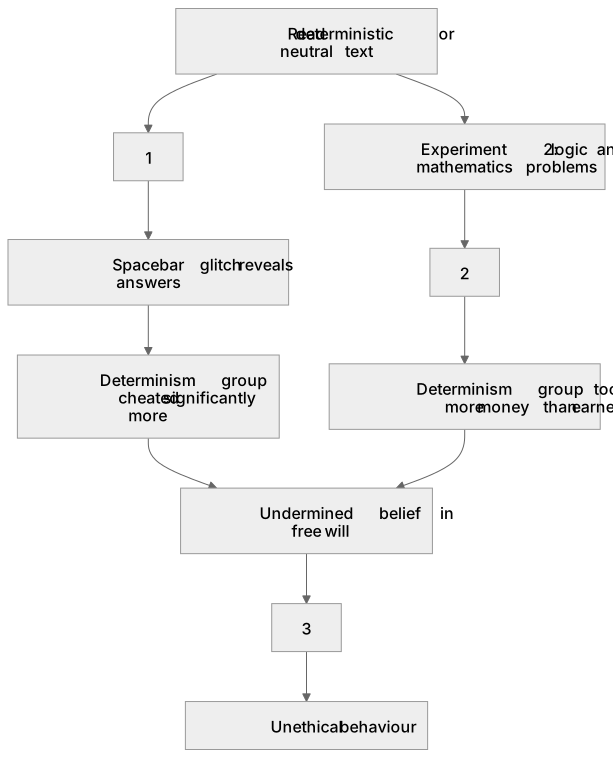
1Box 1
2Box 2
3Box 3
There is more to this lesson
The full lesson goes on to check your understanding and help you earn the marks. Create a free account to carry on, with your progress saved.
A week of Premium from your first lesson · Then the free plan continues · No card, no charge
Test your understanding of Topic 7: The self - 7.2 Studies: 7.2.1 Vohs and Schooler (2008) The Value of Believing in Free Will: Encouraging a Belief in Determinism Increases Cheating
Active recall beats re-reading. Take an instant quiz now to test what you’ve learned and lock it into long-term memory.
A week of Premium from your first lesson · Then the free plan continues · No card, no charge