Pearson Edexcel · GCSE · Psychology
Course version: 1PS0 · Version from Sept 2017
Perception - 8.2 Studies: *8.2.1 Haber and Levin (2001) The Independence…
Full specification wording
Topic 8: Perception - 8.2 Studies: *8.2.1 Haber and Levin (2001) The Independence of Size Perception and Distance Perception
Haber and Levin (2001) aimed to investigate whether size and distance perception are independent.
Checked against the Pearson Edexcel 1PS0 specification (opens in a new tab) on .
- Point 1 of 2
Study notes
From the checked teaching notes for this specification point.
The idea
Haber and Levin (2001) aimed to investigate whether size and distance perception are independent. The procedure involved nine male college students in a field experiment. Participants estimated the distance and size of 15 objects placed at various distances across a large field. Objects were categorised as having a familiar size (e.g. a door), an unfamiliar size but familiar shape, or an unfamiliar size and shape. The findings showed that distance estimates were most accurate for objects with a familiar size. They concluded that size and distance perception are not independent; familiarity with an object's size acts as a cue for distance. Strengths include high ecological validity, while weaknesses include a small, unrepresentative sample.
What earns the marks
- State the aim: to investigate the independence of size and distance perception.
- Describe the procedure: nine male participants estimated the size and distance of 15 objects in a field.
- State the findings: distance estimates were most accurate for objects with a familiar size.
- Explain a weakness: the sample of nine male college students lacks population validity.
Common mistakes and how to put them right
Stating that size and distance perception are completely independent.
Put it right: Explain that the study concluded they are not independent, as familiar size aids distance perception.
Forgetting the specific object categories.
Put it right: The three categories (familiar size, unfamiliar size but familiar shape, and unfamiliar size and shape).
Claiming the study lacked ecological validity.
Put it right: Recognise that as a field experiment, it had high ecological validity compared to artificial laboratory studies.
Exam tips
- Memorise the sample size of nine male students as a key point for evaluating population validity.
- Clearly distinguish between the three categories of objects used in the procedure to demonstrate detailed knowledge.
- Use this study to support extended answers about how top-down processing and past experience influence perception.
Try the lesson
The start of the Topic 8: Perception - 8.2 Studies: *8.2.1 Haber and Levin (2001) The Independence of Size Perception and Distance Perception lesson, made from checked teaching notes for this specification point.
Have a go first
What was the main aim of Haber and Levin's (2001) study on perception?
Listen
Haber and Levin (2001) aimed to investigate whether size and distance perception are independent. The procedure involved nine male college students in a field experiment. Participants estimated the distance and size of 15 objects placed at various distances across a large field. Objects were categorised as having a familiar size (e.g. a door), an unfamiliar size but familiar shape, or an unfamiliar size and shape. The findings showed that distance estimates were most accurate for objects with a familiar size. They concluded that size and distance perception are not independent; familiarity with an object's size acts as a cue for distance. Strengths include high ecological validity, while weaknesses include a small, unrepresentative sample. A strong answer earns marks for these points. State the aim: to investigate the independence of size and distance perception. Describe the procedure: nine male participants estimated the size and distance of 15 objects in a field. State the findings: distance estimates were most accurate for objects with a familiar size. Explain a weakness: the sample of nine male college students lacks population validity. A common slip: Stating that size and distance perception are completely independent. Instead, explain that the study concluded they are not independent, as familiar size aids distance perception. Exam tip: Memorise the sample size of nine male students as a key point for evaluating population validity.
See it
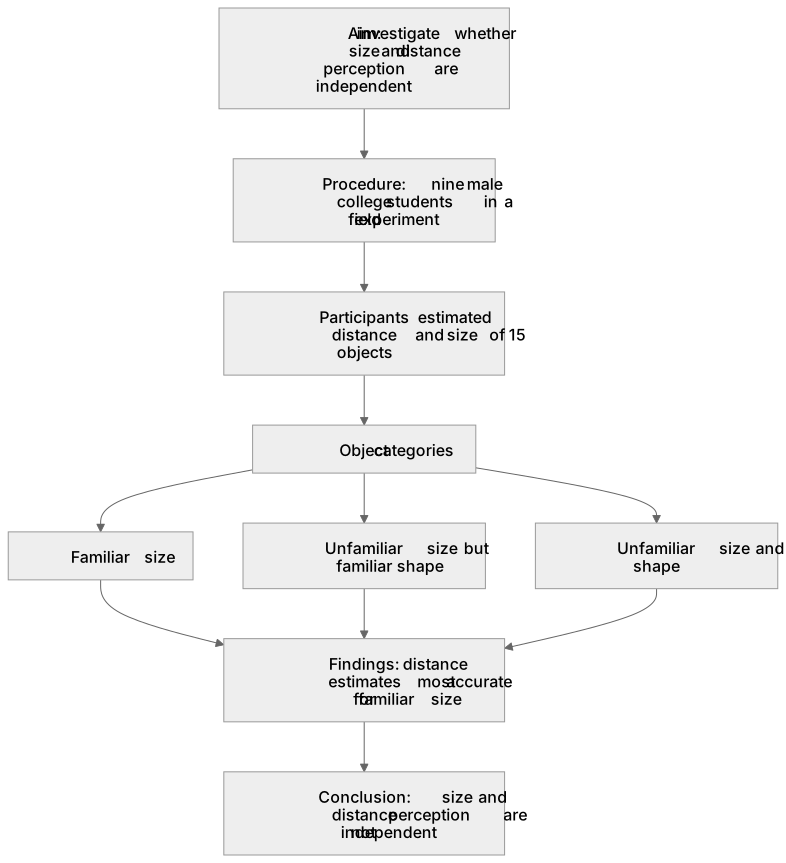
Label the diagram
Some boxes have lost their names. Pick the right name for each number.
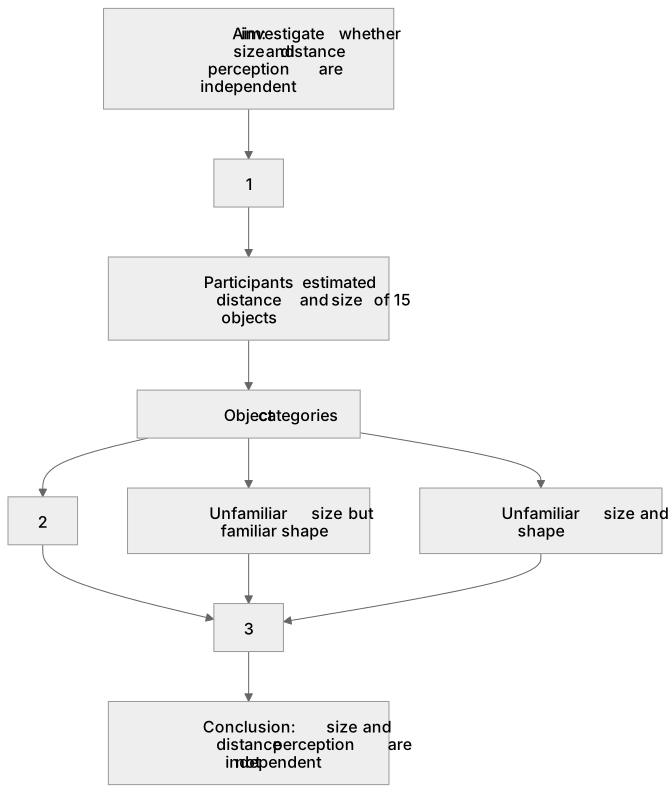
1Box 1
2Box 2
3Box 3
There is more to this lesson
The full lesson goes on to check your understanding and help you earn the marks. Create a free account to carry on, with your progress saved.
A week of Premium from your first lesson · Then the free plan continues · No card, no charge
Test your understanding of Topic 8: Perception - 8.2 Studies: *8.2.1 Haber and Levin (2001) The Independence of Size Perception and Distance Perception
Active recall beats re-reading. Take an instant quiz now to test what you’ve learned and lock it into long-term memory.
A week of Premium from your first lesson · Then the free plan continues · No card, no charge