AQA · GCSE · Religious Studies
Course version: 8062 · Version from Sept 2018
Students should study the influence of the beliefs, teachings and…
Full specification wording
Buddhism: Students should study the influence of the beliefs, teachings and practices studied on individuals, communities and societies.
Buddhist beliefs, teachings, and practices profoundly shape the lives of adherents across multiple levels.
Checked against the AQA 8062 specification (opens in a new tab) on .
- Point 3 of 4
- 3 key terms
Study notes
From the checked teaching notes for this specification point.
The idea
Buddhist beliefs, teachings, and practices profoundly shape the lives of adherents across multiple levels. For individuals, concepts like kamma and the Eightfold Path influence daily ethical choices, such as practising Right Livelihood by avoiding harmful trades. Within communities, practices like dana (giving) foster mutual support, where laypeople provide food for the Sangha (monastic community), who in turn offer spiritual guidance. On a societal level, Buddhist principles inspire broader movements, such as Engaged Buddhism, which addresses social injustice, environmental protection, and peacebuilding. Understanding these cascading impacts is crucial for evaluating how ancient teachings remain actively lived and relevant today.
What earns the marks
- Identify specific ways Buddhist beliefs, such as kamma, influence individual moral decision-making and daily behaviour.
- Explain the reciprocal relationship between the monastic Sangha and the lay community through shared practices like dana.
- Evaluate how Buddhist teachings on compassion (karuna) and loving-kindness (metta) drive societal actions and charity work.
- Link specific practices, such as meditation, to their practical outcomes for individuals, such as developing mindfulness and reducing suffering.
Common mistakes and how to put them right
Discussing beliefs in the abstract without explaining their practical impact.
Put it right: Link a belief, such as anatta, to how it changes a person's behaviour, like acting less selfishly.
Confusing the impact on an individual with the impact on society.
Put it right: Clearly distinguish between personal practices like meditation and societal impacts like Engaged Buddhism campaigns.
Assuming all Buddhists are monks or nuns.
Put it right: Acknowledge the distinct roles and influences of teachings on the lay community versus the monastic Sangha.
Exam tips
- Use the phrase 'This influences a Buddhist to...' to explicitly demonstrate the practical impact of a teaching in your answers.
- When evaluating a statement, contrast the impact on an individual's spiritual journey with the broader societal benefits of a practice.
- Memorise one concrete example of a Buddhist charity or movement, such as the Triratna Buddhist Community, to illustrate societal influence.
Try the lesson
The start of the Buddhism: Students should study the influence of the beliefs, teachings and practices studied on individuals, communities and societies. lesson, made from checked teaching notes for this specification point.
Have a go first
How is the Buddhist belief in karma most likely to influence an individual's daily behaviour?
Listen
Buddhist beliefs, teachings, and practices profoundly shape the lives of adherents across multiple levels. For individuals, concepts like kamma and the Eightfold Path influence daily ethical choices, such as practising Right Livelihood by avoiding harmful trades. Within communities, practices like dana (giving) foster mutual support, where laypeople provide food for the Sangha (monastic community), who in turn offer spiritual guidance. On a societal level, Buddhist principles inspire broader movements, such as Engaged Buddhism, which addresses social injustice, environmental protection, and peacebuilding. Understanding these cascading impacts is crucial for evaluating how ancient teachings remain actively lived and relevant today. A strong answer earns marks for these points. Identify specific ways Buddhist beliefs, such as kamma, influence individual moral decision-making and daily behaviour. Explain the reciprocal relationship between the monastic Sangha and the lay community through shared practices like dana. Evaluate how Buddhist teachings on compassion (karuna) and loving-kindness (metta) drive societal actions and charity work. Link specific practices, such as meditation, to their practical outcomes for individuals, such as developing mindfulness and reducing suffering. A common slip: Discussing beliefs in the abstract without explaining their practical impact. Instead, link a belief, such as anatta, to how it changes a person's behaviour, like acting less selfishly. Exam tip: Use the phrase 'This influences a Buddhist to... to explicitly demonstrate the practical impact of a teaching in your answers.
See it

Key words
Say what each word means before you turn the card.
Community (Sangha)
Try answering aloud or in your head before turning the card.
Social action and Engaged Buddhism
Try answering aloud or in your head before turning the card.
Practical application of Dhamma
Try answering aloud or in your head before turning the card.
See every definition
- Community (Sangha)
- The monastic community for whom laypeople provide food, and who in turn offer spiritual guidance.
- Social action and Engaged Buddhism
- Movements inspired by Buddhist principles which address social injustice, environmental protection and peacebuilding.
- Practical application of Dhamma
- Ancient teachings remain actively lived and relevant today, shaping the lives of adherents across multiple levels.
Label the diagram
Some boxes have lost their names. Pick the right name for each number.
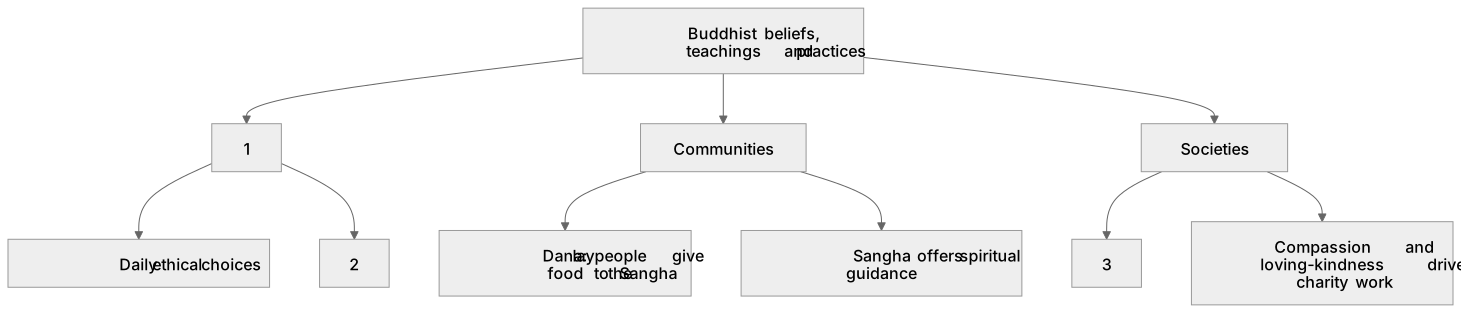
1Box 1
2Box 2
3Box 3
There is more to this lesson
The full lesson goes on to check your understanding and help you earn the marks. Create a free account to carry on, with your progress saved.
A week of Premium from your first lesson · Then the free plan continues · No card, no charge
Test your understanding of Buddhism: Students should study the influence of the beliefs, teachings and practices studied on individuals, communities and societies.
Active recall beats re-reading. Take an instant quiz now to test what you’ve learned and lock it into long-term memory.
A week of Premium from your first lesson · Then the free plan continues · No card, no charge