Key Beliefs
This study guide covers the foundational Key Beliefs of Buddhism, from the Buddha's life and enlightenment to the core teachings of the Dhamma. Understanding these concepts is essential for your GCSE exam, as they form the basis of all Buddhist practice and the distinction between Theravada and Mahayana traditions.
Study Notes
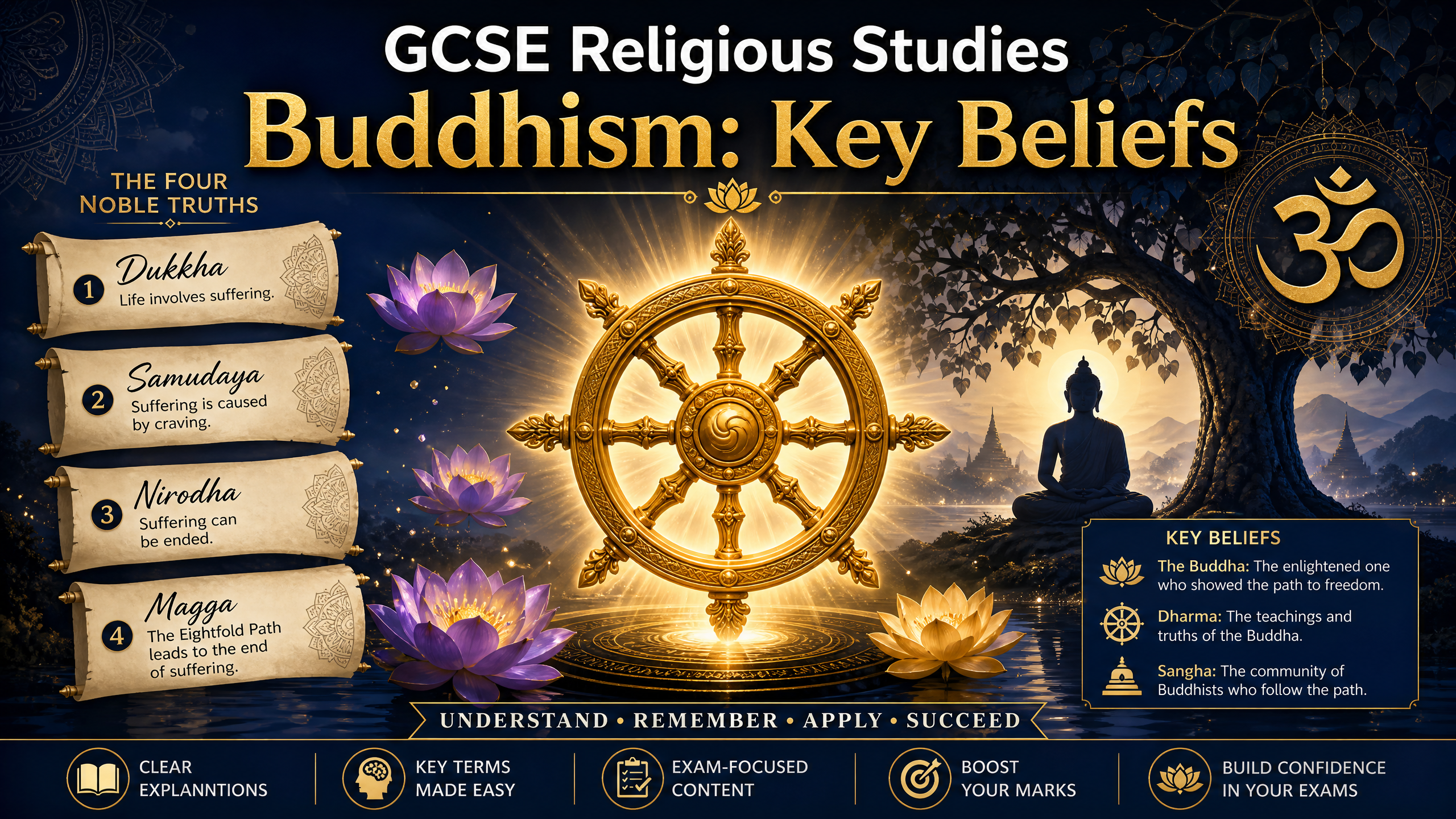
Overview
This topic covers the foundational beliefs of Buddhism, a tradition that began in India over 2,500 years ago with the enlightenment of Siddhartha Gautama. For your GCSE Religious Studies exam, you need a precise understanding of the core teachings (the Dhamma), including the Three Marks of Existence, the Four Noble Truths, and the Noble Eightfold Path. Examiners will test your ability to explain these concepts using accurate terminology (Pali or Sanskrit) and to compare the two major traditions: Theravada and Mahayana Buddhism. You must also be able to reference prescribed texts, such as Jataka 075 and Dhammapada 190-191, to support your answers and demonstrate how these beliefs influence individuals and communities today.
Listen to the Podcast
The Life of the Buddha
Early Life and Luxury
Date(s): c. 563 BCE
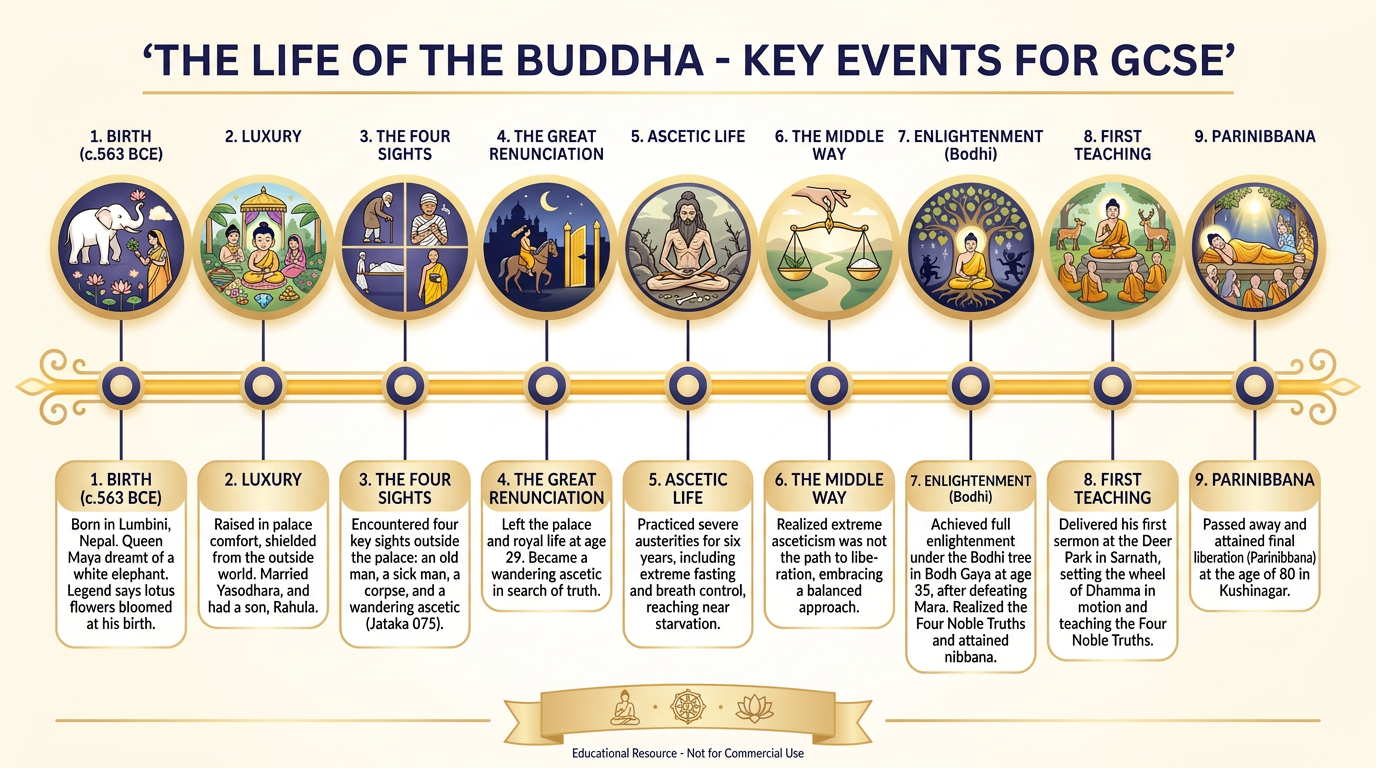
What happened: Siddhartha Gautama was born in Lumbini (modern-day Nepal) to King Suddhodana and Queen Maya. According to legend, his mother dreamed of a white elephant before his birth. A prophecy declared he would become either a great king or a great holy man. To ensure he became a king, his father shielded him from all suffering, raising him in a palace of extreme luxury.
Why it matters: The extreme luxury of his early life contrasts sharply with his later asceticism, eventually leading him to discover the 'Middle Way'.
Specific Knowledge: Born in Lumbini; parents King Suddhodana and Queen Maya; wife Yasodhara; son Rahula.
The Four Sights (Jataka 075)
Date(s): Age 29
What happened: Siddhartha left the palace and encountered four sights that changed his life: an old man, a sick man, a corpse, and a wandering ascetic monk who seemed at peace.
Why it matters: These sights introduced Siddhartha to the reality of suffering (dukkha) and impermanence (anicca). The ascetic inspired him to seek a spiritual solution to suffering.
Specific Knowledge: Jataka 075 is the prescribed text detailing this event. The four sights: old age, illness, death, and a holy man.
Ascetic Life and The Middle Way
Date(s): Age 29-35
What happened: Siddhartha left his family (the Great Renunciation) and spent six years practising extreme asceticism, including severe fasting and holding his breath. Realising this weakened his mind and did not lead to enlightenment, he accepted a bowl of milk-rice and adopted the 'Middle Way'—a path between the extremes of luxury and self-mortification.
Why it matters: It demonstrates that extreme physical deprivation is not the path to spiritual liberation.
Specific Knowledge: Six years of austerities; the Middle Way (Majjhima Patipada).
Enlightenment (Bodhi)
Date(s): Age 35
What happened: Meditating under the Bodhi tree in Bodh Gaya, Siddhartha was tempted by the demon Mara (representing desire and delusion). He resisted, touched the earth as his witness, and achieved full enlightenment, becoming the Buddha ('The Awakened One').
Why it matters: This is the founding moment of Buddhism. It proves that a human being can achieve liberation from the cycle of rebirth (samsara).
Specific Knowledge: Bodh Gaya; the Bodhi tree; the demon Mara; achieving Nibbana.
Core Teachings (The Dhamma)
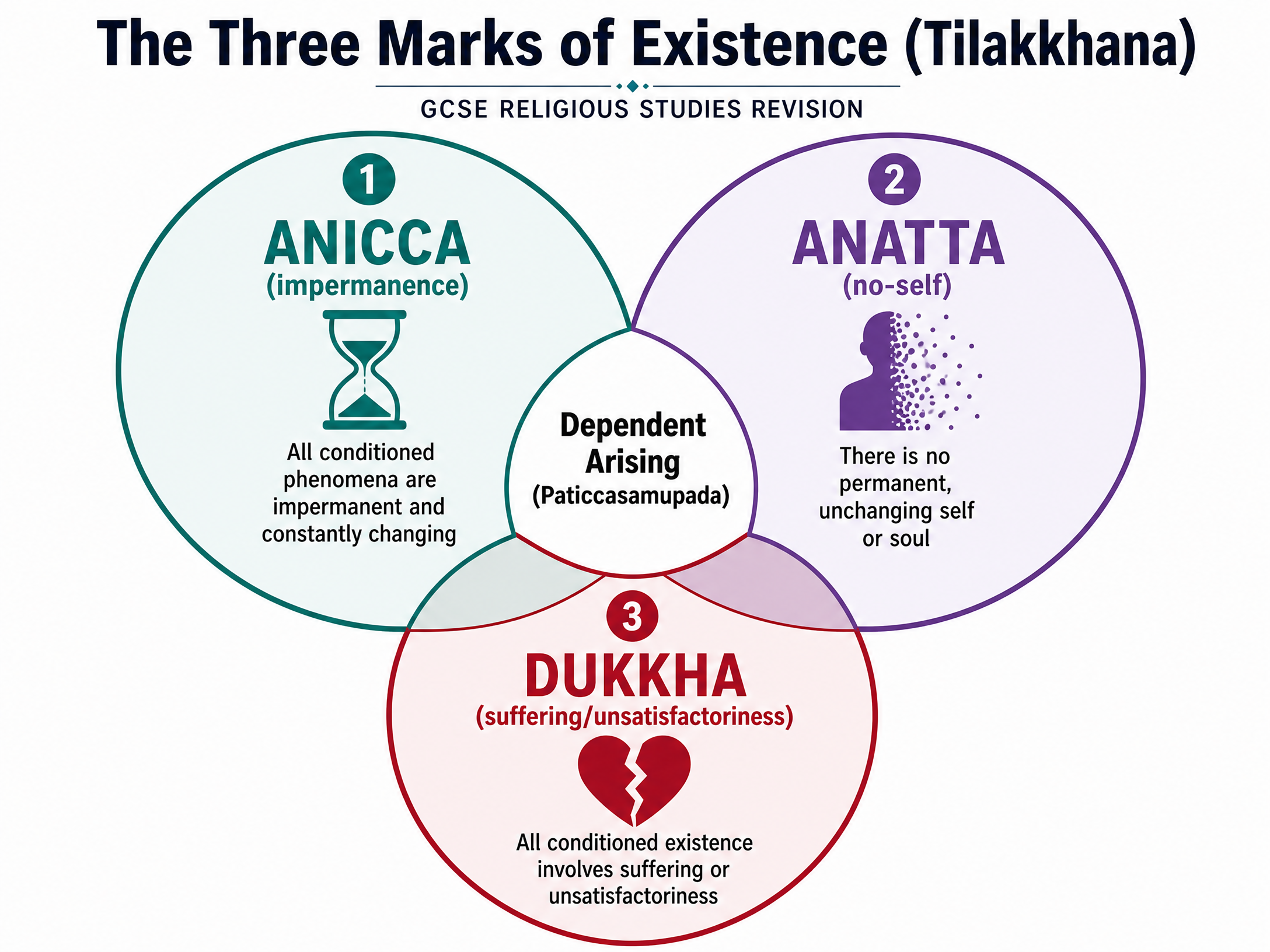
Dependent Arising (Paticcasamupada)
Role: The foundational principle of Buddhist philosophy.
Key Concept: The idea that everything arises in dependence upon conditions. Nothing exists independently. When conditions change, the phenomenon changes.
Impact: This explains the cycle of birth, life, death, and rebirth (samsara) and underpins the teachings of impermanence (anicca) and no-self (anatta).
The Three Marks of Existence (Tilakkhana)
1. Anicca (Impermanence): All conditioned things are in a constant state of flux. Nothing lasts forever.
2. Anatta (No-self): There is no permanent, unchanging soul or self. Humans are made up of five changing processes (the Five Aggregates/Skandhas).
3. Dukkha (Suffering/Unsatisfactoriness): Because everything is impermanent and without a fixed self, all conditioned existence is ultimately unsatisfactory.
The Four Noble Truths (Cattari Ariyasaccani)
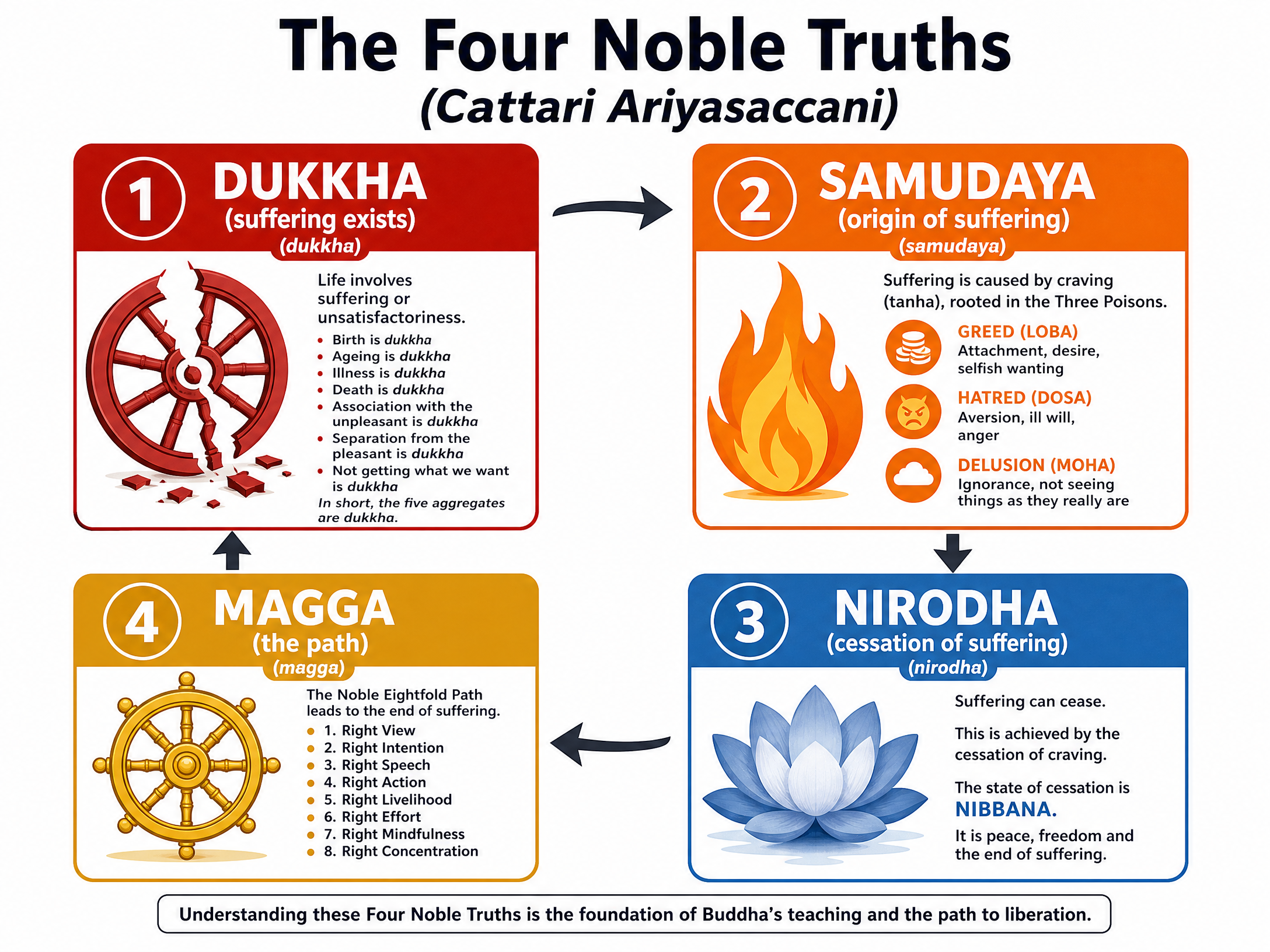
1. Dukkha: The truth of suffering. Life involves physical and mental suffering.
2. Samudaya: The truth of the origin of suffering. Suffering is caused by craving (tanha), which is rooted in the Three Poisons: Greed (lobha), Hatred (dosa), and Delusion (moha).
3. Nirodha: The truth of the cessation of suffering. Suffering can end when craving ends. This state is Nibbana.
4. Magga: The truth of the path to the cessation of suffering. This is the Noble Eightfold Path.
The Noble Eightfold Path and The Threefold Way
The path is grouped into three sections (The Threefold Way):
- Ethics (Sila): Right Speech, Right Action, Right Livelihood.
- Meditation (Samadhi): Right Effort, Right Mindfulness, Right Concentration.
- Wisdom (Panna): Right View, Right Intention.
Prescribed Text: Dhammapada 190-191 highlights taking refuge in the Buddha, Dhamma, and Sangha (The Three Jewels) to understand the Four Noble Truths.
Visual Resources
3 diagrams and illustrations
Interactive Diagrams
1 interactive diagram to visualise key concepts
Conceptual Flow Outline
The cycle of suffering and the path to liberation.
Worked Examples
3 detailed examples with solutions and examiner commentary
Practice Questions
Test your understanding — click to reveal model answers
Outline three events in the life of the Buddha before his enlightenment. (3 marks)
Hint: Think chronologically: birth, early life, leaving the palace.
Explain two of the Three Marks of Existence. (4 marks)
Hint: Choose two from Anicca, Anatta, or Dukkha. Give the definition and a brief explanation of why it matters.
Explain two differences between Theravada and Mahayana Buddhism. (4 marks)
Hint: Focus on the ultimate goal/ideal person, and their view of the self/universe.
Explain two ways in which belief in the Four Noble Truths influences Buddhists today. (4 marks)
Hint: How does knowing these truths change a person's daily behaviour or mindset?
'The life of the Buddha is the most important teaching in Buddhism.' Evaluate this statement. (12 marks)
Hint: Compare the importance of his life story (as an example) against his actual philosophical teachings (the Dhamma, Four Noble Truths).